Franchise Revenue Models: How Franchisors Make Money (2026)
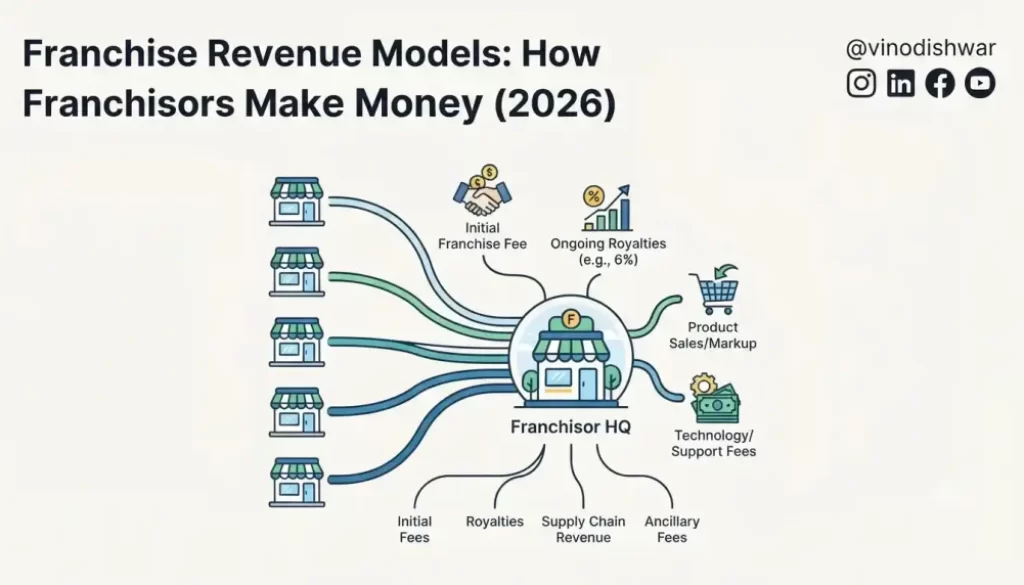
Franchise Revenue Models are the foundation of every successful franchise system because they determine how franchisors generate sustainable income while supporting franchisees. Many businesses assume franchisors only earn money by selling franchise licenses, but successful brands create multiple recurring revenue streams through royalties, marketing funds, technology fees, product supply, and ongoing support. Understanding Franchise Revenue Models is essential for building a scalable and profitable franchise business.
One of the biggest misconceptions about franchising is that franchisors earn money only by selling franchise licenses. In reality, successful franchise brands build multiple revenue streams that create recurring income while supporting long-term network growth.
A well-designed franchise revenue model balances profitability for both the franchisor and the franchisee. If the franchisor earns too much without delivering value, franchisees become dissatisfied. If the franchisee retains all profits without contributing to the brand, the franchisor lacks the resources to provide support, innovation, and marketing.
Whether you’re planning to franchise a restaurant, café, retail store, salon, fitness center, healthcare business, education institute, manufacturing company, or service brand, understanding franchise revenue models is essential for building a financially sustainable franchise system.
This guide explains the different franchise revenue streams, how they work, and how to design a balanced revenue model that supports long-term success.
What are Franchise Revenue Models?
A franchise revenue model defines how a franchisor generates income from its franchise network while providing ongoing value to franchisees.
Unlike a traditional business that relies mainly on customer sales, a franchisor typically earns revenue from multiple sources, including:
- Initial franchise fees
- Ongoing royalty payments
- Marketing fund contributions
- Product and inventory supply
- Technology or software subscriptions
- Training fees
- Renewal fees
- Multi-unit development agreements
The goal is to create predictable, recurring income that funds brand growth and franchise support.
Why Franchise Revenue Models Matter for Business Growth
A strong revenue model helps franchisors:
- Generate recurring income
- Fund franchise support services
- Invest in marketing and technology
- Improve brand value
- Scale sustainably
- Attract quality franchisees
- Increase long-term profitability
For franchisees, a fair revenue structure ensures they receive continuous support, brand recognition, and operational improvements.
Core Franchise Revenue Models and Revenue Streams
1. Initial Franchise Fee
The initial franchise fee is the one-time payment made by a franchisee to join the franchise network.
It typically covers:
- Brand licensing
- Initial training
- Business setup assistance
- Access to systems and documentation
- Launch support
This fee helps recover the franchisor’s investment in onboarding new franchisees.
2. Royalty Fees
Royalty is the most common recurring revenue stream.
It is usually charged as:
- A percentage of gross sales
- A fixed monthly amount
- A hybrid of both
Royalty income funds:
- Operational support
- Business coaching
- Research and development
- Brand management
- Continuous system improvements
Recurring royalties create predictable long-term revenue.
3. Marketing Fund Contributions
Most franchise systems require franchisees to contribute to a shared marketing fund.
These funds are used for:
- National advertising
- Digital marketing campaigns
- Brand awareness initiatives
- Lead generation
- Creative development
- Promotional campaigns
A centralized marketing fund strengthens the brand while reducing individual marketing costs.
4. Product & Supply Chain Revenue
Many franchisors generate income by supplying:
- Raw materials
- Inventory
- Equipment
- Packaging
- Uniforms
- Branded merchandise
This creates an additional revenue stream while ensuring product quality and consistency across all locations.
5. Technology & Software Fees
Modern franchise systems rely on technology platforms such as:
- POS systems
- CRM software
- Inventory management
- Learning Management Systems (LMS)
- Mobile apps
- Reporting dashboards
Franchisors may charge monthly technology fees to maintain and improve these systems.
6. Training & Certification Fees
While initial training is often included in the franchise fee, franchisors may charge separately for:
- Advanced training programs
- Refresher courses
- Leadership development
- Manager certification
- New product training
These programs help maintain operational excellence.
7. Franchise Renewal Fees
Many franchise agreements include renewal options after the initial term.
Renewal fees help cover:
- Updated documentation
- New training
- Technology upgrades
- Brand modernization
Renewals also reinforce long-term relationships with successful franchisees.
8. Area Development & Multi-Unit Fees
Franchisors may receive additional payments from:
- Area developers
- Multi-unit franchisees
- Master franchisees
These agreements often involve:
- Development rights
- Territory reservation fees
- Performance milestones
They accelerate regional and international expansion.
Comparing Franchise Revenue Models
| Revenue Stream | Frequency | Purpose |
|---|---|---|
| Initial Franchise Fee | One-time | Onboarding and licensing |
| Royalty Fees | Monthly | Ongoing support and brand development |
| Marketing Fund | Monthly | National and regional marketing |
| Product Supply | Ongoing | Inventory and quality control |
| Technology Fees | Monthly | Software and digital systems |
| Training Fees | As required | Continuous learning |
| Renewal Fees | Periodic | Agreement renewal and upgrades |
| Area Development Fees | One-time / Milestone | Regional expansion rights |
How to Build Balanced Franchise Revenue Models
Step 1: Ensure Franchisee Profitability
Your revenue model should leave enough margin for franchisees to earn attractive returns.
Healthy franchisees are more likely to expand and renew their agreements.
Step 2: Fund Ongoing Support
Recurring revenue should finance:
- Field support
- Training
- Technology
- Marketing
- Quality audits
- Innovation
Support creates value that justifies recurring fees.
Step 3: Diversify Revenue Streams
Avoid relying on a single income source.
A balanced mix of franchise fees, royalties, supply chain income, and technology fees improves financial stability.
Step 4: Align Fees with Value
Every fee should correspond to a measurable service or benefit.
Transparent pricing builds trust and long-term franchisee relationships.
Step 5: Plan for Future Growth
As the franchise network expands, revenue should support:
- New markets
- Technology upgrades
- Marketing campaigns
- Product innovation
- Franchisee success programs
Practical Example
A growing quick-service restaurant (QSR) launches its franchise program.
Revenue Model
- Initial Franchise Fee – Brand licensing and training
- Royalty – Monthly percentage of gross sales
- Marketing Fund – National advertising
- Product Supply – Ingredients and packaging
- Technology Fee – POS and reporting software
- Training Fee – Advanced management certification
This diversified revenue model enables the franchisor to invest continuously in brand growth while ensuring franchisees receive ongoing value.
Franchise Revenue Models Framework
Profitable Business
        │
        ▼
Franchise Business Model
        │
        ▼
Initial Franchise Fee
        │
        ▼
Recurring Royalty Income
        │
        ▼
Marketing Fund
        │
        ▼
Supply Chain Revenue
        │
        ▼
Technology & Training Fees
        │
        ▼
Renewal & Expansion Income
        │
        ▼
Sustainable Franchise Growth
Common Mistakes in Franchise Revenue Models
Avoid these common mistakes:
- Setting franchise fees too high
- Charging royalties without providing support
- Overcomplicating the fee structure
- Ignoring franchisee profitability
- Depending only on initial franchise fees
- Underpricing technology and training
- Failing to review pricing periodically
- Not communicating fee utilization transparently
A sustainable revenue model benefits both the franchisor and the franchisee.
How Franchise Development Consultants Help
Experienced franchise consultants assist businesses by:
- Designing balanced revenue models
- Benchmarking franchise fees
- Structuring royalty systems
- Developing financial projections
- Building scalable business models
- Preparing franchise documentation
- Supporting long-term profitability
Professional guidance helps avoid pricing mistakes and improves franchise attractiveness. Learn more about professional Franchise Development Services at https://franchisealpha.com/franchise-development/
Why Choose Franchise Alpha?
At Franchise Alpha, we help businesses design sustainable franchise revenue models using our proprietary SOLEMN® Framework. Explore the complete SOLEMN® Franchise Development Framework at https://franchisealpha.com/
Strategy
Develop customized franchise revenue structures aligned with business goals.
Operations
Standardize systems that support scalable and profitable franchise growth.
Legal
Prepare transparent franchise agreements with clearly defined fee structures.
Entrust
Reduce founder dependency by creating repeatable operational systems.
Marketing
Generate qualified franchise leads through integrated digital marketing strategies.
Nitty-Gritty
Optimize pricing, monitor KPIs, and improve long-term franchise profitability.
Frequently Asked Questions
What is a franchise revenue model?
A franchise revenue model is the financial structure that defines how a franchisor earns income through franchise fees, royalties, marketing contributions, product supply, technology services, and other recurring revenue streams.
What is the most common source of franchise revenue?
Recurring royalty fees are the most common and sustainable revenue source because they provide continuous income while funding franchise support and brand development.
Can franchisors have multiple revenue streams?
Yes. Most successful franchise systems combine franchise fees, royalties, marketing funds, supply chain income, technology fees, training fees, and renewal fees.
Why is a balanced revenue model important?
A balanced revenue model ensures both franchisors and franchisees remain profitable while supporting continuous investment in marketing, technology, operations, and franchisee success.
Conclusion
A successful franchise is built on more than great products or services—it is built on a sustainable financial foundation.
By combining initial franchise fees with recurring revenue streams such as royalties, marketing funds, product supply, technology services, and training, franchisors can create a business model that supports long-term growth while delivering ongoing value to franchisees.
The strongest franchise brands earn recurring revenue because they consistently provide recurring value.
Call to Action
Ready to Design a Profitable Franchise Revenue Model?
Book a Franchise Readiness Assessment with Vinod Ishwar and receive expert guidance on creating a scalable and sustainable franchise revenue model. Discover more franchise growth resources at https://franchisealpha.com/blog/
Your assessment includes:
- Revenue Model Analysis
- Franchise Fee Structure Review
- Royalty Strategy Development
- Profitability Assessment
- Customized Franchise Growth Roadmap
Build a franchise business with revenue systems designed for long-term success.