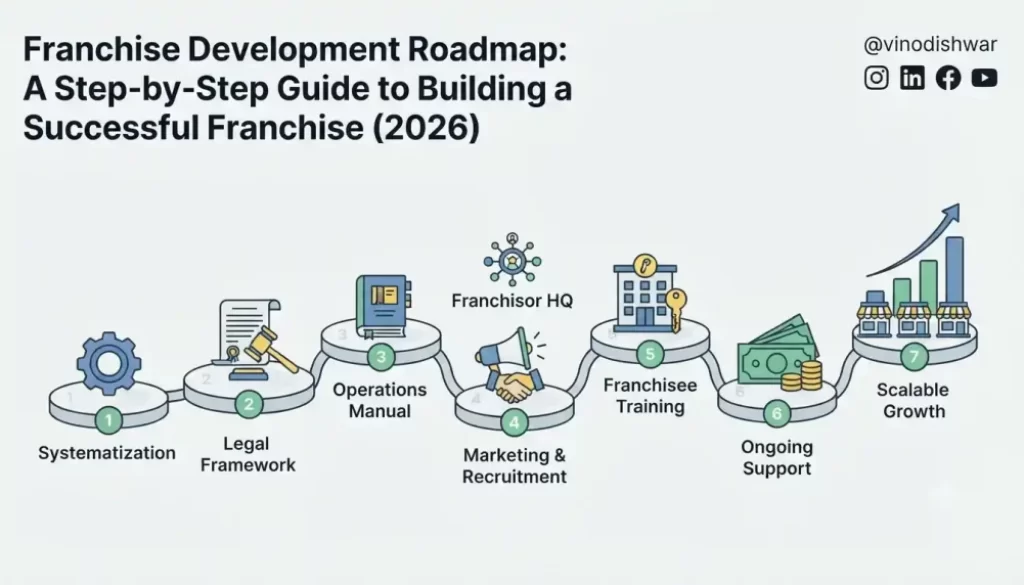
Franchise Development Roadmap: A Step-by-Step Guide to Building a Successful Franchise (2026)
A Franchise Development Roadmap is the foundation for transforming a successful business into a scalable franchise brand. Growing a profitable business into a recognized franchise requires more than ambition—it demands standardized systems, documented processes, and a clear expansion strategy. Many businesses succeed with one or two outlets but struggle to expand because they lack the structure needed for sustainable growth.
Growing a successful business into a recognized franchise brand requires more than ambition—it requires a structured roadmap. Many businesses achieve success with one or two outlets but struggle to expand because they lack standardized systems, documented processes, and a clear expansion strategy.
A Franchise Development Roadmap provides a step-by-step plan that transforms a profitable business into a scalable franchise system. It outlines every stage of the journey, from evaluating franchise readiness to building operational systems, recruiting franchise partners, and supporting long-term network growth.
Whether you own a restaurant, café, salon, retail store, fitness center, healthcare clinic, education institute, manufacturing company, or service business, following a structured roadmap significantly improves your chances of building a successful franchise network.
This guide explains every stage of the franchise development roadmap and provides practical insights to help you expand with confidence.
What is a Franchise Development Roadmap?
A franchise development roadmap is a strategic framework that guides businesses through the process of becoming a successful franchisor.
Instead of expanding randomly, the roadmap creates a logical sequence for building:
- Franchise strategy
- Business model
- Operational systems
- Legal framework
- Training programs
- Marketing systems
- Franchise sales process
- Ongoing support structure
Each stage builds on the previous one, creating a scalable foundation for long-term growth. To understand how professional franchise systems are built, explore the Franchise Development Services offered by Franchise Alpha: https://franchisealpha.com/franchise-development/
Why Every Business Needs a Franchise Development Roadmap
Without a structured roadmap, businesses often face:
- Founder dependency
- Inconsistent operations
- Poor documentation
- Weak franchisee performance
- Brand inconsistency
- Slow expansion
- Increased operational risk
A roadmap helps businesses expand systematically while protecting quality, customer experience, and profitability.
Phase 1: Franchise Readiness Assessment
The first step is determining whether your business is prepared for franchising.
Evaluate:
- Business profitability
- Customer demand
- Brand recognition
- Operational maturity
- Leadership capability
- Scalability
- Competitive advantage
A readiness assessment identifies strengths and areas that need improvement before expansion. Before starting your expansion journey, read our guide on Franchise Readiness Assessment.
Phase 2: Define the Franchise Vision
Clarify your long-term objectives.
Ask questions such as:
- How many outlets do you want in five years?
- Which markets will you target?
- What type of franchise model fits your business?
- What support will franchisees receive?
- What level of operational control is required?
A clear vision keeps expansion aligned with business goals.
Phase 3: Design the Franchise Business Model
Develop a commercially sustainable model by defining:
- Initial franchise investment
- Franchise fee
- Royalty structure
- Marketing contribution
- Territory rights
- Franchisee profile
- Revenue streams
The business model should create value for both franchisor and franchisee. You may also find our article How to Develop a Franchise Business helpful.
Phase 4: Standardize Business Operations
Document every operational activity to ensure consistency.
This includes:
- Sales processes
- Customer service
- Inventory management
- Procurement
- Finance
- Human resources
- Quality assurance
- Reporting systems
Operational standardization is the backbone of every franchise system.
Phase 5: Develop Standard Operating Procedures (SOPs)
Create detailed SOPs covering:
- Opening procedures
- Closing procedures
- Product or service delivery
- Staff onboarding
- Customer complaint resolution
- Cash handling
- Equipment maintenance
- Safety standards
SOPs make operations repeatable and reduce founder dependency. Learn more in our guide Franchise Development Process Explained Step-by-Step.
Phase 6: Create the Franchise Operations Manual
The Operations Manual serves as the complete operational guide for franchisees.
It should include:
- Brand standards
- Daily operating procedures
- Marketing guidelines
- HR policies
- Technology systems
- Financial reporting
- Compliance requirements
- Audit procedures
This manual ensures every outlet follows the same operational standards.
Phase 7: Prepare Legal Documentation
Protect your business with professionally drafted legal documents.
These include:
- Franchise Agreement
- Trademark Registration
- Brand Usage Guidelines
- Non-Disclosure Agreement (NDA)
- Franchise Disclosure Documentation (where applicable)
Strong legal documentation minimizes risk and protects intellectual property.
Phase 8: Build Franchise Training Systems
Training prepares franchisees to operate independently while maintaining brand consistency.
Training programs should cover:
- Business operations
- Customer service
- Sales
- Financial management
- Marketing
- Technology
- Leadership
- Compliance
Ongoing training improves franchise performance over time.
Phase 9: Develop Marketing & Lead Generation Systems
Create a franchise marketing engine that attracts qualified investors.
Key components include:
- Franchise website
- SEO
- Google Ads
- Social media campaigns
- Franchise brochures
- Investor presentations
- Email marketing
- Discovery Day events
Consistent lead generation fuels network growth. Discover how expert Franchise Development Services can support your expansion journey.
Phase 10: Recruit and Qualify Franchise Partners
Develop a structured recruitment process.
Evaluate franchise candidates based on:
- Financial capability
- Business experience
- Leadership skills
- Cultural fit
- Commitment
- Local market knowledge
Selecting the right partners is critical to long-term success.
Phase 11: Launch and Support Franchisees
Support franchisees through:
- Site selection
- Store setup
- Staff recruitment
- Initial marketing
- Technology implementation
- Opening assistance
Strong onboarding increases the likelihood of early success.
Phase 12: Monitor Performance and Scale
Track key performance indicators (KPIs), including:
- Revenue growth
- Customer satisfaction
- Operational compliance
- Marketing effectiveness
- Franchise profitability
- Brand consistency
Use performance data to improve systems and support future expansion.
Franchise Development Roadmap Timeline
| Phase | Objective |
|---|---|
| Phase 1 | Franchise Readiness Assessment |
| Phase 2 | Define Franchise Vision |
| Phase 3 | Develop Franchise Business Model |
| Phase 4 | Standardize Operations |
| Phase 5 | Create SOPs |
| Phase 6 | Develop Operations Manual |
| Phase 7 | Prepare Legal Documentation |
| Phase 8 | Build Training Systems |
| Phase 9 | Marketing & Lead Generation |
| Phase 10 | Franchise Recruitment |
| Phase 11 | Franchise Launch |
| Phase 12 | Continuous Support & Expansion |
Practical Example
A regional fitness studio has three profitable locations.
Before Following a Roadmap
- Operations vary by location.
- Training is informal.
- Expansion depends on the founder.
- Documentation is limited.
After Implementing the Roadmap
- SOPs standardize every workout program.
- Operations Manuals guide daily management.
- Franchisees receive structured training.
- Marketing generates qualified investors.
- Performance dashboards monitor every location.
The studio expands into multiple states while maintaining consistent member experiences.
Franchise Development Roadmap Framework
Profitable Business
        │
        ▼
Franchise Readiness Assessment
        │
        ▼
Franchise Vision & Strategy
        │
        ▼
Business Model Development
        │
        ▼
Operational Standardization
        │
        ▼
SOP Development
        │
        ▼
Operations Manual
        │
        ▼
Legal Documentation
        │
        ▼
Training Systems
        │
        ▼
Marketing & Lead Generation
        │
        ▼
Franchise Recruitment
        │
        ▼
Launch & Onboarding
        │
        ▼
Performance Monitoring
        │
        ▼
Multi-City → Multi-State → International Expansion
Common Mistakes to Avoid
Many businesses fail because they:
- Start selling franchises before building systems
- Depend too heavily on the founder
- Ignore documentation
- Recruit the wrong franchisees
- Underestimate training
- Provide limited operational support
- Expand faster than infrastructure allows
Avoiding these mistakes creates a stronger and more sustainable franchise network.
How Franchise Development Consultants Help
Professional franchise consultants help businesses by:
- Conducting readiness assessments
- Designing franchise business models
- Developing SOPs and Operations Manuals
- Preparing legal documentation
- Building training systems
- Creating franchise marketing strategies
- Recruiting franchise partners
- Supporting long-term operational growth
Their expertise reduces risk and accelerates expansion. Learn more about Franchise Alpha’s franchise consulting solutions at https://franchisealpha.com/.
Why Choose Franchise Alpha?
At Franchise Alpha, we help businesses build scalable franchise systems through our proprietary SOLEMN® Framework.
Strategy
Develop franchise models, pricing structures, and growth roadmaps.
Operations
Create SOPs, Operations Manuals, and standardized workflows.
Legal
Prepare Franchise Agreements, protect trademarks, and ensure compliance.
Entrust
Reduce founder dependency through operational excellence and leadership systems.
Marketing
Generate qualified franchise leads through digital marketing and franchise sales strategies.
Nitty-Gritty
Track KPIs, optimize profitability, and continuously improve franchise performance.
Frequently Asked Questions
What is a franchise development roadmap?
A franchise development roadmap is a structured plan that guides businesses through every stage of becoming a franchise, including strategy, operations, legal documentation, training, marketing, recruitment, and ongoing support.
Why is a franchise roadmap important?
It provides a clear expansion framework, reduces operational risk, improves consistency, and ensures the business is prepared for sustainable franchise growth.
How long does franchise development take?
Most businesses complete franchise development within 3 to 6 months, depending on their operational complexity and documentation needs.
Can small businesses use a franchise development roadmap?
Yes. SMEs with a profitable and repeatable business model can use a franchise roadmap to scale efficiently while maintaining quality and brand consistency.
Conclusion
A successful franchise is never built overnight. It is built through careful planning, standardized systems, strong documentation, effective training, and continuous support. Also read Why Franchise Development Matters for Growing Businesses.
A well-designed Franchise Development Roadmap gives business owners a clear path from a single successful outlet to a scalable franchise network capable of regional, national, and international expansion.
Businesses that follow a structured roadmap grow with confidence, consistency, and long-term sustainability.
For more franchise insights and business growth resources, visit the Franchise Alpha Blog: https://franchisealpha.com/blog/.
Call to Action
Ready to Build Your Franchise Development Roadmap?
Book a Franchise Readiness Assessment with Vinod Ishwar and receive a customized roadmap tailored to your business goals.
Your assessment includes:
- Franchise Readiness Evaluation
- Business Model Review
- SOP & Operations Assessment
- Customized Franchise Development Roadmap
- Growth Strategy for Multi-City Expansion
Take the first step toward building a scalable and successful franchise business.