Choosing the Right Franchise Model: A Complete Guide for Business Owners (2026)
Choosing the Right Franchise Model is one of the most important decisions a business owner will make before franchising. While many entrepreneurs focus on franchise fees, legal agreements, or marketing, the franchise model itself determines how the business will grow, how franchisees will operate, and how profitable the franchise system will be over the long term.
One of the most important decisions a business owner will make before franchising is selecting the right franchise model. While many entrepreneurs focus on franchise fees, legal agreements, or marketing, the franchise model itself determines how the business will grow, how franchisees will operate, and how profitable the franchise system will be over the long term.
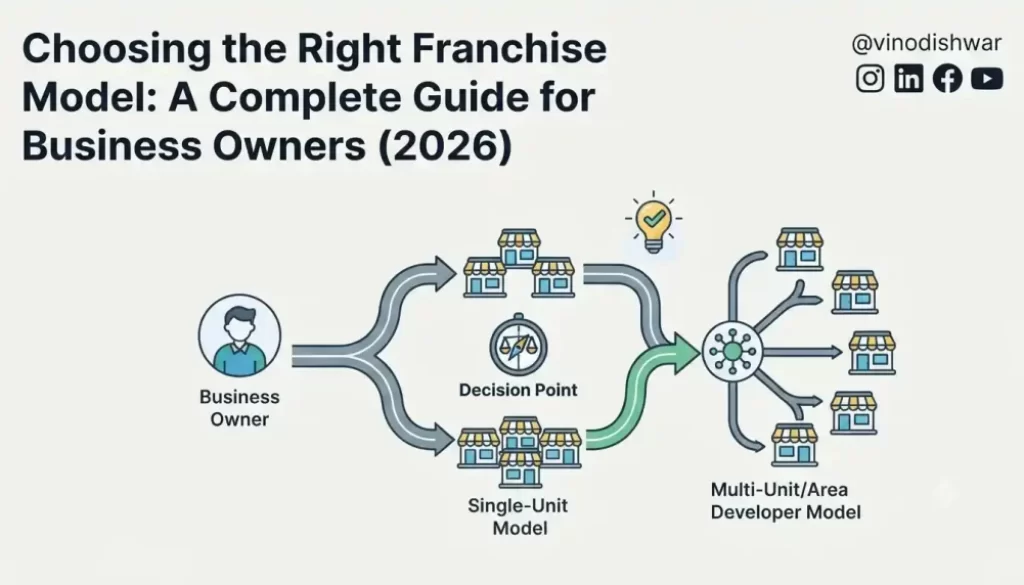
There is no universal franchise model that works for every business. A restaurant chain may benefit from a single-unit franchise structure, while a retail brand may scale faster through multi-unit or area development agreements. Education brands, healthcare providers, service businesses, fitness centers, and manufacturing companies each require different approaches based on their operations, investment requirements, and growth objectives.
Choosing the right franchise model means balancing scalability, operational control, investment requirements, market demand, and franchisee profitability.
This comprehensive guide explains the different franchise models, their advantages and disadvantages, and how to determine which model is best suited for your business.
What is Choosing the Right Franchise Model?
A franchise model is the structure that defines how a franchisor grants rights to franchisees to operate under its brand.
It establishes:
- Ownership structure
- Investment requirements
- Revenue model
- Operational responsibilities
- Territory rights
- Franchisee obligations
- Support systems
- Growth strategy
A well-designed franchise model creates value for both the franchisor and franchisee while supporting sustainable business expansion. Learn more about professional Franchise Development Services at https://franchisealpha.com/franchise-development-services/
Choosing the Right Franchise Model: Key Factors to Consider
Selecting the wrong model can lead to:
- Slow expansion
- Franchisee dissatisfaction
- Operational complexity
- Reduced profitability
- Poor customer experience
- Brand inconsistency
- High support costs
The right model enables businesses to grow efficiently while maintaining operational excellence and customer satisfaction.
Factors to Consider Before Choosing a Franchise Model
Before selecting a franchise model, evaluate the following:
Business Type
Different industries require different franchise structures.
For example:
- Restaurants
- Retail stores
- Salons
- Fitness centers
- Education institutes
- Healthcare clinics
- Manufacturing businesses
- Service companies
Each has unique operational and investment requirements.
Business Maturity
Ask yourself:
- Is the business consistently profitable?
- Are operations standardized?
- Are SOPs documented?
- Can the business operate without the founder?
- Is customer demand consistent?
A mature business is easier to franchise successfully.
Expansion Goals
Determine whether you plan to:
- Expand locally
- Expand nationally
- Expand internationally
- Build a master franchise network
- Develop multi-unit operators
Your growth vision influences the ideal franchise model.
Investment Requirements
Consider:
- Startup investment
- Equipment costs
- Working capital
- Store size
- Technology requirements
- Staffing needs
The investment level affects the type of franchisee you attract.
Common Types of Franchise Models
1. Single-Unit Franchise
The franchisee owns and operates one location.
Best For
- Restaurants
- Cafés
- Salons
- Retail stores
Advantages
- Simple management
- Easier training
- Strong operational control
- Lower investment
Challenges
- Slower expansion
- More franchisees to manage
2. Multi-Unit Franchise
A franchisee owns multiple outlets within a defined territory.
Best For
- Retail brands
- Restaurants
- Fitness centers
- Healthcare businesses
Advantages
- Faster expansion
- Experienced operators
- Lower management costs
- Higher revenue potential
Challenges
- Larger investment requirements
- Greater operational complexity
3. Area Development Franchise
A franchisee commits to opening a specified number of outlets within a defined territory over a set period.
Advantages
- Rapid regional growth
- Long-term commitment
- Predictable expansion
Best For
Businesses targeting multi-city or state-level growth.
4. Master Franchise
The master franchisee develops and manages franchisees within an entire region or country.
Advantages
- Rapid international expansion
- Reduced management burden
- Local market expertise
Challenges
- Lower operational control
- Dependence on master franchisee performance
5. Conversion Franchise
Existing independent businesses convert into franchise locations.
Best For
- Service industries
- Healthcare
- Automotive services
- Education
Advantages
- Faster network growth
- Experienced operators
- Lower startup costs
Comparing Franchise Models
| Franchise Model | Investment | Control | Expansion Speed | Best For |
|---|---|---|---|---|
| Single Unit | Low | High | Moderate | Restaurants, cafés, salons |
| Multi-Unit | Medium–High | Medium | Fast | Retail, fitness, healthcare |
| Area Development | High | Medium | Very Fast | Regional expansion |
| Master Franchise | Very High | Lower | Extremely Fast | International growth |
| Conversion Franchise | Medium | Medium | Fast | Service-based businesses |
How to Choose the Right Franchise Model Step by Step
Step 1: Evaluate Your Business
Assess:
- Profitability
- Operational systems
- Brand strength
- Market demand
- Scalability
Step 2: Understand Your Industry
Different industries scale differently.
For example:
- Restaurants often begin with single-unit franchises.
- Retail brands frequently use multi-unit operators.
- Education brands may expand through area developers.
- Service businesses often adopt conversion franchises.
Step 3: Define Franchisee Expectations
Determine:
- Required investment
- Operational responsibilities
- Support requirements
- Performance expectations
A clear franchisee profile improves recruitment.
Step 4: Build Financial Sustainability
Ensure the model supports:
- Franchisee profitability
- Franchisor revenue
- Marketing investment
- Operational support
- Long-term scalability
Step 5: Plan Future Expansion
Consider future opportunities such as:
- Multi-city growth
- Multi-state expansion
- Master franchising
- International markets
Your chosen model should accommodate long-term ambitions.
Practical Example
A successful premium bakery has five profitable outlets.
Option 1: Single-Unit Franchise
The business recruits individual entrepreneurs to operate one bakery each.
Result:
- Strong quality control
- Slower expansion
- Higher support requirements
Option 2: Multi-Unit Franchise
Experienced investors operate five to ten bakeries within a city.
Result:
- Faster growth
- Lower management costs
- Stronger regional presence
The bakery chooses the multi-unit model because it aligns with its expansion goals and operational capabilities.
Franchise Model Selection Framework
Business Assessment
        │
        ▼
Industry Analysis
        │
        ▼
Expansion Goals
        │
        ▼
Investment Planning
        │
        ▼
Franchise Model Selection
        │
        ▼
Business Model Development
        │
        ▼
SOP Development
        │
        ▼
Operations Manual
        │
        ▼
Legal Documentation
        │
        ▼
Franchise Recruitment
        │
        ▼
Launch & Ongoing Support
        │
        ▼
Scalable Franchise Growth
Common Mistakes When Choosing the Right Franchise Model
Avoid these common mistakes:
- Selecting a model based only on competitors
- Ignoring franchisee profitability
- Expanding too quickly
- Underestimating support requirements
- Failing to document operations
- Choosing complex structures too early
- Overlooking market demand
- Not planning for future scalability
The best franchise model is the one that matches your business capabilities—not simply the fastest growth option.
How Franchise Development Consultants Help
Professional franchise consultants help businesses:
- Assess franchise readiness
- Compare franchise models
- Design customized franchise structures
- Develop SOPs and Operations Manuals
- Build financial models
- Prepare legal documentation
- Recruit suitable franchise partners
- Support long-term expansion
Their expertise helps businesses select a model that maximizes growth while minimizing risk. Explore how Franchise Alpha helps businesses build scalable franchise systems through expert consulting: https://franchisealpha.com/
Why Choose Franchise Alpha?
At Franchise Alpha, we help businesses choose and develop the right franchise model using our proprietary SOLEMN® Framework.
Strategy
Design franchise models aligned with your industry, investment capacity, and growth objectives.
Operations
Develop SOPs, Operations Manuals, and standardized operational systems.
Legal
Prepare Franchise Agreements, trademark protection, and compliance documentation.
Entrust
Reduce founder dependency through structured operational systems and leadership development.
Marketing
Generate qualified franchise leads using proven digital marketing and franchise sales strategies.
Nitty-Gritty
Monitor KPIs, improve profitability, and optimize franchise performance for long-term success.
Frequently Asked Questions
What is the best franchise model?
There is no single best franchise model. The ideal model depends on your industry, investment requirements, business maturity, operational complexity, and expansion goals.
Which franchise model is best for small businesses?
Single-unit franchising is often the best starting point for SMEs because it offers greater operational control and simpler franchise management.
Can I change my franchise model later?
Yes. Many franchisors begin with single-unit franchises and later introduce multi-unit, area development, or master franchise opportunities as the network grows.
Why is choosing the right franchise model important?
The right franchise model supports sustainable expansion, improves franchisee success, protects brand consistency, and enhances long-term profitability.
Conclusion
Choosing the right franchise model is one of the most strategic decisions in the franchise development journey.
A carefully selected model aligns your business goals, operational capabilities, financial strategy, and expansion vision into a framework that supports sustainable growth. Whether you choose single-unit, multi-unit, area development, master franchising, or conversion franchising, success depends on building standardized systems, selecting the right partners, and providing ongoing support.
The strongest franchise networks are built on the right model—not simply the fastest expansion strategy.
Call to Action
Ready to Choose the Right Franchise Model?
Book a Franchise Readiness Assessment with Vinod Ishwar and discover which franchise model is best suited for your business. Visit https://franchisealpha.com/ to learn more about franchise consulting, franchise development, and business expansion solutions.
Your assessment includes:
- Franchise Readiness Evaluation
- Business Model Analysis
- Franchise Model Recommendation
- SOP & Operations Assessment
- Customized Expansion Strategy
Build a franchise system designed for profitable, sustainable, and scalable growth.