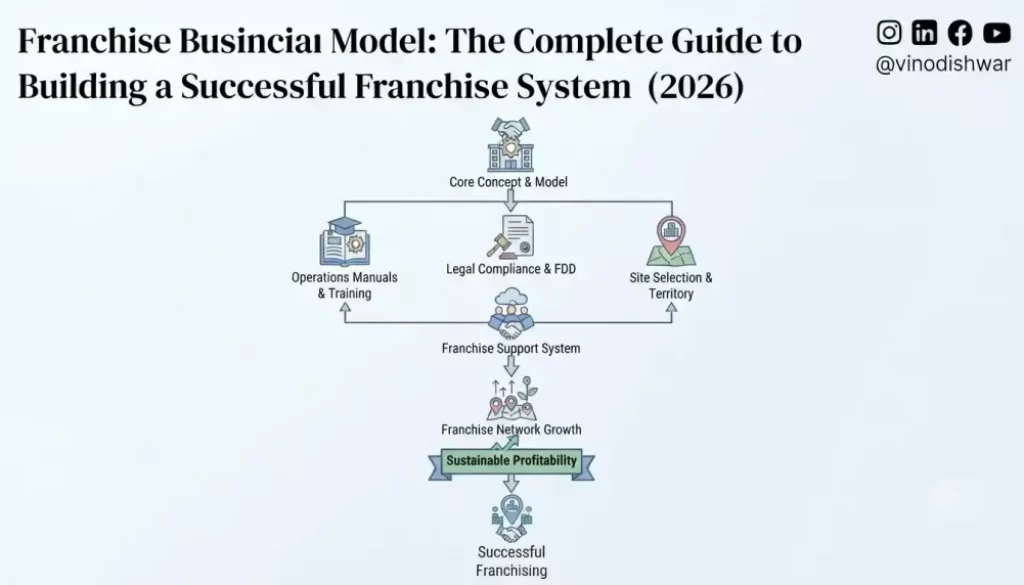
Franchise Business Model: The Complete Guide to Building a Successful Franchise System (2026)
Introduction
Every successful franchise—from global restaurant chains to education brands and retail stores—is built on one critical foundation: a well-designed franchise business model.
While customers see a brand, products, and services, franchisees invest in something much deeper—a proven business system that has been tested, documented, and refined for consistent success.
A franchise business model is far more than licensing a brand name. It is a complete framework that defines how the business operates, generates revenue, maintains quality, supports franchisees, and scales into multiple locations while delivering a consistent customer experience.
Without a structured business model, franchising becomes difficult to manage. Inconsistent operations, weak franchisee performance, and poor customer experiences can quickly damage a growing brand.
In this guide, you’ll learn what a franchise business model is, how it works, its essential components, and how to design a scalable model that supports long-term franchise growth.
What Is a Franchise Business Model?
A franchise business model is a structured system that allows independent entrepreneurs (franchisees) to operate a business using the franchisor’s established brand, operating systems, products, training, and support.
Instead of building a business from scratch, franchisees invest in a proven model that has already demonstrated success.
The franchisor provides:
- Brand identity
- Business systems
- Standard Operating Procedures (SOPs)
- Operations Manual
- Training
- Marketing support
- Ongoing business guidance
The franchisee invests capital, manages daily operations, and follows the franchisor’s standards. SOPs document how every operational activity should be performed. Learn more in our guide on Standard Operating Procedures (SOPs). Together, both parties work toward expanding the brand while maintaining operational consistency.
Why Businesses Choose the Franchise Model
Franchising enables businesses to expand faster without owning every location.
Key advantages include:
- Faster market expansion
- Lower capital investment by the franchisor
- Motivated owner-operators
- Increased brand visibility
- Shared business risk
- Recurring royalty income
- Economies of scale
- Stronger purchasing power
When supported by effective systems, the franchise model creates sustainable long-term growth.
How the Franchise Business Model Works
The model is built on a partnership between two parties.
The Franchisor
The franchisor develops and owns the business concept.
Responsibilities include:
- Building the brand
- Developing SOPs
- Creating Operations Manuals
- Training franchisees
- Marketing support
- Technology systems
- Operational guidance
- Innovation
The Franchisee
The franchisee invests in operating a local business.
Responsibilities include:
- Managing daily operations
- Hiring employees
- Following brand standards
- Delivering customer service
- Meeting operational KPIs
- Paying franchise fees and royalties
The 15 Core Components of a Franchise Business Model
1. Proven Business Concept
Every successful franchise starts with a business that has demonstrated profitability and market demand.
The concept should be:
- Replicable
- Profitable
- Scalable
- Easy to operate
- Customer-focused
2. Strong Brand Identity
A recognizable and trusted brand attracts both customers and franchise investors.
Brand identity includes:
- Logo
- Brand guidelines
- Customer experience
- Brand values
- Market positioning
3. Standard Operating Procedures (SOPs)
SOPs document how every operational activity should be performed.
These procedures create consistency across every franchise location.
4. Franchise Operations Manual
The Operations Manual becomes the franchisee’s operational guide. Learn why a Franchise Operations Manual is essential for franchise consistency.
It includes:
- Business processes
- Operational standards
- Quality control
- Customer service
- Compliance
- Policies
5. Training System
Franchisees and employees require structured training before launching operations.
Training typically includes:
- Business operations
- Product knowledge
- Technology
- Customer service
- Leadership
- Sales
6. Business Systems
Modern franchise systems include:
- POS software
- CRM platforms
- Inventory management
- HR systems
- Reporting dashboards
Technology improves efficiency and decision-making.
7. Marketing Framework
The business model defines:
- National marketing
- Local store marketing
- Digital campaigns
- Social media
- Promotional calendars
- Brand communication
8. Financial Model
The financial framework includes:
- Franchise fee
- Royalty structure
- Marketing contribution
- Working capital
- Revenue projections
- Profitability analysis
A transparent financial model builds investor confidence.
9. Territory Strategy
Clearly defined territories reduce franchise conflict and support balanced market expansion.
Territory planning considers:
- Population
- Demographics
- Market demand
- Competition
- Growth potential
10. Quality Management System
Quality assurance ensures every location meets the same operational and customer service standards.
Methods include:
- Operational audits
- Mystery shopping
- Customer feedback
- Compliance inspections
11. Franchise Support System
Ongoing support may include:
- Field visits
- Business coaching
- Marketing assistance
- Operational guidance
- Technology support
- Refresher training
Support improves franchisee success.
12. Performance Measurement
Successful franchises monitor KPIs such as:
- Sales growth
- Customer satisfaction
- Profit margins
- Compliance scores
- Employee retention
- Inventory accuracy
Performance data supports continuous improvement.
13. Legal Framework
Every franchise model requires legal protection through:
- Franchise Agreement
- Trademark Registration
- Intellectual Property Protection
- Confidentiality Agreements
- Operational Policies
Strong legal documentation safeguards the brand.
14. Innovation System
Markets evolve continuously.
Successful franchisors regularly introduce:
- New products
- Technology upgrades
- Marketing improvements
- Process enhancements
- Operational efficiencies
Innovation keeps the franchise competitive.
15. Scalability Framework
A scalable franchise model enables expansion into new cities, states, and countries while maintaining operational consistency.
Scalability depends on:
- Documentation
- Training
- Systems
- Leadership
- Continuous improvement
Types of Franchise Business Models
Businesses may adopt different franchise formats depending on their growth strategy.
Single-Unit Franchise
A franchisee owns and operates one outlet.
Ideal for first-time entrepreneurs.
Multi-Unit Franchise
One franchisee operates multiple locations within a defined territory.
Suitable for experienced business owners.
Area Development Franchise
The franchisee commits to opening multiple outlets within a specific timeframe.
Master Franchise
The master franchisee develops an entire region or country while recruiting and supporting sub-franchisees.
Conversion Franchise
Existing independent businesses convert into franchise locations while adopting the franchisor’s systems and brand.
Common Franchise Business Model Mistakes
Businesses often make these mistakes:
- Expanding before documenting systems
- Weak SOPs
- Founder dependency
- Poor financial planning
- Inadequate training
- Weak franchisee support
- Undefined territories
- Inconsistent quality control
Avoiding these issues creates a stronger franchise foundation. Businesses should first understand the complete Franchise Development Process before expansion.
How Franchise Consultants Help
Professional franchise consultants assist businesses by:
- Assessing franchise readiness
- Designing the franchise business model
- Creating SOPs
- Developing Operations Manuals
- Structuring financial models
- Preparing legal documentation
- Designing training programs
- Supporting franchise expansion
Expert guidance helps businesses build scalable and sustainable franchise systems.
The SOLEMN® Framework
At Franchise Alpha, every franchise business model is developed using the proprietary SOLEMN® Framework.
Strategy
Evaluate business potential, scalability, and expansion objectives.
Operations
Develop SOPs, Operations Manuals, workflows, and business systems.
Legal
Prepare franchise agreements, trademarks, compliance documentation, and governance frameworks.
Entrust
Develop training programs, franchise onboarding, leadership systems, and operational support.
Marketing
Create franchise marketing strategies, brand positioning, and lead generation systems.
Nitty-Gritty
Continuously optimize franchise performance through audits, KPIs, innovation, and operational reviews.
This methodology helps businesses build robust franchise models designed for long-term success.
Frequently Asked Questions
What is a franchise business model?
A franchise business model is a structured framework that allows entrepreneurs to operate a business using an established brand, proven systems, operational documentation, training, and ongoing support.
What makes a franchise business model successful?
Successful franchise models combine strong documentation, proven systems, comprehensive training, consistent customer experiences, effective franchisee support, and continuous innovation.
Can every business become a franchise?
No. Businesses should first demonstrate profitability, operational consistency, market demand, and scalability before developing a franchise model.
Why should businesses hire a franchise consultant?
Franchise consultants help design scalable business models, prepare legal and operational documentation, build training systems, and reduce the risks associated with franchise expansion.
Conclusion
A franchise business model is the blueprint that transforms a successful local business into a scalable national or international brand.
By combining documented systems, operational excellence, structured training, strong legal frameworks, and continuous franchise support, businesses create a model that franchisees can confidently replicate.
The strongest franchise brands are not built on products alone—they are built on repeatable systems, disciplined execution, and a commitment to continuous improvement.
If your business has a proven concept and ambitious growth plans, developing the right franchise business model is the first step toward building a sustainable franchise network. Businesses should also work towards standardizing their operations before franchising.
Call to Action
Build a Scalable Franchise Business Model
Book a Franchise Business Model Assessment with Vinod Ishwar to evaluate your business, design a scalable franchise model, develop professional SOPs, create comprehensive Operations Manuals, and prepare your business for successful franchise expansion.
Receive a customized roadmap for building a profitable and sustainable franchise system.