Single Unit vs Multi Unit Franchising: Which Franchise Model is Right for Your Business? (2026)
Single Unit Franchising is one of the most popular franchise expansion strategies for businesses that want controlled, sustainable growth. When comparing Single Unit Franchising with multi-unit ownership, business owners must evaluate investment requirements, operational complexity, scalability, and long-term expansion goals. Choosing the right franchise model can significantly improve profitability, franchisee success, and business growth.
One of the most important decisions during franchise development is choosing how your franchise network will grow. Should each franchisee own a single outlet, or should experienced operators manage multiple locations?
The answer depends on your business model, operational complexity, investment requirements, expansion goals, and the level of control you want to maintain.
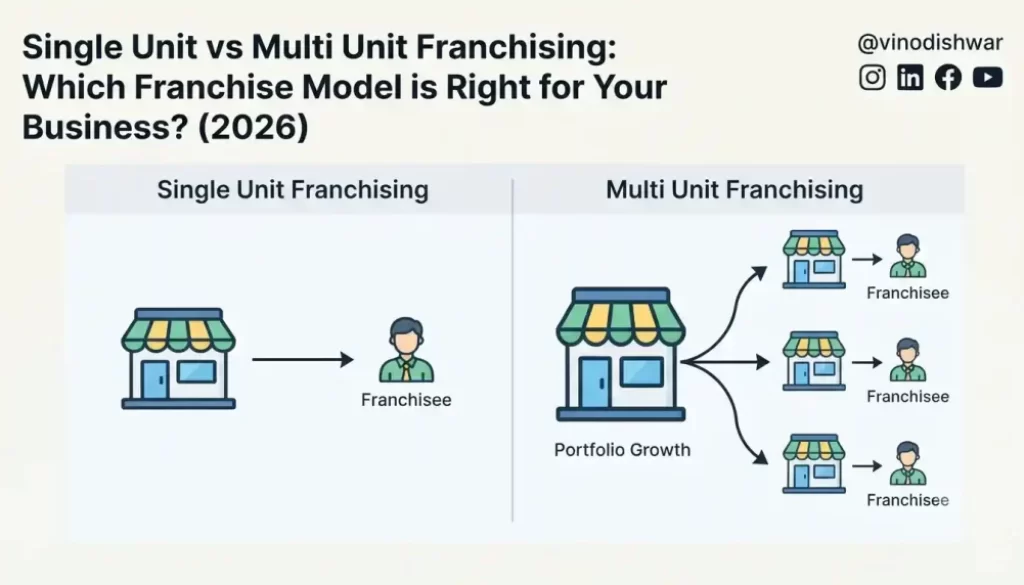
Both Single Unit Franchising and Multi Unit Franchising are proven franchise growth strategies used by successful global brands. While single-unit franchising focuses on recruiting individual owner-operators, multi-unit franchising enables experienced entrepreneurs to own and manage several outlets within a defined territory.
Understanding the differences between these models is essential before launching your franchise program. The right choice can improve operational efficiency, franchisee profitability, and long-term business growth.
This guide compares single-unit and multi-unit franchising, explores their advantages and disadvantages, and helps you determine which model is best for your business.
What is Single Unit Franchising?
A Single Unit Franchise allows a franchisee to own and operate one franchise location under the franchisor’s brand.
The franchisee is typically involved in the day-to-day management of the business and focuses on building a successful local operation before considering further expansion.
Common Industries
- Restaurants
- Cafés
- Salons
- Retail stores
- Fitness studios
- Education centers
What is a Multi Unit Franchise?
A Multi Unit Franchise allows a franchisee to own and operate multiple franchise outlets within a designated territory.
Instead of managing one location personally, the franchisee develops management teams, regional supervisors, and standardized operational systems to oversee multiple businesses.
Common Industries
- Quick Service Restaurants (QSR)
- Retail chains
- Healthcare clinics
- Fitness brands
- Convenience stores
- Service businesses
Key Differences Between Single Unit and Multi Unit Franchising
| Feature | Single Unit Franchise | Multi Unit Franchise |
|---|---|---|
| Number of Outlets | One | Multiple |
| Investment | Lower | Higher |
| Operational Complexity | Low | High |
| Expansion Speed | Moderate | Fast |
| Management Structure | Owner-managed | Professional management |
| Territory Size | Limited | Larger territory |
| Revenue Potential | Moderate | High |
| Franchisor Support | More intensive | More strategic |
Advantages of Single Unit Franchising
Lower Initial Investment
Single-unit franchises require less capital, making them attractive to first-time entrepreneurs.
Strong Owner Involvement
Owner-operators often provide excellent customer service because they are personally invested in the business.
Easier Training
Training one outlet is simpler than managing multiple locations.
Better Operational Control
Franchisors can monitor quality and compliance more closely.
Lower Risk for New Franchisees
Managing one location allows franchisees to gain experience before expanding.
Challenges of Single Unit Franchising
Businesses may experience:
- Slower network expansion
- Higher franchise management workload
- More franchisees to recruit
- Increased operational support requirements
- Smaller average franchise investments
Advantages of Multi Unit Franchising
Faster Expansion
One franchisee can open several outlets within a region, accelerating growth.
Experienced Operators
Multi-unit franchisees often have stronger business management skills and operational expertise.
Higher Revenue
More locations typically generate greater revenue for both franchisor and franchisee.
Reduced Administrative Costs
Managing fewer franchisees with multiple outlets is often more efficient than managing many individual operators.
Strong Regional Presence
Multiple locations improve brand visibility and market share.
Challenges of Multi Unit Franchising
Potential disadvantages include:
- Higher investment requirements
- Greater operational complexity
- Increased dependence on fewer franchisees
- More sophisticated management systems
- Larger financial risk if a multi-unit operator underperforms
Which Businesses Should Choose Single Unit Franchising?
Single-unit franchising works well for businesses that:
- Are launching their first franchise program
- Require strong owner involvement
- Offer personalized customer experiences
- Have moderate investment requirements
- Need tighter operational control
Examples include:
- Boutique cafés
- Premium salons
- Specialty retail stores
- Learning centers
- Local fitness studios
Which Businesses Should Choose Multi Unit Franchising?
Multi-unit franchising is ideal for businesses that:
- Have standardized operations
- Want rapid expansion
- Require experienced investors
- Operate in large metropolitan markets
- Have scalable technology and support systems
Examples include:
- QSR brands
- Supermarkets
- Healthcare chains
- Retail networks
- Automotive service centers
Factors to Consider Before Choosing
1. Expansion Goals
If your objective is controlled growth, single-unit franchising may be suitable.
If your goal is aggressive regional or national expansion, multi-unit franchising often delivers faster results.
2. Operational Complexity
Businesses with highly standardized systems are better positioned for multi-unit franchising.
Businesses requiring close owner involvement may perform better with single-unit operators.
3. Investment Requirements
Consider:
- Store setup costs
- Equipment investment
- Staffing
- Working capital
- Technology infrastructure
Higher investment businesses generally attract experienced multi-unit investors.
4. Franchisee Profile
Single-unit franchisees often include:
- First-time entrepreneurs
- Owner-operators
- Family businesses
Multi-unit franchisees are typically:
- Experienced business owners
- Professional investors
- Existing franchise operators
- Corporate groups
5. Franchise Support Capability
Before expanding, evaluate whether your organization can support:
- Multiple franchisees
- Large regional operators
- Operational audits
- Technology platforms
- Training systems
Support infrastructure should grow alongside the franchise network.
Practical Example
A premium café brand plans national expansion.
Option 1: Single Unit Franchise
The company recruits individual entrepreneurs to open one café each.
Result
- High operational control
- Strong customer engagement
- Slower expansion
Option 2: Multi Unit Franchise
Experienced investors commit to opening five cafés across one metropolitan region.
Result
- Rapid regional growth
- Lower franchise management costs
- Strong market penetration
The café chooses a hybrid strategy, beginning with single-unit operators before transitioning successful franchisees into multi-unit ownership.
Single Unit vs Multi Unit Decision Framework
Successful Business
        │
        ▼
Franchise Readiness Assessment
        │
        ▼
Business Objectives
        │
        ▼
Operational Complexity
        │
        ▼
Investment Analysis
        │
        ▼
Franchisee Profile
        │
        ▼
Choose Franchise Model
      ┌───────────────┐
      │               │
      ▼               ▼
Single Unit      Multi Unit
      │               │
      └───────┬───────┘
              ▼
Scalable Franchise Network
Common Mistakes to Avoid
Many franchisors make these mistakes:
- Choosing multi-unit franchising too early
- Recruiting investors without operational experience
- Ignoring franchisee profitability
- Providing inadequate support
- Expanding without standardized systems
- Failing to document SOPs
- Underestimating management complexity
- Not planning for future scalability
Selecting the right model should align with your business strategy—not simply your growth ambitions.
How Franchise Development Consultants Help
Professional franchise consultants assist businesses by:
- Evaluating franchise readiness
- Comparing franchise models
- Designing scalable business structures
- Creating SOPs and Operations Manuals
- Preparing legal documentation
- Developing financial models
- Recruiting qualified franchisees
- Supporting long-term expansion
Expert guidance helps businesses choose the most sustainable franchise strategy.
Why Choose Franchise Alpha?
At Franchise Alpha, we help businesses design scalable franchise models using our proprietary SOLEMN® Framework.
Strategy
Select the most suitable franchise model based on your industry, business maturity, and growth goals.
Operations
Develop SOPs, Operations Manuals, and standardized operational systems.
Legal
Prepare Franchise Agreements, territory structures, and compliance documentation.
Entrust
Reduce founder dependency through operational excellence and leadership systems.
Marketing
Generate qualified franchise leads using digital marketing and franchise sales strategies.
Nitty-Gritty
Track KPIs, improve profitability, and optimize franchise performance as the network grows.
Frequently Asked Questions
What is the difference between a single unit and a multi unit franchise?
A single-unit franchise allows a franchisee to own one location, while a multi-unit franchise allows the same franchisee to own and operate multiple locations within a defined territory.
Which franchise model is better?
Neither model is universally better. Single-unit franchising offers greater operational control and is ideal for first-time franchisors, while multi-unit franchising supports faster expansion with experienced operators.
Can a single-unit franchisee become a multi-unit operator?
Yes. Many franchisors encourage successful single-unit franchisees to expand into multi-unit ownership after demonstrating strong operational performance.
Which industries commonly use multi-unit franchising?
Quick-service restaurants, retail chains, healthcare providers, fitness brands, supermarkets, and service businesses frequently use multi-unit franchising to accelerate growth.
Conclusion
Both single-unit and multi-unit franchising are powerful growth strategies, but each serves different business objectives.
Single-unit franchising is ideal for businesses seeking controlled growth, strong owner involvement, and simpler management. Multi-unit franchising is better suited for brands with standardized systems, experienced investors, and ambitious expansion plans.
The most successful franchisors often combine both models—starting with single-unit operators and gradually expanding successful partners into multi-unit ownership as the franchise network matures.
Call to Action
Ready to Choose the Right Franchise Growth Model?
Book a Franchise Readiness Assessment with Vinod Ishwar and discover whether single-unit, multi-unit, or a hybrid franchise strategy is the best fit for your business.
Your assessment includes:
- Franchise Readiness Evaluation
- Franchise Model Comparison
- Business Model Analysis
- SOP & Operations Review
- Customized Franchise Expansion Roadmap
Build a franchise network designed for sustainable, profitable, and scalable growth.