Franchise Development Strategy for SMEs: A Complete Growth Guide (2026)
A strong Franchise Development Strategy for SMEs can help small and medium enterprises expand beyond local markets without requiring massive capital investment. As SMEs grow, they often face challenges such as limited resources, operational complexity, and founder dependency. A structured franchise strategy enables businesses to scale through standardized systems, strong documentation, and successful franchise partnerships.
Small and Medium Enterprises (SMEs) are the backbone of India’s economy, contributing significantly to employment, innovation, and economic growth. Many SMEs build loyal customer bases, develop profitable business models, and establish strong local brands. However, when it comes to expanding beyond a few locations, they often face challenges such as limited capital, operational complexity, and founder dependency.
This is where a well-planned franchise development strategy for SMEs becomes a powerful growth engine.
Rather than investing heavily in company-owned outlets, SMEs can leverage franchising to expand through entrepreneurial partners who invest in opening and operating new locations. With the right systems, documentation, legal framework, and support, SMEs can scale efficiently while preserving brand consistency and profitability.
This guide explains how SMEs can develop an effective franchise strategy, avoid common mistakes, and build a business capable of expanding across cities, states, and even international markets.
What is a Franchise Development Strategy?
A franchise development strategy is a structured roadmap that transforms a successful SME into a franchise-ready business.
It includes:
- Franchise readiness assessment
- Business model development
- Standard Operating Procedures (SOPs)
- Franchise Operations Manual
- Legal documentation
- Training systems
- Marketing strategy
- Franchise recruitment
- Ongoing support
- Performance monitoring
The goal is to create a repeatable system that enables multiple entrepreneurs to operate under one brand while delivering a consistent customer experience. Learn more about professional Franchise Development Services at https://franchisealpha.com/franchise-development/.
Why a Franchise Development Strategy for SMEs Matters
Traditional expansion often requires substantial investment, experienced managers, and continuous operational oversight. Many SMEs simply don’t have the resources to grow rapidly using company-owned outlets.
Franchising offers several advantages:
Lower Capital Investment
Franchise partners invest in opening and operating new outlets.
Faster Expansion
SMEs can enter multiple markets simultaneously.
Shared Business Risk
Operational and financial responsibilities are shared with franchisees.
Stronger Local Presence
Local entrepreneurs understand their markets and customer preferences.
Recurring Revenue
Businesses generate income through:
- Franchise fees
- Royalty payments
- Marketing contributions
- Product supply
- Technology fees
Is Your SME Ready for Franchising?
Before expanding, evaluate your business using the following checklist.
✅ Consistent profitability
✅ Proven customer demand
✅ Repeatable business processes
✅ Strong brand identity
✅ Documented operational procedures
✅ Reliable supply chain
✅ Scalable technology
✅ Management commitment
If most of these areas are in place, your SME may be ready for franchise development.
Franchise Development Strategy for SMEs: Step-by-Step Guide
Step 1: Conduct a Franchise Readiness Assessment
Analyze:
- Business performance
- Market demand
- Operational maturity
- Financial stability
- Competitive positioning
- Leadership capability
A readiness assessment identifies strengths and improvement areas before expansion. Before starting, read our guide on Franchise Readiness Assessment.
Step 2: Build a Scalable Franchise Business Model
Define:
- Franchise investment
- Franchise fee
- Royalty structure
- Territory rights
- Profit margins
- Franchisee profile
- Growth roadmap
A balanced business model benefits both the franchisor and franchise partner.
Step 3: Standardize Operations
Document every critical business process, including:
- Customer service
- Sales
- Inventory management
- Procurement
- Finance
- HR
- Quality assurance
- Reporting systems
Operational consistency is the foundation of successful franchising.
Step 4: Develop Standard Operating Procedures (SOPs)
Create detailed SOPs for:
- Opening and closing procedures
- Product or service delivery
- Staff onboarding
- Customer complaint handling
- Inventory control
- Equipment maintenance
- Safety procedures
SOPs ensure every outlet operates consistently. Read Franchise Development Process Explained Step-by-Step to understand how standardized systems support growth.
Step 5: Create a Franchise Operations Manual
The Operations Manual should include:
- Brand guidelines
- Daily workflows
- Marketing standards
- Technology usage
- HR policies
- Financial reporting
- Compliance requirements
This manual becomes the blueprint for every franchise location.
Step 6: Prepare Legal Documentation
Essential legal documents include:
- Franchise Agreement
- Trademark Registration
- Brand Usage Guidelines
- Non-Disclosure Agreement (NDA)
- Franchise Disclosure Documentation (where applicable)
Professional legal documentation protects the business and its intellectual property.
Step 7: Design Franchise Training Programs
Training should cover:
- Business operations
- Customer service
- Sales
- Financial management
- Marketing
- Technology
- Leadership
- Brand standards
Continuous learning improves franchise performance.
Step 8: Develop Franchise Marketing Strategies
Build awareness using:
- Franchise website
- SEO
- Google Ads
- Social media marketing
- Email campaigns
- Investor presentations
- Franchise Discovery Days
- Content marketing
A strong marketing strategy generates qualified franchise leads.
Step 9: Recruit the Right Franchise Partners
Select franchisees based on:
- Financial capability
- Business experience
- Leadership skills
- Cultural alignment
- Long-term commitment
- Local market knowledge
Choosing the right partners is more important than selling more franchises.
Step 10: Support and Monitor Franchisees
Provide:
- Launch assistance
- Operational audits
- Marketing support
- Technology updates
- Refresher training
- Performance reviews
- Business coaching
Ongoing support strengthens the franchise network and improves profitability.
Common Franchise Development Strategy for SMEs Mistakes
SMEs often encounter:
- Founder dependency
- Limited documentation
- Resource constraints
- Weak management systems
- Inconsistent operations
- Slow decision-making
A structured franchise strategy addresses these issues before expansion.
Practical Example
A successful regional bakery operates three profitable outlets.
Before Franchise Development
- Founder manages daily operations.
- Recipes vary by location.
- Staff training is informal.
- Expansion requires significant investment.
After Franchise Development
- SOPs standardize production.
- Operations Manuals document workflows.
- Franchisees receive structured training.
- Marketing generates qualified investors.
- Technology monitors performance.
The bakery expands into multiple states while maintaining quality and customer satisfaction.
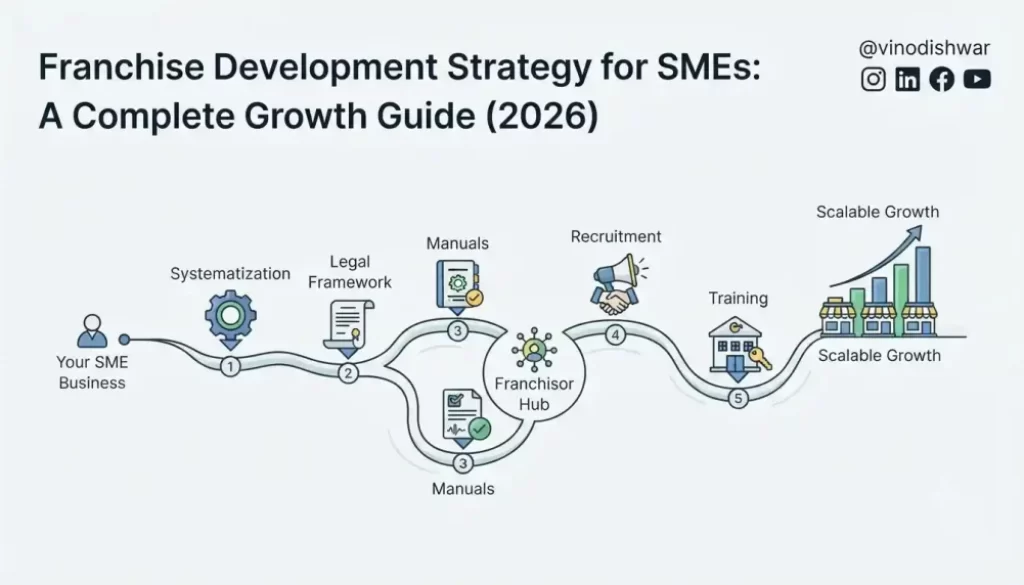
Franchise Development Framework for SMEs
Successful SME
        │
        ▼
Readiness Assessment
        │
        ▼
Franchise Strategy
        │
        ▼
Business Model Development
        │
        ▼
Operational Standardization
        │
        ▼
SOP Development
        │
        ▼
Operations Manual
        │
        ▼
Legal Documentation
        │
        ▼
Training Systems
        │
        ▼
Marketing & Lead Generation
        │
        ▼
Franchise Recruitment
        │
        ▼
Launch & Support
        │
        ▼
Regional → National → Global Growth
Common Mistakes SMEs Should Avoid
Avoid these common franchising mistakes:
- Expanding before documenting processes
- Underpricing franchise fees
- Selecting franchisees based only on investment
- Ignoring technology systems
- Weak franchisee training
- Poor communication
- Inadequate operational support
- Expanding too quickly without infrastructure
Building systems first leads to stronger long-term growth.
How Franchise Development Consultants Help SMEs
Professional franchise consultants assist SMEs by:
- Assessing franchise readiness
- Designing franchise business models
- Creating SOPs and Operations Manuals
- Preparing legal documentation
- Developing training systems
- Building franchise marketing strategies
- Recruiting franchise partners
- Supporting long-term expansion
Expert guidance reduces risk and accelerates growth. Businesses looking for expert guidance can explore Franchise Consulting Services at https://franchisealpha.com/.
Why Choose Franchise Alpha?
At Franchise Alpha, we specialize in helping SMEs build scalable franchise businesses through our proprietary SOLEMN® Framework.
Strategy
Develop franchise business models, pricing structures, and expansion roadmaps.
Operations
Create SOPs, Operations Manuals, and standardized workflows.
Legal
Prepare Franchise Agreements, protect trademarks, and ensure compliance.
Entrust
Reduce founder dependency through structured systems and leadership development.
Marketing
Generate qualified franchise leads using digital marketing and franchise sales strategies.
Nitty-Gritty
Monitor KPIs, improve profitability, and continuously optimize franchise performance.
Frequently Asked Questions
Can SMEs become franchise businesses?
Yes. SMEs with a profitable, repeatable business model and documented systems can successfully expand through franchising.
Why is franchising a good strategy for SMEs?
Franchising enables SMEs to expand faster with lower capital investment by leveraging franchisee funding while maintaining standardized operations.
How long does franchise development take for an SME?
Most SMEs complete franchise development within 3–6 months, depending on business complexity and documentation requirements.
What industries are suitable for SME franchising?
Restaurants, cafés, retail stores, salons, education institutes, healthcare businesses, fitness centers, service companies, manufacturing businesses, and cloud kitchens are among the industries that commonly franchise successfully.
Conclusion
For SMEs, franchising is more than an expansion strategy—it is a pathway to sustainable, scalable growth. A well-planned Franchise Development Strategy for SMEs helps businesses expand sustainably while maintaining operational consistency and long-term profitability.
By investing in operational systems, documentation, legal frameworks, training, and ongoing support, SMEs can build franchise networks that grow consistently while protecting brand reputation and profitability.
The most successful SME franchises don’t expand because they have more resources—they expand because they have better systems. You can also explore additional franchise expansion insights on https://franchisealpha.com/blog/.
Call to Action
Ready to Transform Your SME into a Scalable Franchise?
Book a Franchise Readiness Assessment with Vinod Ishwar and discover how your business can grow through a customized franchise development strategy.
Your assessment includes:
- SME Franchise Readiness Evaluation
- Business Model Review
- SOP & Operations Assessment
- Expansion Roadmap
- Customized Franchise Development Strategy
Start building a franchise-ready business designed for long-term success.