How to Build a Franchise Business Model: A Complete Step-by-Step Guide (2026)
How to Build a Franchise Business Model is one of the most important questions business owners ask when planning to expand through franchising. Many successful businesses dream of becoming the next national or global franchise brand. However, having a profitable business alone does not guarantee franchise success. The difference between businesses that scale successfully and those that struggle often comes down to one critical factor—a well-designed franchise business model.
Many successful businesses dream of becoming the next national or global franchise brand. However, having a profitable business alone does not guarantee franchise success. The difference between businesses that scale successfully and those that struggle often comes down to one critical factor—a well-designed franchise business model.
A franchise business model defines how your business will operate, generate revenue, support franchisees, maintain quality, and expand sustainably. It serves as the blueprint for transforming a single successful outlet into a network of profitable franchise locations.
Whether you operate a restaurant, café, salon, retail store, fitness center, education institute, healthcare clinic, manufacturing company, or service business, building the right franchise business model is the first step toward scalable growth.
This comprehensive guide explains how to build a franchise business model from the ground up, including strategy, operations, legal considerations, financial planning, training, and long-term expansion.
What is a Franchise Business Model?
A franchise business model is a structured system that allows independent entrepreneurs (franchisees) to operate under an established brand using standardized processes, systems, and operational guidelines.
The franchisor provides:
- Brand identity
- Business systems
- Standard Operating Procedures (SOPs)
- Training
- Marketing support
- Technology
- Ongoing operational assistance
The franchisee invests capital, manages daily operations, and follows the established business model while paying agreed franchise fees and royalties.
A successful franchise business model benefits both parties by creating consistent customer experiences and profitable growth. Learn more about professional Franchise Development Services at https://franchisealpha.com/franchise-development-services/
Why a Strong Franchise Business Model Matters
Without a clearly defined model, businesses often experience:
- Inconsistent customer experiences
- Operational confusion
- Founder dependency
- Poor franchisee performance
- Weak profitability
- Brand dilution
- Slow expansion
A professionally developed franchise business model creates repeatable systems that allow the business to grow while maintaining quality and operational consistency.
Step 1: Assess Franchise Readiness
Before developing your franchise model, determine whether your business is suitable for franchising.
Evaluate:
- Consistent profitability
- Strong customer demand
- Repeatable operations
- Brand recognition
- Operational maturity
- Leadership capability
- Scalable systems
A franchise readiness assessment identifies strengths and gaps before expansion begins.
Step 2: Define Your Franchise Vision
Establish a long-term vision for your franchise network.
Consider:
- Number of locations over the next 5–10 years
- Target cities or regions
- Type of franchise model (single-unit, multi-unit, master franchise)
- Level of operational control
- Long-term revenue goals
A clear vision guides every strategic decision.
Step 3: Design the Franchise Revenue Model
Your business model should clearly define how both the franchisor and franchisee earn revenue.
Typical revenue streams include:
- Initial franchise fee
- Royalty payments
- Marketing fund contributions
- Product or inventory supply
- Technology or software fees
- Renewal fees
The pricing structure should ensure long-term profitability for both parties.
Step 4: Identify Your Ideal Franchisee
Define the profile of your ideal franchise partner.
Consider:
- Financial capability
- Business experience
- Leadership skills
- Customer service mindset
- Local market knowledge
- Commitment to brand standards
Selecting the right franchisees is one of the most important success factors.
Step 5: Standardize Business Operations
Every successful franchise relies on standardized operations.
Document processes for:
- Customer service
- Sales
- Inventory management
- Procurement
- Finance
- Human resources
- Quality control
- Reporting
Consistency allows every location to deliver the same customer experience.
Step 6: Create Standard Operating Procedures (SOPs)
Develop detailed SOPs for every operational activity.
Examples include:
- Opening and closing procedures
- Product or service delivery
- Staff recruitment and onboarding
- Cash handling
- Inventory control
- Equipment maintenance
- Customer complaint resolution
- Health and safety procedures
Well-documented SOPs reduce founder dependency and improve operational efficiency.
Step 7: Develop the Franchise Operations Manual
The Operations Manual is the franchisee’s complete guide to running the business.
It should include:
- Brand guidelines
- Daily workflows
- HR policies
- Marketing standards
- Technology systems
- Financial reporting
- Compliance requirements
- Audit procedures
A comprehensive manual ensures consistency across every outlet.
Step 8: Build the Legal Framework
Protect your business with professionally prepared legal documentation.
Essential documents include:
- Franchise Agreement
- Trademark Registration
- Brand Usage Guidelines
- Confidentiality Agreement (NDA)
- Intellectual Property Protection
- Franchise Disclosure Documentation (where applicable)
A strong legal framework safeguards both the franchisor and franchisee.
Step 9: Develop Franchise Training Systems
Provide structured training covering:
- Business operations
- Customer service
- Sales
- Marketing
- Financial management
- Technology
- Leadership
- Compliance
Ongoing learning improves franchise performance and operational consistency.
Step 10: Build Franchise Support Systems
Support is essential for long-term franchise success.
Provide:
- Site selection assistance
- Store setup guidance
- Launch support
- Operational audits
- Marketing assistance
- Technology support
- Business coaching
- Performance reviews
A strong support system improves franchisee satisfaction and retention.
Step 11: Create a Franchise Marketing Strategy
Generate qualified franchise leads through:
- SEO
- Google Ads
- Social media marketing
- Content marketing
- Email campaigns
- Franchise portals
- Investor presentations
- Discovery Day events
Consistent marketing creates a sustainable pipeline of franchise prospects.
Step 12: Plan for Long-Term Growth
Develop an expansion roadmap that includes:
- Multi-unit franchising
- Multi-city expansion
- Multi-state expansion
- Regional hubs
- Master franchising
- International growth
Expansion should be driven by operational readiness rather than speed alone.
Essential Components of a Franchise Business Model
| Component | Purpose |
|---|---|
| Franchise Strategy | Defines long-term growth goals |
| Business Model | Establishes revenue and profitability |
| SOPs | Standardizes operations |
| Operations Manual | Documents business processes |
| Legal Framework | Protects intellectual property |
| Training Systems | Prepares franchisees |
| Marketing Systems | Generates franchise leads |
| Support Systems | Helps franchisees succeed |
| Performance Monitoring | Improves network performance |
| Growth Roadmap | Guides future expansion |
Practical Example
A regional café brand has five successful outlets and wants to expand nationwide.
Before Building the Franchise Model
- Operations differ between locations.
- Training is informal.
- Marketing is inconsistent.
- Expansion depends on the founder.
After Building the Franchise Model
- SOPs standardize beverage preparation and customer service.
- Operations Manuals guide daily activities.
- Franchisees receive structured onboarding and training.
- Marketing systems generate qualified franchise enquiries.
- Performance dashboards track sales, quality, and compliance.
The café brand expands across multiple states while maintaining consistent customer experiences.
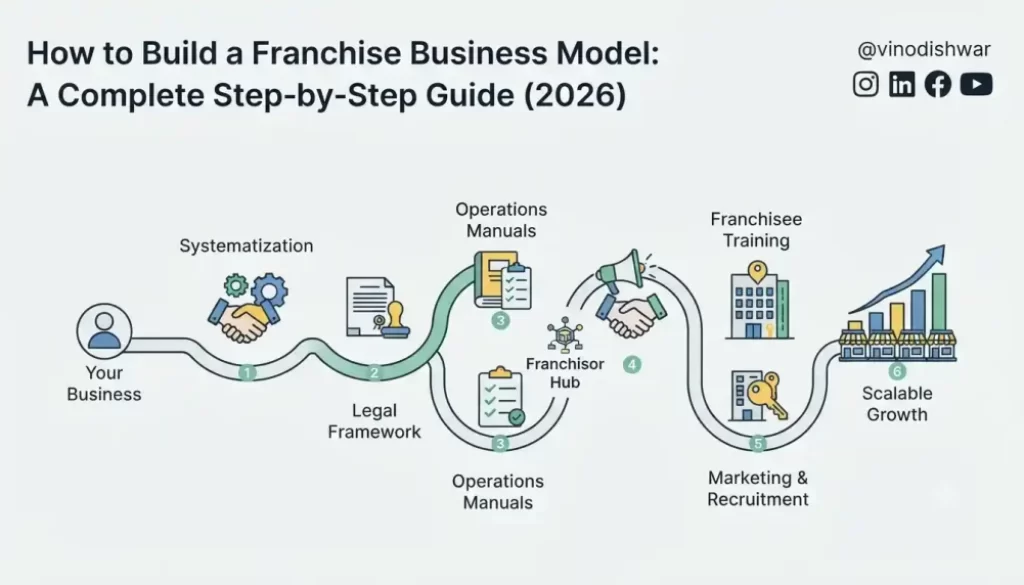
Franchise Business Model Framework
Successful Business
        │
        ▼
Franchise Readiness Assessment
        │
        ▼
Vision & Strategy
        │
        ▼
Revenue Model Design
        │
        ▼
Operational Standardization
        │
        ▼
SOP Development
        │
        ▼
Operations Manual
        │
        ▼
Legal Documentation
        │
        ▼
Training Systems
        │
        ▼
Marketing & Lead Generation
        │
        ▼
Franchise Launch
        │
        ▼
Support & Performance Monitoring
        │
        ▼
Regional → National → International Growth
Common Mistakes to Avoid
Avoid these common franchising mistakes:
- Franchising before documenting operations
- Charging unsustainable franchise fees
- Choosing franchisees based only on investment
- Ignoring technology and reporting systems
- Providing inadequate training
- Offering limited post-launch support
- Expanding too quickly without infrastructure
A successful franchise business model is built on systems—not assumptions.
How Franchise Development Consultants Help
Experienced franchise consultants help businesses by:
- Conducting franchise readiness assessments
- Designing profitable franchise business models
- Developing SOPs and Operations Manuals
- Preparing legal documentation
- Building franchise training programs
- Creating lead generation strategies
- Recruiting qualified franchisees
- Supporting long-term network growth
Professional guidance reduces risk and accelerates expansion. Explore how Franchise Alpha helps businesses scale through proven franchise systems: https://franchisealpha.com/
Why Choose Franchise Alpha?
At Franchise Alpha, we help businesses build scalable franchise business models through our proprietary SOLEMN® Framework.
Strategy
Develop customized franchise strategies, pricing structures, and expansion roadmaps.
Operations
Create SOPs, Operations Manuals, and standardized business systems.
Legal
Prepare Franchise Agreements, protect trademarks, and ensure legal compliance.
Entrust
Reduce founder dependency through leadership development and operational excellence.
Marketing
Generate qualified franchise leads through digital marketing and franchise sales strategies.
Nitty-Gritty
Track KPIs, optimize profitability, and continuously improve franchise performance.
Frequently Asked Questions
What is a franchise business model?
A franchise business model is a structured system that enables a business to expand through franchise partners using standardized operations, legal agreements, training, and ongoing support.
How do I build a franchise business model?
Start by assessing franchise readiness, designing a revenue model, documenting operations, creating SOPs and an Operations Manual, preparing legal documents, developing training programs, and building franchise support systems.
How long does it take to build a franchise business model?
Most businesses complete franchise business model development within 3 to 6 months, depending on operational complexity and documentation requirements.
Which businesses can use a franchise business model?
Restaurants, cafés, retail stores, salons, fitness centers, education institutes, healthcare businesses, manufacturing companies, and service-based businesses with proven, repeatable operations are excellent candidates.
Conclusion
Building a franchise business model is the foundation of successful franchise expansion.
A well-designed model aligns strategy, operations, legal protection, training, marketing, and support into a repeatable system that allows businesses to scale while maintaining quality and profitability.
Businesses that invest in strong franchise models are better positioned to expand across cities, states, and international markets with confidence.
Call to Action
Ready to Build Your Franchise Business Model?
Book a Franchise Readiness Assessment with Vinod Ishwar and discover how your business can be transformed into a scalable franchise.
Your assessment includes:
- Franchise Readiness Evaluation
- Business Model Analysis
- SOP & Operations Review
- Franchise Business Model Blueprint
- Customized Expansion Strategy
Build a franchise business model that supports sustainable growth and long-term success.
Visit https://franchisealpha.com/ to learn more about franchise consulting and business expansion.