Territory Mapping Guide: How to Design Exclusive Franchise Territories (2026)
Introduction
Territory Mapping Guide is essential for businesses planning to expand through franchising. One of the biggest reasons franchise systems fail is poor territory planning. When franchise territories overlap, franchisees compete against each other instead of the market, reducing profitability and damaging long-term brand growth. A well-planned territory strategy ensures sustainable franchise expansion.
One of the biggest reasons franchise systems fail is poor territory planning.
When franchise territories overlap, franchisees compete against each other instead of the market. This creates conflicts, reduces profitability, damages relationships, and weakens the overall brand.
A professionally designed territory mapping strategy ensures every franchise location has sufficient market potential while allowing the franchisor to expand efficiently without cannibalizing existing outlets.
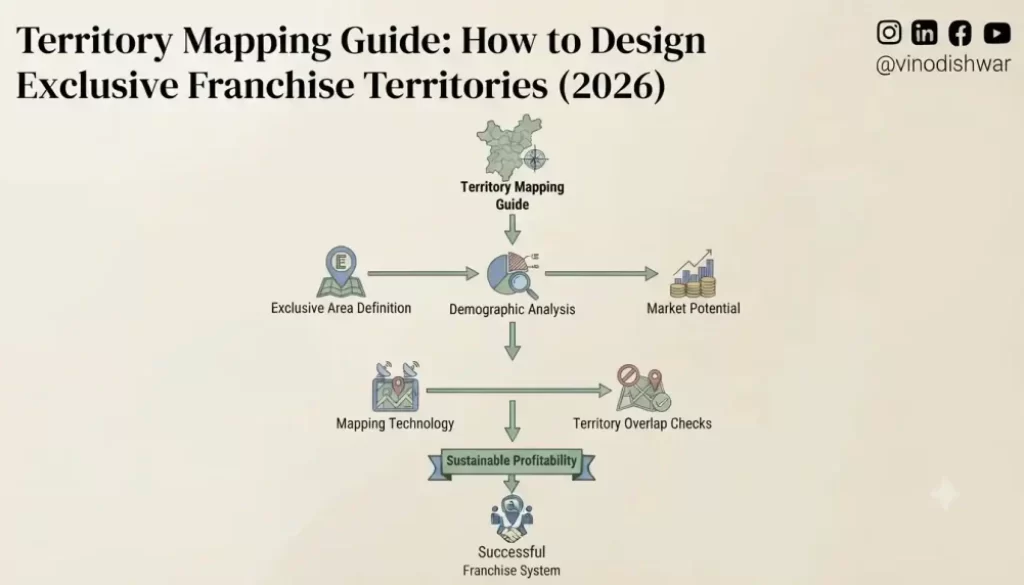
Territory mapping is much more than drawing circles on a map. It combines demographic analysis, customer behavior, market demand, competition, infrastructure, and business economics to create balanced and profitable franchise territories.
Whether you are planning your first franchise outlet or expanding across multiple cities, a strategic territory mapping process helps maximize growth while protecting both the franchisor and franchisee.
This guide explains how franchise territory mapping works, why it matters, and the step-by-step process used by professional franchise consultants.
Territory Mapping Guide: What Is Franchise Territory Mapping?
Franchise territory mapping is the strategic process of defining the geographic area where a franchisee has the right to operate and market the franchise business.
The objective is to:
- Protect franchisee investments
- Avoid market overlap
- Maximize customer reach
- Improve operational efficiency
- Support long-term expansion
- Maintain balanced network growth
A well-designed territory becomes a valuable business asset.
Why the Territory Mapping Guide Matters for Franchise Growth
Effective territory planning provides several benefits. Franchise Development Process
It helps businesses:
- Reduce franchise conflicts
- Improve outlet profitability
- Increase market penetration
- Protect franchise investments
- Simplify expansion planning
- Optimize marketing spend
- Improve customer accessibility
- Strengthen brand presence
- Increase investor confidence
- Build sustainable franchise networks
Poor territory planning often results in internal competition and inconsistent performance.
15-Step Territory Mapping Guide for Franchise Expansion
Step 1. Define Expansion Objectives
Begin by understanding your long-term growth vision.
Questions to consider include:
- How many outlets do you plan to open?
- Which cities or regions are priorities?
- Will expansion be regional, national, or international? Franchise Business Model
Step 2. Analyze Customer Demographics
Study your target audience using factors such as:
- Population
- Income levels
- Age groups
- Education
- Lifestyle
- Purchasing behavior
Demographic insights improve location selection.
Step 3. Evaluate Market Demand
Assess:
- Customer demand
- Existing competitors
- Market saturation
- Industry growth
- Local trends
Demand determines territory viability.
Step 4. Study Competitor Locations
Identify:
- Direct competitors
- Indirect competitors
- Market leaders
- Customer preferences
Competitive analysis helps avoid oversaturated markets.
Step 5. Map Population Density
High population alone doesn’t guarantee success.
Evaluate:
- Residential clusters
- Commercial zones
- Office districts
- Educational institutions
- Business hubs
Step 6. Analyze Accessibility
Consider:
- Road connectivity
- Public transport
- Parking availability
- Walkability
- Visibility
Convenient access improves customer traffic.
Step 7. Define Exclusive Territories
Determine whether franchisees receive:
- Exclusive territory
- Protected territory
- Shared market
- Performance-based expansion rights
Clear agreements reduce disputes.
Step 8. Calculate Market Potential
Estimate:
- Customer base
- Sales potential
- Market size
- Revenue opportunities
- Future population growth
Data-driven planning improves investment decisions.
Step 9. Determine Outlet Density
Avoid opening too many outlets within the same market.
Proper spacing protects franchisee profitability.
Step 10. Use Geographic Information Systems (GIS)
Professional territory mapping often uses:
- GIS software
- Heat maps
- Customer location analysis
- Catchment area studies
- Drive-time analysis
Technology improves planning accuracy.
Step 11. Plan Future Expansion
Reserve opportunities for:
- Multi-unit franchisees
- New cities
- Emerging markets
- Regional hubs
Future planning reduces restructuring.
Step 12. Develop Territory Policies
Document:
- Territory rights
- Expansion conditions
- Performance requirements
- Territory modification rules
Policies provide operational clarity.
Step 13. Integrate Marketing Strategy
Territories should align with:
- Local marketing
- Regional advertising
- Digital campaigns
- Community engagement
Marketing becomes more efficient.
Step 14. Monitor Territory Performance
Track KPIs including:
- Sales
- Customer growth
- Market penetration
- Profitability
- Operational compliance
Performance data supports future decisions.
Step 15. Review and Optimize
Markets evolve continuously.
Review territories periodically based on:
- Population growth
- Infrastructure development
- Consumer trends
- Competitive changes
Continuous optimization ensures long-term success.
Common Territory Models
Exclusive Territory
One franchisee receives complete rights within a defined geographic area.
Protected Territory
The franchisor limits competition but may retain selected operating rights.
Non-Exclusive Territory
Multiple franchisees may operate within the same market.
Area Development
One investor commits to opening multiple outlets across a designated territory.
Master Franchise Territory
A master franchisee develops and manages an entire state, country, or region.
Common Territory Planning Mistakes
Businesses frequently make these errors:
- Expanding too quickly
- Ignoring demographic research
- Poor market analysis
- Overlapping territories
- Weak legal documentation
- No future expansion planning
- Ignoring traffic patterns
- Unrealistic outlet density
Professional planning minimizes these risks.
How Franchise Consultants Help
Experienced franchise consultants support businesses by:
- Conducting market research
- Designing territory maps
- Performing demographic analysis
- Creating expansion strategies
- Defining exclusive territories
- Preparing legal documentation
- Forecasting market potential
- Optimizing franchise growth
Expert guidance helps businesses expand strategically. Businesses looking for professional franchise territory planning and expansion strategy can explore Franchise Alpha’s franchise consulting services.
The SOLEMN® Framework
At Franchise Alpha, franchise territory planning follows the proprietary SOLEMN® Framework.
Strategy
Identify target markets and long-term expansion goals.
Operations
Develop scalable territory structures supported by operational systems.
Legal
Document territory rights, exclusivity clauses, and franchise agreements.
Entrust
Support franchisees with regional planning, onboarding, and performance coaching.
Marketing
Align territory planning with localized marketing and customer acquisition strategies.
Nitty-Gritty
Continuously review market data, KPIs, demographic trends, and expansion opportunities.
This structured methodology enables businesses to build balanced and profitable franchise networks.
Frequently Asked Questions
What is franchise territory mapping?
Franchise territory mapping is the process of defining geographic operating areas for franchisees to maximize market coverage while minimizing competition between locations.
Why is territory planning important?
Territory planning protects franchisee investments, prevents market overlap, improves profitability, and supports sustainable franchise expansion.
What is an exclusive franchise territory?
An exclusive territory gives a franchisee sole rights to operate within a defined geographic area, subject to the terms of the franchise agreement.
How do businesses determine franchise territories?
Businesses analyze demographics, market demand, customer behavior, competition, infrastructure, accessibility, and future growth potential before defining territories.
Conclusion
Territory mapping is one of the most strategic decisions in franchise development. This Territory Mapping Guide demonstrates why strategic planning is one of the most important foundations of successful franchise expansion.
A carefully designed territory structure creates profitable markets for franchisees, protects brand value, reduces internal competition, and supports long-term expansion.
Rather than relying on intuition or simple geographic boundaries, successful franchise systems use research, analytics, technology, and strategic planning to create balanced territories.
The strongest franchise networks grow because every location has the opportunity to succeed. Franchise Fee Structure
Call to Action
Build a Smarter Franchise Expansion Strategy
Book a Franchise Territory Mapping Assessment with Vinod Ishwar to analyze your target markets, define exclusive territories, create scalable expansion plans, and design a data-driven franchise growth strategy.
Receive a customized territory development roadmap for sustainable franchise expansion.