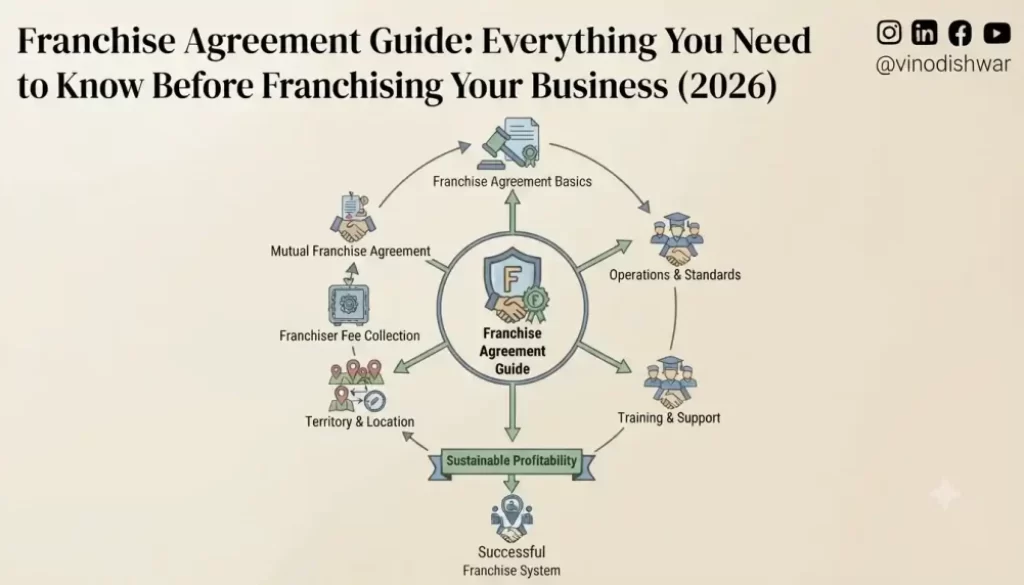
Franchise Agreement Guide: Everything You Need to Know Before Franchising Your Business (2026)
Introduction
This Franchise Agreement Guide explains why a professionally drafted franchise agreement is one of the most important legal documents in franchise development. Every successful franchise relationship begins with clear legal documentation that protects both franchisors and franchisees while supporting long-term business growth.
Every successful franchise relationship begins with a well-drafted franchise agreement.
While branding, operations, and marketing are essential components of a franchise system, the franchise agreement serves as the legal foundation that protects both the franchisor and the franchisee. It clearly defines the rights, responsibilities, financial obligations, operational standards, and dispute resolution mechanisms that govern the partnership.
Without a comprehensive agreement, misunderstandings, operational inconsistencies, and legal disputes can jeopardize the growth of the franchise network.
A franchise agreement is far more than a legal contract—it is a strategic business document that creates clarity, protects intellectual property, establishes operational expectations, and provides a roadmap for long-term collaboration.
This guide explains what a franchise agreement is, why it matters, the essential clauses every agreement should include, and how businesses can develop legally sound franchise documentation.
Franchise Agreement Guide: What Is a Franchise Agreement?
A franchise agreement is a legally binding contract between the franchisor and the franchisee that grants the franchisee the right to operate a business using the franchisor’s brand, business systems, trademarks, operational procedures, and intellectual property. Before drafting agreements, businesses should first evaluate their Franchise Readiness.
The agreement defines:
- Franchise rights
- Operational responsibilities
- Financial obligations
- Territory rights
- Brand usage
- Training and support
- Quality standards
- Duration of the relationship
- Renewal conditions
- Termination procedures
It provides legal certainty for both parties. Territory planning should always align with a well-defined Territory Mapping Strategy.
Why This Franchise Agreement Guide Matters
A professionally drafted agreement helps businesses:
- Protect intellectual property
- Define operational standards
- Reduce legal disputes
- Protect brand reputation
- Clarify financial obligations
- Support franchise expansion
- Improve investor confidence
- Create long-term business stability
- Standardize franchise relationships
- Ensure consistent business operations
A clear agreement builds trust and minimizes future conflicts. Standard Operating Procedures (SOPs)
The 15 Essential Clauses of a Franchise Agreement
1. Grant of Franchise Rights
Defines the legal right granted to the franchisee to operate under the franchisor’s brand.
It specifies:
- Business format
- Licensed trademarks
- Business systems
- Scope of rights
2. Franchise Term
Specifies the duration of the franchise relationship.
Typical agreements range from:
- 5 years
- 10 years
- 15 years
Renewal conditions should also be clearly documented.
3. Territory Rights
Defines whether the franchisee receives:
- Exclusive territory
- Protected territory
- Non-exclusive territory
Clear territory clauses prevent market conflicts.
4. Franchise Fees
Documents:
- Initial franchise fee
- Royalty payments
- Marketing contributions
- Technology fees
- Other recurring charges
Financial transparency is essential.
5. Brand Usage Guidelines
Explains how franchisees may use:
- Trademarks
- Logos
- Marketing materials
- Brand identity
- Intellectual property
Consistent branding protects customer trust.
6. Operational Standards
Requires franchisees to follow:
- Standard Operating Procedures (SOPs)
- Operations Manual
- Customer service standards
- Product quality requirements
- Compliance guidelines
Operational consistency strengthens the brand.
7. Training & Support
Specifies the franchisor’s obligations regarding:
- Initial training
- Ongoing coaching
- Operational assistance
- Technology support
- Refresher programs
Support contributes to franchisee success.
8. Marketing Obligations
Clarifies:
- National marketing
- Local advertising
- Marketing fund contributions
- Promotional activities
A structured marketing approach enhances brand visibility.
9. Confidentiality
Protects proprietary business information including:
- SOPs
- Business processes
- Financial information
- Trade secrets
- Customer data
Confidentiality safeguards competitive advantage.
10. Non-Compete Clause
Restricts franchisees from operating competing businesses during and, where legally enforceable, after the franchise relationship.
This helps protect the franchise system.
11. Performance Standards
Defines measurable expectations such as:
- Sales targets
- Operational compliance
- Customer satisfaction
- Quality audits
Performance standards promote accountability.
12. Renewal & Extension
Outlines:
- Renewal eligibility
- Renewal fees
- Updated agreement requirements
- Performance conditions
Planning ahead encourages long-term partnerships.
13. Transfer & Assignment
Explains the process for:
- Selling the franchise
- Business transfers
- Ownership changes
- Franchisor approval
This protects network integrity.
14. Termination
Identifies circumstances where the agreement may be terminated.
Examples include:
- Breach of contract
- Non-payment
- Operational violations
- Brand misuse
Termination procedures should be fair and clearly documented.
15. Dispute Resolution
Defines how disagreements will be handled through:
- Negotiation
- Mediation
- Arbitration
- Court jurisdiction
A structured dispute process minimizes legal uncertainty.
Common Types of Franchise Agreements
Single Unit Franchise Agreement
One franchise location operated by one franchisee.
Multi-Unit Development Agreement
One franchisee commits to opening multiple outlets.
Area Development Agreement
Rights to develop a defined territory within a specified timeframe.
Master Franchise Agreement
Allows a master franchisee to recruit and manage sub-franchisees within a larger region.
Conversion Franchise Agreement
Existing businesses adopt the franchisor’s systems and brand.
Common Franchise Agreement Mistakes
Businesses often make these legal mistakes:
- Using generic templates
- Poorly defined territory rights
- Weak intellectual property protection
- Unclear royalty clauses
- Missing operational obligations
- No dispute resolution process
- Inadequate confidentiality provisions
- Failing to update agreements as the business evolves
Professional legal drafting reduces these risks.
How Franchise Consultants Help
Experienced franchise consultants work alongside legal professionals to:
- Design franchise structures
- Define operational responsibilities
- Develop SOPs and Operations Manuals
- Create franchise documentation
- Align financial and legal frameworks
- Improve franchise readiness
- Support expansion planning
A collaborative approach ensures the agreement reflects the operational reality of the franchise system. Businesses can also explore professional franchise development services offered by Franchise Alpha:
The SOLEMN® Framework
At Franchise Alpha, franchise agreements are developed as part of the proprietary SOLEMN® Framework.
Strategy
Define the business model, expansion objectives, and franchise structure.
Operations
Align legal documentation with operational systems, SOPs, and business processes.
Legal
Develop comprehensive franchise agreements, intellectual property protection, and compliance documentation.
Entrust
Clearly define training obligations, support commitments, and franchisee responsibilities.
Marketing
Include brand usage policies and marketing obligations within the agreement.
Nitty-Gritty
Review, update, and strengthen agreements as the franchise network grows and regulations evolve.
This integrated approach helps businesses create legally robust and operationally effective franchise systems.
Frequently Asked Questions
What is a franchise agreement?
A franchise agreement is a legally binding contract that outlines the rights, obligations, operational standards, and financial responsibilities between a franchisor and a franchisee.
Why is a franchise agreement important?
It protects both parties, establishes operational consistency, safeguards intellectual property, and reduces the risk of legal disputes.
Can I use a standard legal template?
No. Every franchise business has unique operational, financial, and legal requirements. Agreements should be customized with professional legal guidance.
Who should prepare a franchise agreement?
A franchise agreement should be drafted by experienced legal professionals familiar with franchise law, working closely with franchise consultants who understand operational systems and business strategy.
Conclusion
A franchise agreement is the legal backbone of every successful franchise system. Learn more about franchise consulting and business expansion at https://franchisealpha.com
It protects the brand, defines expectations, creates operational consistency, and builds long-term trust between franchisors and franchisees.
Rather than treating the agreement as a simple legal formality, businesses should view it as a strategic document that supports sustainable growth, minimizes risk, and strengthens the entire franchise network.
A professionally structured agreement lays the foundation for successful and scalable franchise expansion.
Call to Action
Build a Legally Strong Franchise System
Book a Franchise Documentation & Legal Readiness Assessment with Vinod Ishwar to develop a comprehensive franchise agreement, align your legal framework with your business systems, and prepare your brand for confident franchise expansion.
Receive expert guidance on creating a legally secure and operationally scalable franchise model.