Retail Expansion Strategy: How to Choose Your Next Location Wisely
Retail expansion strategy plays a crucial role in determining whether a new store succeeds or struggles. Choosing the right location requires more than intuition—it demands customer research, market analysis, and long-term planning. India’s growing retail landscape offers exciting opportunities, but selecting the wrong location can limit growth, increase costs, and reduce profitability.
Ask any experienced retailer what determines a store’s success, and location almost always tops the list — often above product quality, pricing, or even brand strength. A great product in the wrong location will consistently underperform a mediocre product in the right one. Yet many retail expansion decisions are still made on gut feeling, availability, or a founder’s personal familiarity with an area, rather than rigorous evaluation. A strong business growth strategy helps retailers expand confidently while minimizing financial and operational risks.
Why a Retail Expansion Strategy Starts with Location Analysis
A retail lease is typically a multi-year commitment involving significant capital in deposits, interiors, and setup costs. Getting the location wrong doesn’t just mean underperformance — it means locking up capital and management attention in a site that may never become profitable, regardless of how well it’s run.
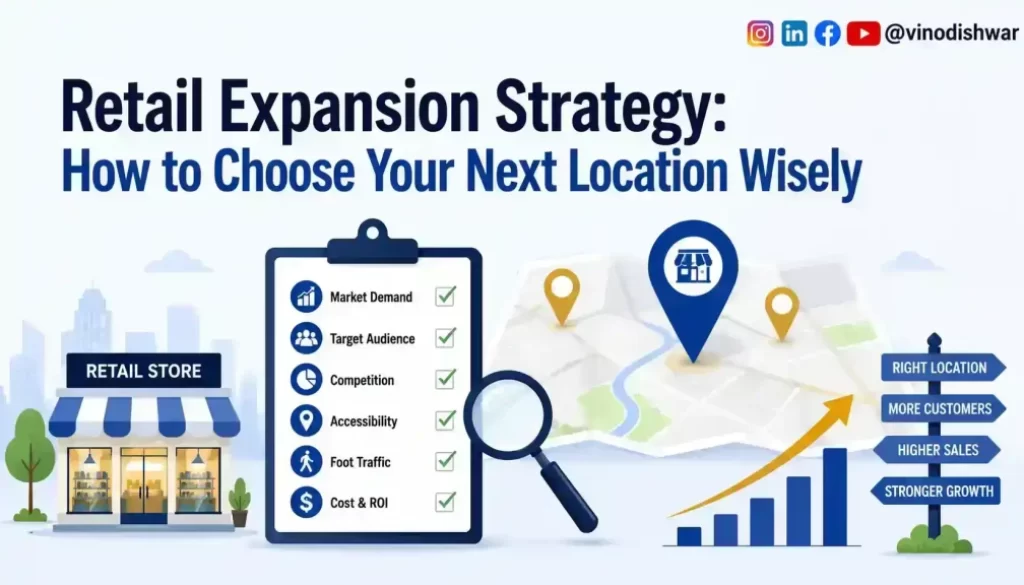
Retail Expansion Strategy: How to Evaluate Store Locations
1. Footfall Quality, Not Just Footfall Quantity
High foot traffic alone doesn’t guarantee sales. It matters whether that traffic matches your target customer profile. A high-footfall street dominated by budget shoppers won’t convert well for a premium retail brand, regardless of the numbers. Understanding customer acquisition strategies ensures that the selected location consistently attracts high-value customers.
2. Catchment Area Analysis
Understand who actually lives, works, or regularly passes through the surrounding area — income levels, age demographics, family composition, and shopping habits. This data should come from genuine research, not assumptions based on how the area “feels.” Strong market opportunities research helps identify areas with long-term growth potential before competitors enter.
3. Competitive Density and Positioning
Some proximity to competitors validates that customers are already primed to shop that category in that area. Too much competitive density, however, can fragment the available customer base beyond what the location can sustainably support.
4. Accessibility and Visibility
Consider parking availability, public transport access, signage visibility from the main road, and ease of entry. A store hidden behind other buildings or difficult to reach loses significant potential footfall regardless of the surrounding area’s overall quality.
5. Rental Cost Relative to Revenue Potential
Rather than evaluating rent in isolation, calculate it as a percentage of realistically projected revenue. A more expensive location that drives proportionally higher sales can outperform a cheaper one that struggles to generate footfall. Maintaining sustainable growth is equally important when expanding into multiple retail locations.
6. Anchor Tenants and Complementary Businesses
Locations near strong anchor tenants — a popular supermarket, a well-known restaurant, a busy transit hub — benefit from borrowed footfall. Complementary (non-competing) businesses nearby can also create natural cross-shopping behavior.
7. Future Growth Trajectory of the Area
Some areas are already at peak development; others are on a clear upward trajectory — new residential projects, infrastructure development, commercial growth. Entering a rising area early, at lower rental costs, can be more strategically valuable than entering an already-saturated prime location. Industry reports published by IBEF regularly highlight retail growth trends across India.
Using Data to Improve Your Retail Expansion Strategy
Retailers today have access to far more than intuition: mobile location data, footfall counters, demographic mapping tools, and competitor location analysis. Combining this data with on-ground evaluation — visiting the location at different times and days, observing actual customer behavior nearby — produces far more reliable site decisions than either approach alone.
Retail Expansion Strategy Mistakes to Avoid
- Choosing a location because it’s cheap, without evaluating whether it can realistically generate sufficient footfall.
- Ignoring catchment demographics, assuming any busy area will suit any business.
- Underestimating the impact of poor visibility or accessibility.
- Signing long-term leases without contingency clauses in case performance doesn’t meet projections.
- Relying solely on a broker’s recommendation without independent site validation.
Key Takeaways
- Footfall quality matters more than raw footfall quantity.
- Catchment demographics should be verified with real data, not assumptions.
- Rental cost should always be evaluated relative to realistic revenue potential.
- Anchor tenants and complementary businesses can significantly boost location performance.
- Combining data analysis with on-ground observation produces the most reliable site decisions.
Conclusion
Retail expansion success is won or lost largely before the store even opens — in the site selection decision. A rigorous, data-informed approach to choosing your next location dramatically improves your odds of sustainable, profitable growth. Building a memorable brand also increases customer trust and improves the performance of every new retail outlet.
-Vinod Ishwar
Frequently Asked Questions
What is a retail expansion strategy?
A retail expansion strategy is a structured plan that helps businesses select profitable locations, manage investment risks, and grow sustainably.
How do I choose the best retail store location?
Analyze customer demographics, foot traffic, accessibility, nearby competitors, rental costs, and future development before making a decision.
Why is location important for retail success?
The right location attracts your target customers, improves visibility, increases sales, and supports long-term business growth.
Should retailers expand into Tier-2 and Tier-3 cities?
Yes. Many Tier-2 and Tier-3 cities in India are experiencing rapid economic growth, making them attractive markets for retail expansion.
What mistakes should businesses avoid during retail expansion?
Avoid relying only on intuition, ignoring market research, signing long-term leases without analysis, and expanding too quickly without proper planning.