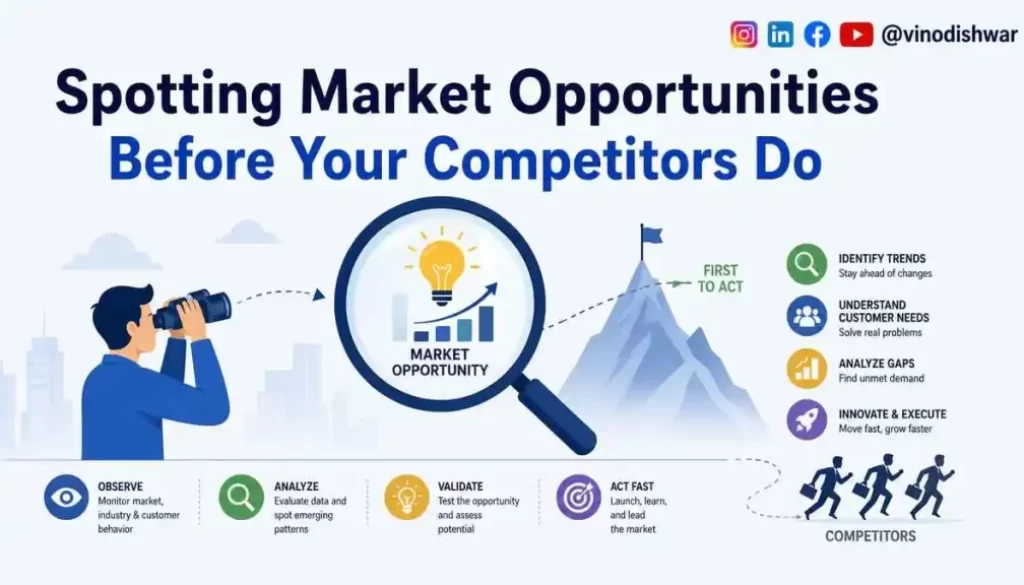
Spotting Market Opportunities Before Your Competitors Do
Market opportunities often appear long before they become obvious to everyone. Businesses that identify emerging customer needs, industry shifts, and changing market trends early can gain a significant competitive advantage, strengthen their market position, and achieve sustainable business growth.
By the time a market opportunity is obvious to everyone, it’s usually already crowded, competitive, and far less profitable than it was when it first emerged. The businesses that capture outsized returns from new opportunities are almost always the ones who spotted the signal early — before the trend had a name, before competitors had noticed, while the opportunity still looked uncertain or unproven to most observers. A strong business website helps businesses attract and convert customers when new market opportunities emerge.
Why Most Businesses Miss Emerging Opportunities
Established businesses often miss emerging opportunities not from lack of intelligence, but from structural blind spots — teams focused entirely on optimizing the current model, limited exposure to adjacent markets or customer segments, and a natural bias toward familiar, proven approaches over uncertain new ones.
A Systematic Approach to Spotting Market Opportunities
1. Track Shifts in Customer Behavior, Not Just Industry News
Industry reports tend to describe what’s already happened. Direct engagement with customers — through conversations, reviews, support tickets, and social listening — often reveals emerging needs and frustrations well before they become widely recognized trends. Content marketing helps businesses understand customer interests while building authority in emerging markets.
2. Watch Adjacent and International Markets
Trends often emerge in one market or category before spreading to others. Businesses that actively monitor adjacent industries, and how similar trends have played out internationally or in other Indian metros, can anticipate shifts before they arrive locally.
3. Pay Attention to Underserved Customer Segments
Opportunities frequently hide in customer segments larger businesses consider too small, too niche, or too inconvenient to serve well. These segments can represent significant opportunity for businesses willing to build a model specifically around their needs.
4. Monitor Where Competitors Are Consistently Failing
Recurring customer complaints about competitors — on reviews, social media, forums — highlight unmet needs. A business that systematically identifies and solves these gaps often captures dissatisfied customers looking for an alternative.
5. Study Emerging Technology and Its Business Applications
New technologies frequently create business opportunities before most companies in a category have adapted — whether that’s a new payment method, a logistics innovation, or an AI-driven capability that changes what’s operationally possible. Artificial intelligence enables businesses to analyze customer data and identify new growth opportunities faster.
6. Look at Demographic and Economic Shifts
Changes in income levels, urbanization patterns, age demographics, and lifestyle trends in specific regions often create opportunities years before they become mainstream business considerations. Businesses can identify customer search trends using Google Trends.
7. Test Small, Learn Fast
Rather than waiting for complete certainty, businesses that spot opportunities early often run small, low-cost experiments to validate demand — a pilot product, a test location, a limited marketing campaign — before committing significant resources. Sustainable business growth comes from validating new ideas before investing significant resources.
Evaluating Whether an Opportunity Is Worth Pursuing
Not every emerging trend represents a genuine opportunity for your specific business. Before committing resources, assess:
- Does this opportunity align with your existing capabilities and brand strengths?
- Is there evidence of genuine, sustained customer demand, not just short-term novelty?
- Can you realistically build a defensible position before larger competitors enter once the opportunity becomes obvious?
- Does pursuing this opportunity distract meaningfully from your core, currently profitable business?
Common Mistakes in Opportunity Identification
- Chasing every emerging trend without evaluating genuine fit with the business.
- Waiting for complete market validation before acting, by which point the opportunity window has often closed.
- Ignoring signals from customer complaints and underserved segments.
- Failing to allocate any resources to exploration, focusing entirely on optimizing the existing model.
- Overcommitting to an unproven opportunity without testing on a smaller scale first.
Key Takeaways
- Genuine market opportunities are usually visible before they become obvious industry trends.
- Direct customer engagement often reveals emerging needs earlier than industry reports.
- Underserved segments and recurring competitor failures are reliable signals of opportunity.
- Small, low-cost experiments validate opportunities faster and more cheaply than full commitment.
- Opportunity scanning should be a continuous discipline, not a one-time strategic exercise.
Conclusion
The businesses that consistently find profitable new opportunities aren’t necessarily smarter or luckier than their competitors — they’ve simply built the habits and systems to notice signals earlier and act on them with disciplined experimentation. Building this capability deliberately can become a genuine, lasting competitive advantage. A strong personal brand also helps business owners recognize new opportunities through industry networking and customer trust.
-Vinod Ishwar
Frequently Asked Questions (FAQs)
1. What are market opportunities?
Market opportunities are unmet customer needs, emerging trends, or new business areas that offer potential for growth and competitive advantage.
2. How can businesses identify new market opportunities?
Businesses can monitor customer behavior, industry trends, competitor weaknesses, technological advancements, and changing consumer demands.
3. Why is customer feedback important for finding market opportunities?
Customer feedback highlights pain points, unmet needs, and improvement areas that can lead to new products, services, or business ideas.
4. How can small businesses stay ahead of competitors?
Small businesses can stay ahead by continuously researching market trends, testing new ideas, adopting technology, and responding quickly to customer needs.
5. Why should businesses test opportunities before investing heavily?
Small-scale testing reduces financial risk, validates customer demand, and provides valuable insights before committing significant resources.
6. How does technology help businesses discover new opportunities?
Technology tools such as AI, market research platforms, and data analytics help businesses identify trends, customer preferences, and emerging market demands more efficiently.