Innovation Doesn’t Require Reinvention: Small Changes That Drive Big Growth
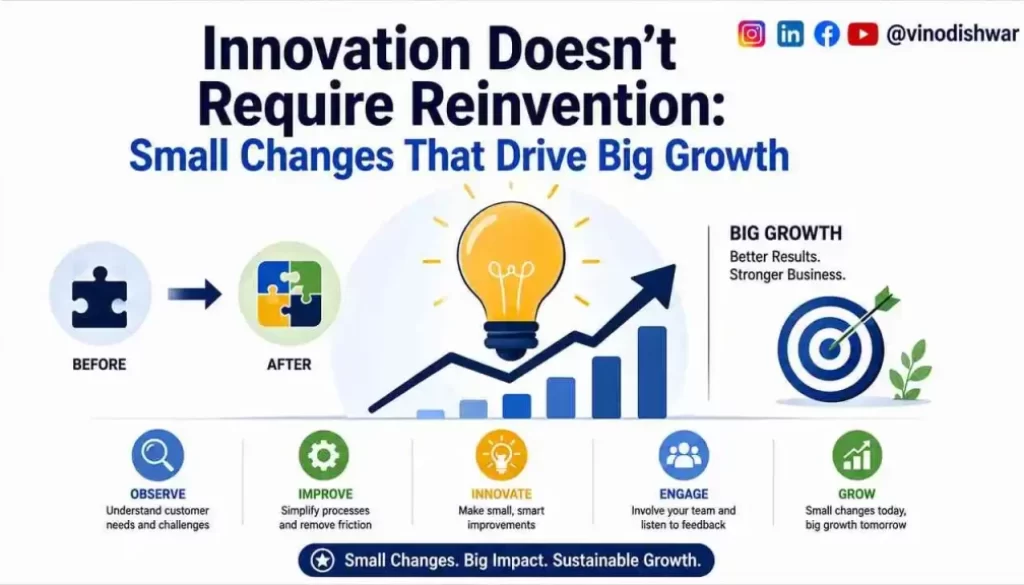
Business innovation is not always about creating revolutionary products or disruptive technologies. For most businesses, innovation comes from making small, meaningful improvements that enhance customer experience, streamline operations, and create sustainable business growth over time.
When business owners hear “innovation,” many picture something dramatic — a groundbreaking new product, a disruptive technology, a completely new business model. This narrow definition causes many genuinely innovative opportunities to go unnoticed, because most meaningful innovation in established businesses actually looks much smaller: a process improved, a customer pain point removed, a small feature added that competitors haven’t thought of yet. A well-designed business website makes it easier to introduce new ideas and deliver a better customer experience.
Redefining Innovation for Everyday Businesses
Innovation, at its core, simply means finding a better way to deliver value — to customers, or within your own operations. It doesn’t require inventing something entirely new. It requires paying close attention to friction points, inefficiencies, and unmet needs, and having the discipline to actually act on what you notice.
Categories of Practical, High-Impact Innovation
1. Process Innovation
Simplifying or automating an internal process — order fulfillment, inventory tracking, customer onboarding — that reduces cost, time, or error rate. These innovations rarely make headlines but often deliver measurable, compounding operational benefits. Business automation can simplify repetitive processes and help businesses implement innovative ideas more efficiently.
2. Product or Service Innovation
Small additions or modifications to an existing offering — a new size, a modified formulation, a bundled service — that better meets customer needs without requiring an entirely new product line.
3. Customer Experience Innovation
Removing friction from the customer journey — a simpler checkout process, faster response times, a more intuitive way to book or order — often has an outsized impact on customer satisfaction and repeat business relative to its implementation cost. Businesses that consistently publish valuable content often build stronger customer trust and long-term relationships.
4. Business Model Innovation
Adjusting how value is delivered or monetized — introducing a subscription option alongside one-time purchases, or offering a service-based add-on to a product business — without abandoning the core offering entirely.
5. Technology-Enabled Innovation
Adopting accessible technology — a simple CRM system, an automated appointment reminder tool, a basic AI-powered chatbot for common queries — to improve efficiency or customer experience without significant capital investment. AI-powered tools are helping businesses automate tasks, improve customer support, and increase operational efficiency. Businesses can organize customer information and improve sales processes using HubSpot CRM.
How to Build an Innovation Habit Into Your Business
1. Create Structured Channels for Ideas
Frontline staff and customers often notice friction points and opportunities long before management does. Building simple, structured channels — regular staff feedback sessions, customer suggestion mechanisms — surfaces these insights systematically rather than relying on chance conversations.
2. Dedicate Time and Resources, Even Small Amounts
Innovation rarely happens in businesses where every hour and rupee is allocated purely to maintaining current operations. Even a modest, dedicated allocation of time or budget for testing improvements signals that innovation is a genuine priority, not an afterthought.
3. Test Small Before Scaling
Pilot new ideas in a limited, low-risk way — one location, one product variant, one customer segment — before committing to a full rollout. This reduces the cost of ideas that don’t work while allowing successful ones to be identified quickly.
4. Study Adjacent Industries for Inspiration
Many effective innovations are adaptations of ideas already working well in other industries, applied thoughtfully to your specific category and customer base.
5. Measure and Communicate Wins
Tracking and sharing the tangible results of successful small innovations — time saved, revenue gained, customer satisfaction improved — builds organizational momentum and encourages continued innovative thinking at every level.
Common Innovation Mistakes to Avoid
- Waiting for a “big idea” instead of acting on small, practical improvements available right now.
- Treating innovation as solely a leadership responsibility, ignoring frontline staff insights.
- Implementing changes without testing, risking costly missteps at full scale.
- Failing to allocate any dedicated time or resources, leaving innovation entirely dependent on spare capacity that rarely materializes.
- Not measuring results, making it difficult to justify continued investment in innovation efforts.
A Practical Example
A neighborhood grocery retailer noticed customers frequently asked staff to help locate specific products. Rather than pursuing an expensive technology overhaul, the store simply reorganized shelving with clearer category signage and trained staff on a consistent, quick way to guide customers. The result was faster checkout times, reduced staff strain during peak hours, and measurably improved customer satisfaction scores — a small innovation with a meaningful business impact, achieved without significant investment
Key Takeaways
- Innovation doesn’t require dramatic reinvention — small, practical improvements often deliver significant compounding value.
- Process, product, customer experience, and business model innovation are all accessible without major capital investment.
- Structured channels for staff and customer feedback surface valuable innovation opportunities.
- Testing on a small scale before full rollout reduces risk and speeds up learning.
- Measuring and communicating results builds sustained organizational momentum for innovation.
Conclusion
The businesses that grow most consistently over time aren’t necessarily the ones with the single biggest breakthrough idea — they’re the ones that build a genuine habit of noticing friction, testing improvements, and acting consistently on what works. This kind of practical, ongoing innovation is available to businesses of any size. Building a strong personal brand also makes it easier for business owners to introduce innovative ideas and earn customer trust.
-Vinod Ishwar
Frequently Asked Questions (FAQs)
1. What is business innovation?
Business innovation is the process of improving products, services, operations, or customer experiences to create greater value and support long-term business growth.
2. Does innovation always require new technology?
No. Many successful innovations come from small improvements in processes, customer service, pricing, or operations without major technology investments.
3. Why is business innovation important?
Innovation helps businesses stay competitive, improve efficiency, enhance customer satisfaction, and adapt to changing market demands.
4. How can small businesses encourage innovation?
Small businesses can gather employee feedback, listen to customers, test new ideas on a small scale, and invest in continuous improvement.
5. What are the different types of business innovation?
Common types include process innovation, product innovation, customer experience innovation, business model innovation, and technology-enabled innovation.
6. How do you measure the success of innovation?
Businesses can measure innovation by tracking customer satisfaction, operational efficiency, revenue growth, cost savings, and overall business performance.