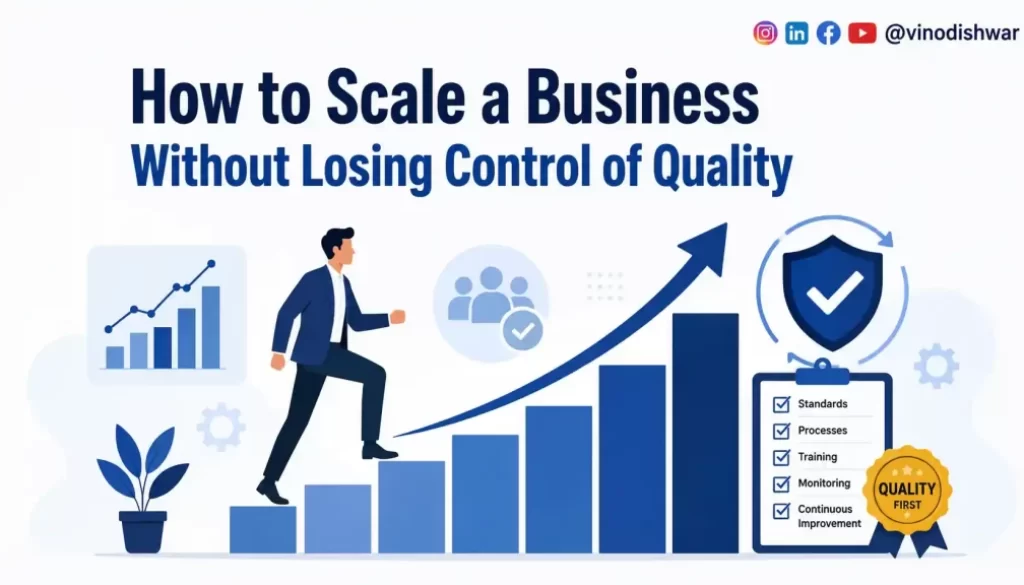
How to Scale a Business Without Losing Control of Quality
Scaling a business without losing quality is one of the biggest challenges entrepreneurs face. As businesses grow, maintaining consistent customer experiences, product standards, and operational efficiency becomes more difficult. With the right systems, leadership, and planning, businesses can expand successfully while protecting the quality that drives long-term growth. A strong sustainable growth strategy helps businesses expand steadily without compromising quality or customer satisfaction.
There’s a particular kind of fear that hits successful founders right when things start going well: “If I grow this any further, will it still be as good?” It’s a legitimate concern. Most businesses that scale quickly do see quality slip — inconsistent customer service, longer wait times, product defects, a founder stretched too thin to catch problems personally anymore. But quality decline isn’t an inevitable cost of growth. It’s a symptom of scaling without the right systems in place.
Why Scaling a Business Without Losing Quality Is Challenging
In a small business, quality control often lives inside the founder’s head. They notice when something feels off, step in personally, and fix it before the customer notices. This works beautifully at a small scale and fails completely at a larger one — because the founder simply cannot be everywhere at once. The businesses that scale successfully are the ones that convert founder instinct into documented systems before they need to.
Strategies to Scale a Business Without Losing Quality
1. Document What “Good” Actually Looks Like
Before you can protect quality at scale, you need to define it precisely — not “great customer service” as a vague aspiration, but specific, observable standards: response times, product specifications, tone of communication, defect tolerances. Ambiguous standards can’t be enforced consistently across a growing team. Effective business transformation often begins with creating standardized systems that support long-term growth.
2. Build Quality Checkpoints Into the Process, Not After It
Rather than inspecting finished output for problems, build checks into each stage of the process — ingredient checks before cooking begins, code review before deployment, quality audits at each production step. Catching issues early is dramatically cheaper than catching them at the customer’s doorstep.
3. Hire for Judgment, Not Just Task Execution
As you scale, you can’t personally supervise every decision. Hiring and training people who understand why a standard exists — not just the mechanical steps to follow — means they can make good judgment calls in situations your SOPs didn’t anticipate.
4. Invest in Middle Management Earlier Than Feels Necessary
Many founders delay hiring supervisors and team leads to save costs, then find themselves personally firefighting quality issues across multiple locations or teams simultaneously. A strong middle management layer, even a lean one, protects quality far more cost-effectively than founder burnout does.
5. Use Data to Catch Problems Before Customers Do
Customer complaint trends, return rates, review sentiment, and internal audit scores are early indicators of quality drift. Reviewing these regularly — weekly, not quarterly — lets you intervene before small issues become reputational damage. Strong business automation tools also help maintain consistency by reducing manual errors across daily operations. Customer satisfaction can also be measured using the Net Promoter Score (NPS) framework.
6. Grow in Controlled Phases, Not All at Once
Rather than doubling capacity overnight, scale in stages that allow you to stress-test your systems at each new size before pushing further. A business that grows from 1 to 3 locations, stabilizes, and then grows from 3 to 8 builds far more resilient quality control than one that jumps from 1 to 10 in a single push. Every expansion should follow a clear retail expansion strategy to ensure systems can support long-term growth.
Mistakes to Avoid When You Scale a Business Without Losing Quality
- Hiring quickly without proper training pipelines, prioritizing headcount over capability.
- Removing the founder from quality oversight entirely, instead of transitioning that role deliberately to a trained team.
- Scaling supply chains faster than quality control can verify new vendors.
- Measuring growth purely by revenue, without tracking quality metrics in parallel.
- Assuming systems that worked at a small scale will automatically work at a larger one.
Real-World Example of Scaling a Business Without Losing Quality
Consider two regional retail chains expanding from 5 to 20 outlets over two years. One documents every process, trains a regional quality manager for every 5 outlets, and reviews customer feedback weekly. The other focuses purely on opening new locations as fast as possible, assuming staff will “figure it out” the way the founding team did. Two years later, the first chain has consistent reviews and repeat customers across all 20 locations; the second has a handful of strong original outlets and a cluster of newer ones with declining reputations — not because the concept was weak, but because growth outpaced quality systems.
Key Takeaways
- Quality decline during growth is a systems failure, not an inevitable trade-off.
- Documented, specific standards are far easier to protect at scale than vague aspirations.
- Middle management should be built ahead of urgent need, not in reaction to crisis.
- Data on complaints, returns, and reviews should be monitored weekly during growth phases.
- Controlled, staged expansion builds more resilient quality systems than rapid, uncontrolled growth.
Conclusion
Scaling a business doesn’t have to mean compromising the quality that built your reputation in the first place. With the right systems, training, and phased approach, growth and quality can reinforce each other rather than compete. Building a memorable brand depends on maintaining consistent quality as your business grows.
-Vinod Ishwar
Frequently Asked Questions
How can you scale a business without losing quality?
By creating standard operating procedures, training employees, monitoring quality metrics, and expanding in controlled phases.
Why does quality often decline during business growth?
Quality declines when businesses grow faster than their systems, processes, staffing, and quality control measures can support.
What are the biggest mistakes businesses make while scaling?
Common mistakes include hiring too quickly, ignoring employee training, lacking documented processes, and focusing only on revenue growth.
Why are standard operating procedures (SOPs) important?
SOPs help teams deliver consistent products and services, ensuring quality remains the same as the business expands.
How often should quality metrics be reviewed?
Businesses should review customer feedback, complaints, returns, and operational performance every week during periods of rapid growth.