Franchise Disclosure Document (FDD) Guide: Everything You Need to Know Before Franchising Your Business (2026)
Franchise Disclosure Document Guide is an essential resource for businesses planning to franchise. A Franchise Disclosure Document (FDD) helps prospective franchisees understand the legal, financial, and operational aspects of a franchise opportunity before signing an agreement. This Franchise Disclosure Document Guide explains what an FDD is, when it is required, what it typically contains, and how it supports transparent and compliant franchise development.
Transparency is one of the most important foundations of a successful franchise relationship. Before a prospective franchisee invests in a franchise, they should understand the business, its financial commitments, legal obligations, operational expectations, and potential risks.
In several countries, franchisors are legally required to provide this information through a Franchise Disclosure Document (FDD) or an equivalent disclosure document.
An FDD helps prospective franchisees make informed decisions while promoting trust and reducing misunderstandings between franchisors and franchisees.
If you’re planning to franchise your business, it’s essential to understand when disclosure documents are required, what they typically contain, and how they fit into the overall franchise development process.
This guide explains the purpose of an FDD, its common sections, legal considerations, and best practices for preparing disclosure documentation.
Important: Franchise disclosure requirements vary significantly by country and jurisdiction. Some countries require an FDD by law, while others do not. Always seek advice from a qualified franchise lawyer regarding the legal requirements applicable to your business.
What is a Franchise Disclosure Document (FDD)?
A Franchise Disclosure Document (FDD) is a legal disclosure document that provides prospective franchisees with detailed information about a franchise opportunity before they sign a franchise agreement or make certain payments.
The purpose of the FDD is to promote transparency by disclosing important business, financial, legal, and operational information.
Depending on the jurisdiction, disclosure documents may be mandatory, optional, or governed by different legal frameworks. Before preparing an FDD, businesses should first understand the Business Process Documentation Guide.
Franchise Disclosure Document Guide: Why It Matters Before Franchising
A properly prepared disclosure document helps:
- Promote transparency
- Build investor confidence
- Reduce misunderstandings
- Explain franchise obligations
- Improve decision-making
- Support regulatory compliance (where required)
- Protect both franchisor and franchisee
- Strengthen long-term franchise relationships
Disclosure documents are designed to help prospective franchisees evaluate opportunities more effectively.
Is an FDD Required Everywhere?
No.
Franchise disclosure laws vary around the world.
For example:
- Some countries require franchisors to provide a disclosure document before selling franchises.
- Some jurisdictions regulate the timing and content of disclosures.
- Other countries have no specific franchise disclosure legislation.
Businesses expanding internationally should ensure they comply with the franchise laws of each country where they offer franchises.
Always consult a qualified franchise lawyer before preparing or issuing disclosure documents.
Typical Information Included in an FDD
Although requirements vary by jurisdiction, an FDD commonly includes information such as:
1. Company Background
This section typically describes:
- Business history
- Company structure
- Brand overview
- Management experience
It helps prospective franchisees understand the franchisor.
2. Business Experience
Provide information about key executives and management.
This may include:
- Leadership experience
- Industry expertise
- Business background
- Franchise experience
3. Litigation History
Where required, disclosure may include relevant information regarding certain legal proceedings involving the franchisor or key individuals.
Disclosure obligations depend on the applicable law.
4. Financial Information
This section may describe:
- Initial investment estimates
- Initial franchise fee
- Royalty structure
- Marketing contributions
- Other recurring fees
Prospective franchisees should understand the financial commitments involved.
5. Estimated Initial Investment
Provide a reasonable estimate of startup costs, which may include:
- Franchise fee
- Equipment
- Interior fit-out
- Inventory
- Licenses
- Working capital
- Professional fees
Use reasonable estimates supported by available information.
6. Franchisee Obligations
Explain the responsibilities of franchisees, including:
- Operating the business
- Following SOPs
- Meeting quality standards
- Reporting financial information
- Participating in training
- Complying with brand guidelines
7. Franchisor Support
Describe the support provided, such as:
- Initial training
- Site selection assistance
- Marketing support
- Technology systems
- Operational guidance
- Ongoing business support
8. Territory Rights
Clarify:
- Exclusive territories
- Protected territories
- Non-exclusive territories
- Expansion policies
Transparency helps prevent future disputes.
9. Intellectual Property
Describe the franchisor’s intellectual property, including:
- Registered trademarks
- Logos
- Copyrights
- Brand assets
Also explain how franchisees may use those assets.
10. Renewal, Transfer, and Termination
Summarize the circumstances relating to:
- Renewal
- Assignment or transfer
- Termination
- Expiration
These provisions are generally explained in more detail within the Franchise Agreement.
11. Financial Statements
Where required by law, disclosure documents may include financial statements prepared in accordance with applicable accounting and legal requirements.
12. Franchise Agreement
Many disclosure packages include or reference the proposed Franchise Agreement that the prospective franchisee will be asked to sign.
Step-by-Step Process for Preparing an FDD
Step 1: Understand Legal Requirements
Determine whether franchise disclosure laws apply in your target market.
Requirements differ significantly between jurisdictions.
Step 2: Organize Business Information
Collect:
- Company information
- Financial information
- Legal documentation
- Operational manuals
- Intellectual property records
Step 3: Prepare Disclosure Content
Develop clear and accurate disclosures supported by appropriate documentation.
Avoid exaggerated claims or unsupported financial representations.
Step 4: Coordinate with Legal Counsel
Have the disclosure document prepared or reviewed by a lawyer experienced in franchise law.
Step 5: Verify Accuracy
Confirm that:
- Financial information is accurate
- Legal information is current
- Brand information is consistent
- Operational descriptions reflect actual practices
Step 6: Deliver the Disclosure
Provide the disclosure document in accordance with the timing and delivery requirements applicable in your jurisdiction.
Step 7: Maintain Records
Keep records of disclosure versions and delivery where legally required.
Step 8: Update Regularly
Review and update the disclosure document whenever there are material changes to:
- Business operations
- Financial information
- Legal matters
- Management
- Franchise system
Franchise Disclosure Document Guide Checklist
Before offering franchises, ensure you have:
- Company profile
- Trademark documentation
- Financial information
- Franchise Agreement
- Operations Manual
- SOP documentation
- Territory policy
- Support program details
- Investment estimates
- Legal review completed
Practical Example
A growing café brand planned international franchise expansion.
Before entering markets with franchise disclosure laws, the company:
- Prepared disclosure documentation
- Updated financial records
- Registered trademarks
- Finalized the Franchise Agreement
- Created an Operations Manual
- Standardized SOPs
- Reviewed all materials with franchise legal counsel
This preparation improved investor confidence and supported compliant market entry.
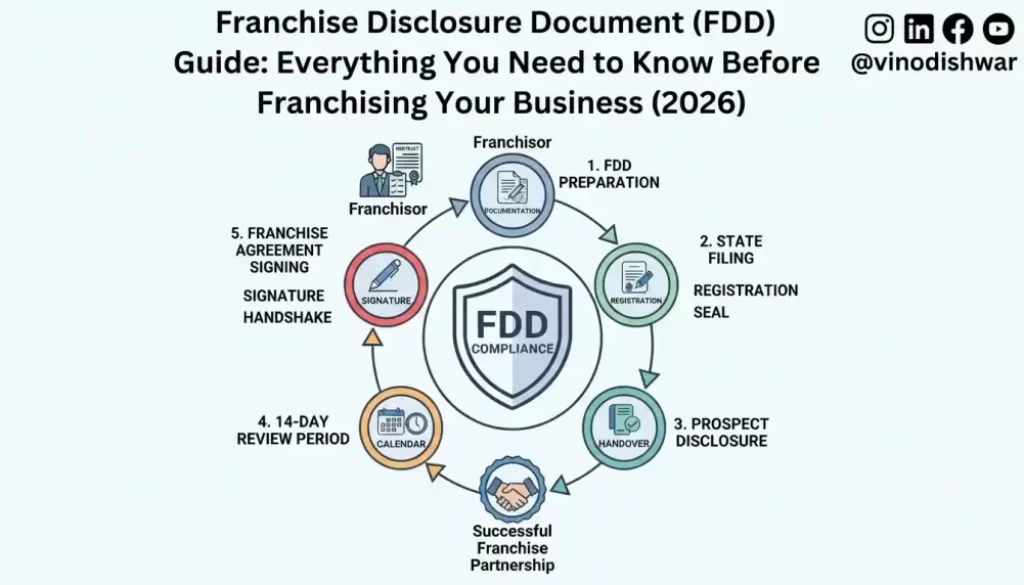
Franchise Disclosure Framework
Business Information
        │
        ▼
Legal Documentation
        │
        ▼
Financial Information
        │
        ▼
Operations Manual
        │
        ▼
Franchise Agreement
        │
        ▼
Disclosure Document
        │
        ▼
Legal Review
        │
        ▼
Franchisee Evaluation
        │
        ▼
Franchise Agreement Execution
        │
        ▼
Successful Franchise Launch
Common Disclosure Mistakes
Avoid these common mistakes:
- Assuming an FDD is required in every country
- Providing outdated financial information
- Making unrealistic earnings claims
- Omitting important legal information
- Using copied disclosure documents
- Failing to update disclosures
- Not obtaining legal review
- Delivering disclosures outside required timelines
Accurate, current, and jurisdiction-specific disclosure documents are essential.
How Franchise Development Consultants Help
Professional franchise development consultants assist businesses by:
- Assessing franchise readiness
- Organizing operational documentation
- Preparing Operations Manuals
- Developing SOPs
- Coordinating with qualified franchise lawyers
- Structuring franchise systems
- Supporting disclosure preparation
- Preparing businesses for compliant franchise expansion
Legal disclosure documents should always be prepared or reviewed by legal professionals familiar with the applicable laws.
Why Choose Franchise Alpha?
At Franchise Alpha, we help businesses build franchise-ready systems through our proprietary SOLEMN® Framework, ensuring that operational documentation, franchise structures, and legal readiness support sustainable expansion.
Strategy
Develop a scalable franchise model and expansion roadmap.
Operations
Create Operations Manuals, SOPs, and standardized business systems.
Legal
Coordinate with qualified legal professionals to support franchise documentation and disclosure readiness.
Entrust
Develop governance systems that improve transparency and accountability.
Marketing
Standardize brand communication and franchise sales materials.
Nitty-Gritty
Implement compliance processes, operational audits, and documentation management.
Frequently Asked Questions
What is a Franchise Disclosure Document?
A Franchise Disclosure Document (FDD) is a legal disclosure document that provides prospective franchisees with information about a franchise opportunity before entering into a franchise relationship where required by applicable law.
Is an FDD required in every country?
No. Franchise disclosure requirements differ by jurisdiction. Some countries require disclosure documents, while others do not have specific franchise disclosure legislation.
What information is usually included in an FDD?
Typical topics include company background, management experience, franchise fees, estimated investment, franchisee obligations, franchisor support, territory rights, intellectual property, legal information, and financial statements where required.
Who should prepare an FDD?
An FDD should be prepared or reviewed by a qualified lawyer experienced in franchise law and tailored to the legal requirements of the applicable jurisdiction.
Conclusion
A Franchise Disclosure Document promotes transparency, supports informed investment decisions, and strengthens trust between franchisors and franchisees.
However, disclosure requirements vary widely across jurisdictions. Businesses should never assume that one disclosure document works everywhere.
By working with experienced franchise consultants and qualified legal professionals, businesses can build compliant franchise systems that support sustainable domestic and international expansion.
Call to Action
Ready to Prepare Your Franchise Documentation?
Book a Franchise Readiness Assessment with Vinod Ishwar and discover how to prepare your business for franchise expansion with structured documentation and legal readiness.
Your assessment includes:
- Franchise Documentation Review
- Operational Documentation Assessment
- Disclosure Readiness Evaluation
- Intellectual Property Review
- Customized Franchise Compliance Roadmap
Build a transparent, compliant, and scalable franchise system with confidence.