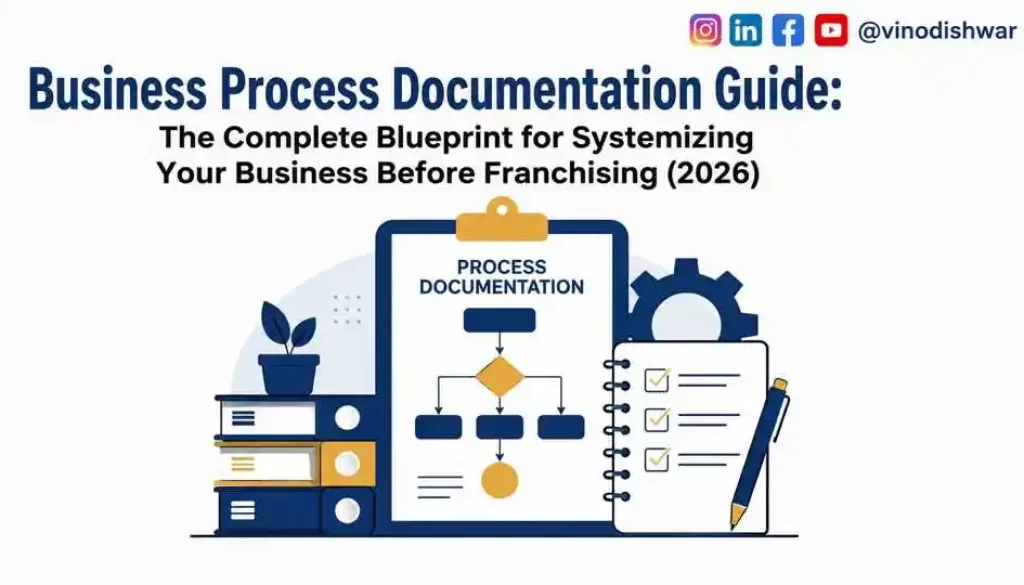
Business Process Documentation Guide: The Complete Blueprint for Systemizing Your Business Before Franchising (2026)
Business Process Documentation Guide is one of the most important resources for businesses preparing for franchise expansion. A comprehensive Business Process Documentation Guide helps standardize workflows, create repeatable systems, reduce founder dependency, and ensure every franchise location operates consistently. Without proper documentation, scaling a business becomes difficult and operational inconsistencies increase.
Every successful franchise business is built on one critical asset that customers never see—business process documentation. Before documenting processes, businesses should first understand Franchise Readiness Assessment.
While great products, strong branding, and effective marketing attract customers, documented business processes ensure every franchise outlet delivers the same experience, quality, and operational efficiency.
Many businesses operate successfully because experienced founders and employees know exactly what to do. However, when expansion begins, undocumented knowledge becomes a major obstacle. Different teams perform tasks differently, customer experiences become inconsistent, training becomes difficult, and operational mistakes increase.
Business process documentation solves these challenges by transforming knowledge into structured systems that anyone can follow.
Whether you own a restaurant, café, retail store, salon, preschool, healthcare clinic, fitness center, cloud kitchen, manufacturing company, or service business, documenting your processes is one of the most important steps before franchise expansion.
This guide explains what business process documentation is, why it matters, how to create it, and how it supports sustainable franchise growth.
What is Business Process Documentation?
Business process documentation is the structured recording of every recurring activity performed within a business.
It explains:
- What needs to be done
- Who performs the task
- When the task should occur
- How it should be completed
- Tools required
- Expected quality standards
- Performance measurements
The objective is to create repeatable processes that produce consistent business results.
Why Every Business Needs a Business Process Documentation Guide
Proper documentation helps businesses:
- Standardize operations
- Reduce operational errors
- Simplify employee training
- Improve franchisee onboarding
- Reduce founder dependency
- Increase efficiency
- Improve compliance
- Support scalable franchise growth
Without documented processes, businesses become dependent on individuals instead of systems.
Benefits of Documenting Business Processes
Well-documented processes provide:
- Operational consistency
- Faster employee onboarding
- Better quality control
- Improved accountability
- Easier delegation
- Faster decision-making
- Greater business scalability
- Higher franchisee success rates
Documentation converts experience into organizational knowledge. Read our guide on Building Operational Excellence for Franchising.
Types of Business Processes to Document
1. Operational Processes
Document day-to-day operational activities such as:
- Opening procedures
- Closing procedures
- Equipment maintenance
- Cleaning schedules
- Inventory management
- Cash handling
These processes ensure every outlet operates consistently.
2. Customer Service Processes
Standardize customer interactions.
Include:
- Greeting customers
- Complaint resolution
- Service standards
- Feedback collection
- Loyalty program management
- Customer follow-up
Consistency improves customer satisfaction.
3. Sales Processes
Document every stage of the sales journey.
Include:
- Lead generation
- Customer qualification
- Product demonstrations
- Quotation process
- Payment collection
- After-sales service
A standardized sales process improves conversion rates.
4. Human Resource Processes
Document workforce management activities.
Include:
- Recruitment
- Employee onboarding
- Training
- Attendance
- Performance reviews
- Exit procedures
HR documentation creates consistent employee experiences.
5. Marketing Processes
Create repeatable marketing workflows.
Document:
- Campaign planning
- Social media management
- Email marketing
- Local promotions
- Brand approvals
- Advertising guidelines
Marketing documentation protects brand consistency.
6. Financial Processes
Document financial operations.
Include:
- Daily reporting
- Cash reconciliation
- Expense approvals
- Budget planning
- Royalty calculations
- Financial audits
Financial documentation improves transparency.
7. Procurement Processes
Standardize purchasing activities.
Document:
- Vendor selection
- Purchase requests
- Inventory ordering
- Goods receiving
- Invoice approvals
- Supplier evaluation
Consistent procurement improves cost control.
8. Quality Assurance Processes
Protect operational excellence through documented quality procedures.
Include:
- Internal audits
- Compliance inspections
- Product quality checks
- Customer satisfaction surveys
- Corrective actions
Quality documentation maintains brand reputation.
How to Create a Business Process Documentation Guide
Step 1: Identify Core Processes
List every recurring activity within the business.
Examples include:
- Sales
- Operations
- Customer service
- Finance
- Marketing
- Inventory
- HR
- Compliance
Prioritize processes that directly impact customer experience. Learn how Creating Repeatable Business Systems supports process standardization before franchising.
Step 2: Map Each Workflow
Break every process into sequential steps.
Identify:
- Inputs
- Activities
- Decision points
- Outputs
- Responsible roles
Workflow mapping helps eliminate inefficiencies.
Step 3: Interview Subject Matter Experts
Gather knowledge from:
- Founders
- Managers
- Employees
- Department heads
- Experienced operators
Capture practical knowledge before documenting procedures.
Step 4: Create Process Documentation
Each document should include:
- Process title
- Purpose
- Scope
- Responsible department
- Required resources
- Step-by-step workflow
- Quality standards
- Performance metrics
- Related SOPs
Use clear, action-oriented language.
Step 5: Develop Standard Operating Procedures (SOPs)
Convert documented workflows into detailed SOPs.
Every SOP should explain:
- What to do
- How to do it
- Who performs the task
- Expected results
SOPs become the operational standard for franchisees.
Step 6: Add Visual Documentation
Support written instructions with:
- Flowcharts
- Checklists
- Screenshots
- Process diagrams
- Decision trees
- Photos
Visuals improve understanding and reduce training time.
Step 7: Validate the Process
Test documentation with employees unfamiliar with the process.
If they can complete the task successfully without additional guidance, the documentation is effective.
Step 8: Review and Improve
Business processes evolve continuously.
Review documentation annually or whenever:
- Technology changes
- Regulations change
- Products change
- Customer expectations change
- Operational improvements occur
Continuous improvement keeps documentation relevant.
Business Process Documentation Template
Every process document should include:
| Section | Description |
|---|---|
| Process Name | Title of the process |
| Objective | Purpose of the activity |
| Scope | Departments involved |
| Process Owner | Responsible role |
| Inputs | Resources required |
| Workflow Steps | Sequential activities |
| Decision Points | Approval stages |
| Outputs | Expected results |
| KPIs | Performance indicators |
| Related SOPs | Supporting documents |
Business Process Documentation Checklist
Before franchising, confirm you have documented:
- Daily operations
- Customer service
- Sales workflows
- Marketing activities
- HR procedures
- Financial reporting
- Procurement systems
- Technology usage
- Quality assurance
- Compliance requirements
Practical Example
A fast-growing bakery chain wanted to expand through franchising.
Initially, recipes, inventory ordering, staff scheduling, and customer service depended on experienced employees.
The company documented:
- 180 operational processes
- 320 SOPs
- Franchise Operations Manual
- Employee training modules
- Inventory workflows
- Quality assurance checklists
When new franchisees joined, onboarding time reduced significantly, operational consistency improved, and every outlet delivered the same customer experience.
Business Process Documentation Framework
Business Activities
        │
        ▼
Process Identification
        │
        ▼
Workflow Mapping
        │
        ▼
Process Documentation
        │
        ▼
Standard Operating Procedures
        │
        ▼
Operations Manual
        │
        ▼
Training Programs
        │
        ▼
Technology Integration
        │
        ▼
Performance Measurement
        │
        ▼
Continuous Improvement
        │
        ▼
Scalable Franchise Operations
Common Documentation Mistakes
Avoid these common mistakes:
- Relying on verbal instructions
- Documenting only major processes
- Using complex language
- Ignoring visual aids
- Failing to assign process ownership
- Not updating documentation
- Missing performance metrics
- Expanding before documentation is complete
Effective documentation should be practical, easy to follow, and regularly updated.
How Franchise Development Consultants Help
Professional franchise consultants support businesses by:
- Conducting process mapping workshops
- Documenting business workflows
- Developing SOPs
- Creating Franchise Operations Manuals
- Designing training systems
- Implementing quality standards
- Building KPI frameworks
- Preparing businesses for franchise expansion
Expert guidance ensures documentation supports long-term scalability. Professional franchise consultants help businesses document workflows, create SOPs, standardize operations, and prepare for franchise expansion. Learn more about Franchise Development Services.
Why Choose Franchise Alpha?
At Franchise Alpha, we help businesses document and standardize operations using our proprietary SOLEMN® Framework, creating franchise-ready systems that support sustainable growth.
Strategy
Identify critical business processes and develop a structured documentation roadmap.
Operations
Create SOPs, Operations Manuals, process maps, and workflow documentation.
Legal
Align operational documentation with franchise agreements and compliance requirements.
Entrust
Reduce founder dependency by converting business knowledge into documented systems.
Marketing
Develop standardized marketing workflows and brand execution processes.
Nitty-Gritty
Implement KPIs, reporting systems, operational audits, and continuous improvement programs.
Frequently Asked Questions
What is business process documentation?
Business process documentation is the structured recording of business workflows, procedures, responsibilities, and quality standards so tasks can be performed consistently.
Why is business process documentation important before franchising?
It helps standardize operations, simplify training, reduce founder dependency, improve franchisee performance, and ensure consistent customer experiences across all locations.
What is the difference between process documentation and an SOP?
Process documentation provides a high-level overview of how a workflow operates, while an SOP gives detailed step-by-step instructions for completing a specific task.
How often should business processes be updated?
Business processes should be reviewed at least once a year or whenever significant operational, regulatory, technological, or customer-related changes occur.
Conclusion
Business process documentation is the bridge between a successful local business and a scalable franchise system. Businesses should also explore Business Systems Required for Franchise Development before expanding.
By documenting workflows, creating SOPs, implementing technology, and continuously improving operations, businesses build repeatable systems that deliver consistent results across every location.
The strongest franchise brands are not built on memory—they are built on documented processes that anyone can follow.
Call to Action
Ready to Document Your Business Processes for Franchising?
Book a Franchise Readiness Assessment with Vinod Ishwar and discover how to transform your business knowledge into scalable operational systems.
Your assessment includes:
- Business Process Audit
- Workflow Mapping Review
- SOP Development Assessment
- Operations Manual Evaluation
- Customized Business Documentation Roadmap
Document your processes today to build a franchise-ready business for tomorrow.