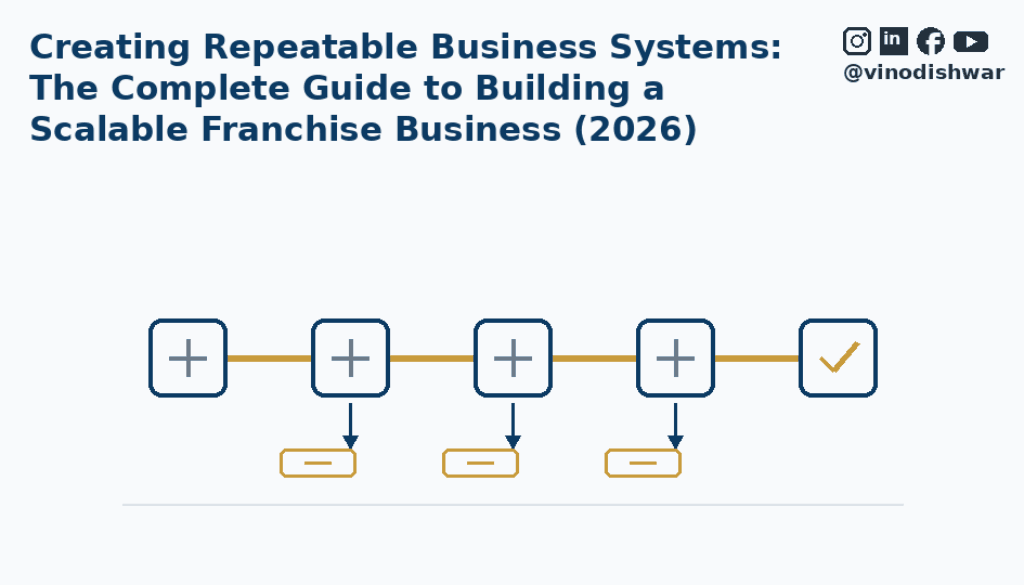
Creating Repeatable Business Systems: The Complete Guide to Building a Scalable Franchise Business (2026)
Creating Repeatable Business Systems is one of the most important steps before franchising a business. Creating Repeatable Business Systems enables companies to deliver consistent customer experiences, standardized operations, and scalable growth across multiple franchise locations. Without Creating Repeatable Business Systems, businesses often struggle to maintain quality, efficiency, and profitability as they expand.
One of the biggest differences between a successful local business and a successful franchise brand is the ability to repeat success consistently across every location. Before creating repeatable business systems, businesses should first understand the fundamentals of franchise development and assess whether they are ready to scale.
Many entrepreneurs believe that having a profitable business is enough to franchise. In reality, profitability alone is not sufficient. A franchise business must be able to deliver the same customer experience, operational efficiency, product quality, and financial performance—whether it operates one outlet or one hundred.
This consistency is only possible through repeatable business systems.
Repeatable business systems transform a founder-driven business into a process-driven organization. They reduce dependency on individuals, improve operational efficiency, simplify employee training, and enable franchisees to replicate success using proven methods.
Whether you own a restaurant, café, retail store, salon, preschool, healthcare clinic, fitness center, cloud kitchen, manufacturing company, or service business, creating repeatable systems is one of the most important steps before franchising.
This guide explains what repeatable business systems are, why they matter, how to build them, and how they support long-term franchise success.
Why Creating Repeatable Business Systems Matters
Repeatable business systems are documented processes, standardized workflows, operational procedures, and technology-enabled frameworks that allow a business to produce consistent results regardless of who performs the work or where the business operates.
Instead of relying on individual knowledge or founder involvement, repeatable systems ensure that every task follows a defined process.
Examples include:
- Customer service workflows
- Sales processes
- Inventory management
- Employee onboarding
- Marketing campaigns
- Financial reporting
- Quality assurance
- Vendor management
These systems create predictable outcomes and make business growth easier to manage.
Why Repeatable Business Systems Matter
Businesses with repeatable systems can:
- Deliver consistent customer experiences
- Reduce operational errors
- Improve employee productivity
- Simplify franchisee onboarding
- Scale faster across multiple locations
- Reduce founder dependency
- Improve profitability
- Maintain brand standards
Without repeatable systems, expansion often results in inconsistency and operational inefficiency.
Characteristics of a Repeatable Business System
An effective business system should be:
- Documented
- Easy to understand
- Measurable
- Repeatable
- Scalable
- Technology-enabled
- Continuously improved
- Accessible to employees and franchisees
If a process cannot be taught easily, it is not yet systemized.
Essential Repeatable Business Systems
1. Customer Experience System
Document every customer interaction.
Include:
- Greeting customers
- Service standards
- Complaint handling
- Feedback collection
- Loyalty programs
- Follow-up communication
Consistent customer experiences strengthen brand loyalty.
2. Sales System
Standardize the sales journey.
Include:
- Lead qualification
- Customer consultation
- Product presentation
- Closing techniques
- Payment process
- Post-sale engagement
A repeatable sales process improves conversion rates.
3. Operations System
Document daily operational activities.
Include:
- Opening procedures
- Closing procedures
- Equipment maintenance
- Inventory management
- Cash handling
- Cleaning schedules
Operational consistency improves efficiency.
4. Human Resources System
Standardize employee management.
Document:
- Recruitment
- Hiring
- Onboarding
- Performance reviews
- Employee training
- Exit procedures
Strong HR systems improve workforce consistency.
5. Marketing System
Develop repeatable marketing workflows.
Include:
- Campaign planning
- Social media posting
- Digital advertising
- Local promotions
- Email marketing
- Lead nurturing
Centralized marketing supports franchise growth.
6. Financial Management System
Standardize financial reporting.
Include:
- Daily sales reports
- Expense approvals
- Cash reconciliation
- Budget planning
- Profit & Loss reporting
- Royalty calculations
Financial systems improve business visibility.
7. Quality Assurance System
Maintain operational excellence through:
- Operational audits
- Mystery shopping
- Customer satisfaction surveys
- Compliance inspections
- Corrective action plans
Quality systems protect brand reputation.
8. Technology System
Use technology to automate repetitive tasks.
Examples include:
- CRM
- ERP
- POS
- Inventory software
- Learning Management System (LMS)
- Business Intelligence dashboards
Automation reduces manual errors and increases efficiency.
Steps for Creating Repeatable Business Systems
Step 1: Identify Core Business Processes
List every activity required to operate your business.
Focus on:
- Sales
- Operations
- Marketing
- Finance
- Customer service
- HR
- Inventory
- Compliance
Step 2: Map Each Workflow
Break every process into clear, sequential steps.
Use process maps or flowcharts to identify bottlenecks and improve efficiency.
Step 3: Develop Standard Operating Procedures (SOPs)
Convert each workflow into detailed SOPs.
Every SOP should include:
- Purpose
- Scope
- Responsibilities
- Step-by-step instructions
- Quality standards
- Safety guidelines
- Performance metrics
Step 4: Create an Operations Manual
Organize SOPs into a comprehensive Franchise Operations Manual.
This manual becomes the primary reference for franchisees and employees. A comprehensive operations manual is one of the most important documents developed during the franchise development process.
Step 5: Train Your Team
Introduce standardized systems through:
- Classroom sessions
- Hands-on demonstrations
- E-learning modules
- Assessments
- Certification programs
Training ensures consistent execution.
Step 6: Implement Technology
Use digital tools to automate repetitive activities.
Examples include:
- CRM for customer management
- POS for sales tracking
- ERP for resource planning
- LMS for training
- BI dashboards for reporting
Technology strengthens system reliability.
Step 7: Measure Performance
Track Key Performance Indicators (KPIs) such as:
- Sales growth
- Customer satisfaction
- Employee productivity
- Operational compliance
- Inventory accuracy
- Profit margins
Performance measurement enables continuous improvement.
Step 8: Review and Improve
Business systems should evolve as the business grows.
Review systems regularly based on:
- Customer feedback
- Operational audits
- Technology updates
- Regulatory changes
- Franchisee feedback
Continuous improvement keeps systems effective.
Repeatable Business Systems Checklist
Before franchising, confirm you have:
- Documented business processes
- Standard Operating Procedures
- Franchise Operations Manual
- Employee training program
- Customer service standards
- Marketing workflows
- Financial reporting system
- Technology platforms
- KPI dashboard
- Quality assurance program
Practical Example
A premium retail brand planned to expand nationally.
Initially, every store manager followed different inventory practices, customer service varied, and financial reports lacked consistency.
The company created:
- 300+ SOPs
- Franchise Operations Manual
- CRM integration
- POS standardization
- LMS for employee training
- Monthly quality audits
- KPI dashboards
Within 24 months, the business expanded to multiple cities while maintaining consistent customer experiences and operational efficiency across all locations.
Repeatable Business Systems Framework
Business Knowledge
        │
        ▼
Process Mapping
        │
        ▼
Workflow Documentation
        │
        ▼
Standard Operating Procedures
        │
        ▼
Operations Manual
        │
        ▼
Training Systems
        │
        ▼
Technology Integration
        │
        ▼
Performance Monitoring
        │
        ▼
Continuous Improvement
        │
        ▼
Scalable Franchise Business
Common Mistakes
Avoid these common mistakes:
- Expanding without documented processes
- Relying on founder knowledge
- Ignoring employee training
- Using inconsistent workflows
- Delaying technology implementation
- Failing to monitor KPIs
- Not updating SOPs
- Weak quality control systems
A repeatable system should be simple, measurable, and continuously improved.
How Franchise Development Consultants Help
Professional franchise consultants assist businesses by:
- Mapping business processes
- Developing SOPs
- Creating Franchise Operations Manuals
- Designing repeatable workflows
- Implementing technology systems
- Standardizing training
- Building KPI dashboards
- Preparing businesses for franchise expansion
Expert support reduces operational risk and accelerates franchise readiness.
Why Choose Franchise Alpha?
At Franchise Alpha, we help businesses create repeatable business systems using our proprietary SOLEMN® Framework, enabling scalable and sustainable franchise growth.
Strategy
Develop scalable operational systems aligned with your business goals.
Operations
Create SOPs, Operations Manuals, workflow documentation, and standardized processes.
Legal
Ensure systems support franchise agreements and regulatory compliance.
Entrust
Reduce founder dependency by documenting knowledge and empowering leadership teams.
Marketing
Build repeatable marketing systems for consistent brand execution across all locations.
Nitty-Gritty
Implement KPIs, quality audits, reporting dashboards, and continuous improvement systems.
Frequently Asked Questions
What are repeatable business systems?
Repeatable business systems are documented processes and standardized workflows that allow businesses to deliver consistent results across multiple locations without relying on individual employees or founders. Learn how to build scalable operational processes in our guide on Operations & Systemization.
Why are repeatable systems important before franchising?
They ensure operational consistency, simplify training, improve franchisee success, reduce founder dependency, and support scalable business growth.
What should a repeatable business system include?
A complete system should include documented workflows, SOPs, training materials, technology platforms, quality standards, KPIs, and continuous improvement processes.
Can small businesses create repeatable systems?
Yes. Small businesses should develop repeatable systems before franchising to build a scalable and sustainable business model.
Conclusion
Creating repeatable business systems is one of the most important investments a business can make before franchising.
Documented processes, standardized workflows, employee training, technology integration, and performance monitoring create a business that can grow consistently without depending on individual expertise.
The most successful franchise brands are not built on exceptional founders—they are built on exceptional systems.
Call to Action
Ready to Build Repeatable Business Systems?
Book a Franchise Readiness Assessment with Vinod Ishwar and discover how to transform your business into a scalable franchise model.
Your assessment includes:
- Business Systems Audit
- Process Mapping Review
- SOP Development Assessment
- Operations Manual Evaluation
- Customized Business Systemization Roadmap
Create systems that enable your business to grow consistently, profitably, and independently.