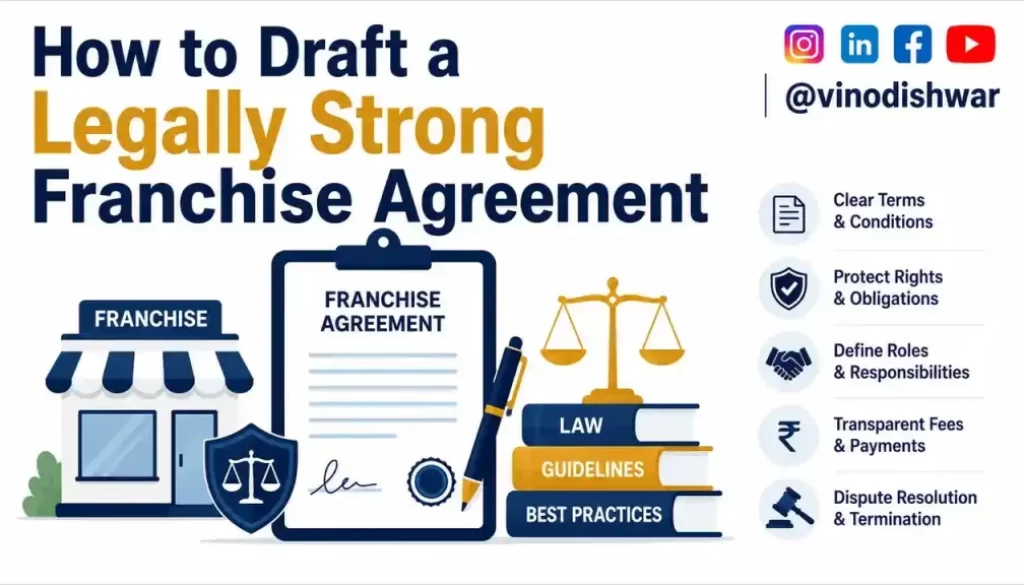
How to Draft a Legally Strong Franchise Agreement
Franchise agreement drafting is one of the most important steps when preparing a business for franchise expansion. A legally strong franchise agreement defines the relationship between the franchisor and franchisee, including franchise rights, territory, fees, intellectual property, operating standards, support, compliance, termination, and dispute resolution.
It establishes the contractual relationship between the franchisor and franchisee and defines the rights, responsibilities, financial obligations, operating standards, intellectual-property permissions, support commitments, compliance requirements, and exit conditions that govern the relationship.
A legally strong franchise agreement is not simply a long document filled with legal language. It should be clear, commercially practical, internally consistent, enforceable to the extent permitted by applicable law, and aligned with the actual franchise model.
For businesses expanding in India, drafting requires particular attention to contract law, intellectual property, competition law, taxation, consumer protection, data protection, employment matters, and industry-specific regulations.
The Indian Contract Act, 1872 provides the general statutory framework for contracts in India. Other laws may apply depending on the structure and activities of the franchise.
What Makes a Franchise Agreement Legally Strong?
A strong franchise agreement should accomplish five things:
1. Define Rights
It should clearly establish what the franchisee is permitted to do.
2. Define Obligations
Both parties should understand what they are required to do.
3. Allocate Risk
The agreement should identify who is responsible for different risks.
4. Protect the Franchise System
Brand, intellectual property, confidential information, operating standards, and business systems should receive appropriate protection.
5. Establish an Exit Mechanism
The agreement should clearly explain what happens when the relationship expires, is terminated, or is transferred.
A useful principle is:
If an important commercial expectation is not clearly documented, it can become a future dispute.
Step 1: Understand the Franchise Business Model Before Drafting
Do not start by copying a franchise agreement template.
Start by documenting the actual business model.
Ask:
- What exactly is being franchised?
- What does the franchisee receive?
- What does the franchisor provide?
- What does the franchisee pay?
- How does the franchisor earn revenue?
- How much operational control is required?
- What intellectual property is involved?
- What territory is being granted?
- What support is promised?
- How is performance measured?
For example, a:
- Restaurant franchise
- Education franchise
- Healthcare franchise
- Retail franchise
- Salon franchise
- Fitness franchise
- Service franchise
may require substantially different contractual provisions.
Step 2: Identify the Parties Correctly
The agreement should accurately identify the parties.
Include:
- Legal name
- Entity type
- Registered address
- Business address
- Registration details where relevant
- Authorized signatory
- Notice details
If the franchisee is a company, LLP, partnership, or other entity, identify the actual legal entity entering the agreement.
Why It Matters
An agreement should clearly establish who is legally bound.
Step 3: Define Key Terms
A definitions section can eliminate ambiguity throughout the agreement.
Consider defining terms such as:
- Franchise
- Franchise Location
- Territory
- Brand
- Intellectual Property
- Gross Sales
- Royalty
- Marketing Fund
- Confidential Information
- Operations Manual
- Approved Supplier
- Business Day
- Commencement Date
- Term
- Renewal Term
- Customer Data
For example, if royalty is calculated as a percentage of “Gross Sales,” the agreement should clearly explain exactly what Gross Sales means.
Step 4: Clearly Define the Grant of Franchise
The franchise grant should explain exactly what the franchisee is receiving.
It may include rights to:
- Operate a franchise outlet
- Use trademarks
- Use copyrighted material
- Access proprietary systems
- Sell approved products
- Provide approved services
- Use technology
- Access training
- Use the franchisor’s operating system
The agreement should also identify what the franchisee does not receive.
Step 5: Draft a Precise Territory Clause
Territory disputes are among the issues that can create serious friction in franchise networks.
The agreement should clearly define:
- Geographic boundaries
- Location
- Exclusive territory
- Protected territory
- Non-exclusive territory
- Radius
- Pin codes
- Delivery area
- Online sales
- E-commerce
- Digital leads
- Marketplace sales
Avoid vague language such as:
“The franchisee will receive an exclusive area around the outlet.”
Instead, define the territory objectively.
Step 6: Define Exclusivity Carefully
If exclusivity is offered, explain exactly what it means.
For example:
Does exclusivity prevent the franchisor from:
- Opening another physical outlet?
- Appointing another franchisee?
- Selling products online?
- Selling through marketplaces?
- Serving customers from outside the territory?
- Running corporate-owned locations?
- Accepting digital leads?
The word “exclusive” should never be left undefined.
Competition-law considerations should also be reviewed where territorial, exclusivity, supplier, or pricing restrictions are involved. The Competition Act, 2002 addresses certain vertical agreements and restraints subject to statutory conditions.
Step 7: Define the Agreement Term
The agreement should clearly establish:
- Effective date
- Initial term
- Commencement date
- Opening deadline
- Expiry date
- Renewal procedure
The term should make commercial sense relative to:
- Franchise investment
- Payback expectations
- Equipment life
- Lease duration
- Business model
Step 8: Draft Clear Renewal Conditions
The renewal clause should explain:
- Renewal period
- Renewal fee
- Notice period
- Performance requirements
- Compliance requirements
- Renovation requirements
- Updated equipment requirements
- Updated agreement requirements
Avoid language that simply says:
“The agreement may be renewed by mutual consent.”
That may not provide enough commercial certainty.
Step 9: Clearly Document All Fees
A legally strong agreement should identify every material fee.
Potential fees include:
- Initial franchise fee
- Royalty
- Marketing fee
- Technology fee
- Training fee
- Renewal fee
- Transfer fee
- Audit-related charges
- Other agreed fees
For each fee, specify:
- Amount
- Calculation method
- Payment date
- Frequency
- Taxes
- Late-payment consequences
- Refundability, where applicable
Step 10: Define Royalty Calculations
Royalty clauses should be particularly precise.
If royalty is calculated as:
Percentage × Gross Sales
then define Gross Sales.
Clarify whether it includes or excludes:
- GST
- Refunds
- Discounts
- Cancellations
- Delivery charges
- Online marketplace sales
- Gift cards
- Promotional transactions
The more precise the calculation, the lower the potential for financial disputes.
Franchise Agreement: Franchisor vs Franchisee Perspective
A strong agreement should balance both sides.
Franchisor Needs
- Brand protection
- Operational consistency
- IP protection
- Reporting
- Audit rights
- Quality control
- Compliance
- Payment protection
- Termination rights
Franchisee Needs
- Clear territory
- Defined fees
- Support commitments
- Training
- Renewal clarity
- Transfer mechanism
- Fair operational expectations
- Defined performance requirements
- Clear termination procedures
The objective is not to create a document that is simply “franchisor-friendly.”
The objective is to create a clear, commercially workable agreement that reduces ambiguity and protects legitimate interests.
Franchise Agreement and Franchise Marketing Must Match
One often-overlooked issue is the relationship between the franchise agreement and franchise recruitment marketing.
Suppose marketing material says:
“Guaranteed exclusive territory.”
But the agreement does not actually provide defined exclusivity.
That creates a significant expectation gap.
Similarly, marketing materials should accurately represent:
- Investment
- Fees
- Royalties
- Support
- Training
- Territory
- Store formats
- Revenue claims
- Business opportunities
The commercial proposition communicated to prospects should be consistent with the contractual documents.
Franchise Agreement and Operations Manual Must Match
Another important principle is:
Contract ≠ SOP Manual
The franchise agreement establishes contractual obligations.
The operations manual establishes how the business should operate.
They should complement each other.
For example:
Agreement: Franchisee must comply with operating standards.
Operations Manual: Explains those operating standards.
This approach allows the franchise system to maintain operational consistency while keeping the legal agreement focused on the contractual relationship.
Should You Use a Franchise Agreement Template?
A template can be useful as a starting framework, but it should not automatically become the final contract.
A generic template may fail to account for:
- Indian law
- Business model
- Industry regulations
- Territory structure
- IP ownership
- Fee model
- Technology
- Data
- Supplier arrangements
- Franchisee support
- Local requirements
Better Approach
Use a structured template as a checklist, then have qualified legal counsel customize and review it.
How Franchise Alpha Approaches Franchise Agreement Readiness
At Franchise Alpha, franchise agreement preparation is best treated as part of a larger franchise-development system rather than an isolated legal document.
Strategy
Define:
- Franchise model
- Investment structure
- Territory
- Unit economics
- Franchise proposition
Operations
Develop:
- SOPs
- Operations manuals
- Training systems
- Quality-control processes
Legal Coordination
Coordinate the commercial requirements with qualified legal professionals for:
- Franchise agreement
- IP protection
- Compliance
- Contractual risk
- Regulatory requirements
Marketing
Ensure:
- Franchise marketing
- Sales presentations
- Lead-generation campaigns
- Investment communication
are aligned with the actual franchise proposition.
Technology
Implement:
- Franchise CRM
- Lead management
- Reporting
- Franchise portals
- Automation
- Digital Asset Management
This creates alignment between what the franchise sells, what the agreement promises, and how the franchise actually operates.
Frequently Asked Questions
How do I draft a franchise agreement?
Start by documenting the actual franchise business model, then define the parties, franchise grant, territory, term, fees, IP rights, operations, support, compliance, reporting, renewal, transfer, termination, dispute resolution, and other relevant provisions. The final agreement should be drafted or reviewed by qualified legal counsel.
What clauses should a franchise agreement contain?
Important clauses commonly include franchise rights, territory, term, renewal, fees, royalties, intellectual property, brand standards, operations, training, support, suppliers, marketing, confidentiality, data, compliance, reporting, audits, transfer, default, termination, indemnification, liability, and dispute resolution.
Can I draft a franchise agreement myself?
You can prepare a commercial outline or checklist, but a legally binding franchise agreement should generally be drafted or reviewed by a qualified lawyer familiar with the relevant Indian legal framework and the specific franchise model.
Is a franchise agreement legally required in India?
There is no single comprehensive Indian franchise statute that universally prescribes one standard franchise agreement for all franchise businesses. However, parties should carefully document their contractual relationship and comply with applicable laws. The appropriate structure depends on the particular business and transaction.
What makes a franchise agreement enforceable?
Enforceability depends on multiple factors, including valid contract formation, clear terms, lawful purpose, appropriate execution, applicable statutory requirements, and the circumstances of the particular dispute. A lawyer should review the agreement for the specific transaction.
Should the franchise agreement include the operations manual?
It can establish the franchisee’s obligation to comply with an operations manual and specify how the manual interacts with the agreement. The exact drafting structure should be determined based on the franchise system.
Can a franchise agreement be changed after signing?
It can potentially be amended according to the amendment mechanism in the agreement and applicable law. Material changes should be documented appropriately rather than relying on informal conversations.
How long should a franchise agreement be?
There is no ideal page count. The agreement should be sufficiently detailed to address the actual commercial and legal relationship without unnecessary duplication or ambiguity.
Should franchise agreements have non-compete clauses?
Restrictive covenants require careful legal review in India. Section 27 of the Indian Contract Act concerns agreements in restraint of trade, so a restriction should be evaluated based on its wording, timing, purpose, and circumstances rather than copied from a foreign template.
Conclusion
Learning how to draft a legally strong franchise agreement starts with understanding that the agreement is more than a legal formality.
It is the contractual foundation of the franchise system.
A strong agreement should clearly establish:
- What is being granted
- Where the franchisee can operate
- How much the franchisee pays
- How royalties are calculated
- How the brand can be used
- What operating standards apply
- What training and support are provided
- Who is responsible for compliance
- How information and data are handled
- How performance is monitored
- What happens on renewal, transfer, default, and termination
- How disputes are resolved
The most effective franchise agreements are created when strategy, operations, marketing, intellectual property, technology, compliance, and legal drafting are aligned. Visit Franchise Alpha and Webs Alpha
For Indian businesses, this alignment is particularly important because franchise arrangements can intersect with multiple areas of law rather than one dedicated franchise statute.
A template can provide structure. A lawyer can provide legal analysis. But the business itself must provide the commercial clarity about how the franchise is actually intended to work.
Build the business model first. Document it clearly. Then have the agreement professionally drafted and reviewed.
Call to Action
Need Help Structuring Your Franchise?
Before appointing franchisees, make sure your franchise model, commercial terms, territory, SOPs, brand system, marketing proposition, technology, and legal documentation are aligned.
Franchise Alpha helps businesses prepare for scalable franchise expansion through an integrated approach covering strategy, operations, franchise development, marketing, technology, and coordination with qualified legal professionals.
Book a Franchise Strategy & Agreement Readiness Session
Get clarity on:
- Franchise Model
- Franchise Agreement Requirements
- Territory Structure
- Fees & Royalties
- IP & Brand Protection
- SOP & Operations Manual
- Franchise Compliance
- Franchise Marketing
- Franchisee Recruitment
- Expansion Roadmap
Build the legal foundation before you scale the franchise network.