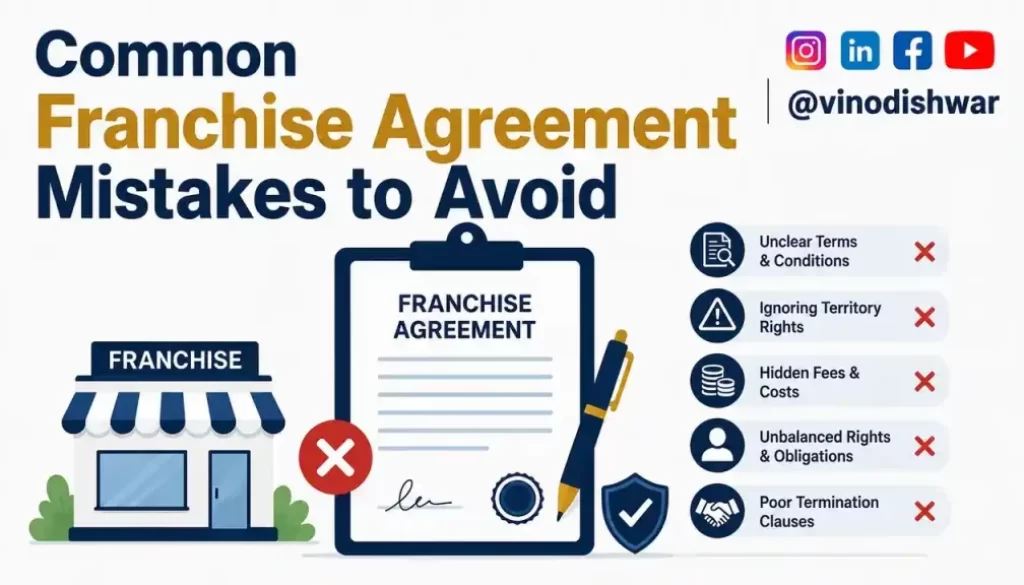
Common Franchise Agreement Mistakes to Avoid
Franchise agreement mistakes can create costly disputes between franchisors and franchisees. A franchise agreement is the legal foundation of the relationship, defining franchise rights, fees, territory, intellectual property, operational standards, support, compliance, and termination obligations.
It determines how the franchise operates, what rights the franchisee receives, what fees are payable, how the brand can be used, what support the franchisor provides, how performance is monitored, and what happens if the relationship ends.
Yet many franchise businesses make the mistake of treating the agreement as a standard document that can simply be copied from another franchise.
That approach can create serious problems.
A poorly drafted franchise agreement can lead to disputes over territory, royalties, intellectual property, operational control, marketing obligations, renewal, termination, supplier arrangements, confidentiality, data, and post-termination rights.
For Indian businesses, the contractual framework also needs to be considered alongside applicable laws, including the Indian Contract Act, 1872, intellectual-property laws, competition law, consumer protection requirements, data-protection requirements, taxation, and industry-specific regulations.
The Indian Contract Act provides the general legal framework for contracts in India, while other legislation may apply depending on the nature of the franchise relationship.
Why Franchise Agreement Mistakes Matter
A franchise agreement should reduce uncertainty.
A weak agreement can do the opposite.
For example:
Vague agreement:
“The franchisee will have an exclusive territory.”
Questions immediately arise:
- How large is the territory?
- Is exclusivity geographic?
- Does it include online sales?
- Can the franchisor open a corporate outlet?
- Can another franchisee deliver into the territory?
- What happens if the territory changes?
A legally strong agreement anticipates these questions and addresses them clearly.
10 Common Franchise Agreement Mistakes
Here are the most important mistakes franchisors and franchisees should watch for:
- Using a generic franchise agreement template
- Failing to define the franchise grant
- Creating vague territory provisions
- Not defining exclusivity
- Making fees and royalties unclear
- Weak intellectual-property protection
- Promising undefined support
- Failing to align the agreement with SOPs
- Ignoring digital and online rights
- Weak compliance provisions
- Overly broad restrictive covenants
- Poor default and cure provisions
- Weak termination and exit clauses
- Ignoring transfer and succession
- Failing to define dispute resolution
Let’s examine each one.
1. Using a Generic Franchise Agreement Template
This is one of the most common mistakes.
A template may look professional but still be completely unsuitable for a particular franchise.
For example, a restaurant franchise may require provisions dealing with:
- Food safety
- Approved ingredients
- Suppliers
- Hygiene
- Store design
- Delivery platforms
A consulting franchise may need very different provisions.
Why It Is a Problem
A generic agreement may:
- Use foreign legal concepts
- Reference laws that do not apply
- Contain inappropriate restrictions
- Ignore the actual business model
- Create contradictory obligations
Better Approach
Use a template as a structural checklist, not as the final contract.
2. Failing to Clearly Define the Franchise Grant
The agreement should clearly explain what the franchisee receives.
Does the franchisee have the right to:
- Operate one outlet?
- Operate multiple outlets?
- Use the trademark?
- Sell specific products?
- Provide specific services?
- Use proprietary software?
- Access the operations manual?
- Use marketing materials?
A vague franchise grant can create disagreements later.
Better Approach
Specify the exact rights being granted and the limitations attached to those rights.
3. Creating a Vague Territory Clause
Territory is one of the most commercially important elements of a franchise agreement.
Avoid wording such as:
“The franchisee will operate in Mumbai.”
Mumbai is not a sufficiently precise commercial territory for many franchise structures.
A territory may instead be defined through:
- Address
- Radius
- Pin codes
- Municipal boundaries
- Geographic coordinates
- Delivery radius
- Customer acquisition area
The appropriate method depends on the business model.
4. Not Defining Exclusivity
“Exclusive territory” can mean different things to different people.
Does it prevent:
- Another franchise outlet?
- Corporate-owned outlets?
- Online sales?
- E-commerce?
- Marketplace sales?
- Home delivery?
- Digital advertising?
- Customers outside the territory purchasing online?
If the agreement does not define these issues, disputes become more likely.
Competition-law implications should also be considered when an agreement contains territorial, exclusive-dealing, supplier, or other vertical restrictions.
5. Making Fees and Royalties Unclear
One of the easiest ways to create a franchise dispute is to make payment terms ambiguous.
The agreement should clearly define:
- Initial franchise fee
- Royalty
- Marketing contribution
- Technology fee
- Training fee
- Renewal fee
- Transfer fee
- Other applicable charges
If royalty is based on sales, define exactly what counts as sales.
For example:
Does Gross Sales include GST?
Are refunds deducted?
Are online orders included?
Are discounts included?
Are marketplace commissions deducted?
These details should not be left to interpretation.
6. Weak Intellectual-Property Protection
The brand may be the franchisor’s most valuable asset.
Yet some agreements treat intellectual property as a single sentence:
“The franchisee may use the franchisor’s trademark.”
That is rarely sufficient for a comprehensive franchise system.
The agreement may need to address:
- Trademarks
- Logos
- Copyright
- Designs
- Software
- Trade dress
- Proprietary materials
- Business methods
- Confidential information
The Trade Marks Act, 1999 should be considered when structuring trademark-related rights and protections in India.
7. Promising “Complete Support” Without Defining It
Franchise marketing often uses phrases such as:
“Complete business support.”
But what exactly does that mean?
Does it include:
- Site selection?
- Recruitment?
- Training?
- Marketing?
- Technology?
- Procurement?
- Operations?
- Opening support?
- Ongoing consulting?
If the agreement promises vague support, both parties may develop different expectations.
Better Approach
Turn broad promises into defined contractual obligations.
8. Failing to Align the Agreement With the Operations Manual
A franchise system typically has:
Franchise Agreement + Operations Manual + Brand Guidelines + Training System
A common mistake is allowing these documents to contradict one another.
For example:
Agreement: Franchisee may operate seven days a week.
Operations Manual: Franchise location must close every Sunday.
Which one controls?
The agreement should establish the hierarchy and relationship between documents.
9. Ignoring Digital and Online Rights
Modern franchise agreements need to consider more than physical outlets.
Digital issues may include:
- Website
- Domain
- Social media
- Google Business Profile
- Online ordering
- E-commerce
- Marketplaces
- CRM
- Digital advertising
- Customer databases
- WhatsApp communications
- Online reviews
For example, who owns the Instagram account created for a franchise location?
Who controls the Google Business Profile after termination?
Who owns customer data?
These questions should be addressed before a dispute arises.
10. Weak Compliance Provisions
The agreement should clearly allocate responsibility for compliance.
Depending on the industry, this could involve:
- GST
- Tax
- Employment
- Labour requirements
- Health and safety
- Food safety
- Local licences
- Advertising standards
- Consumer protection
- Data protection
- Industry-specific regulations
The Digital Personal Data Protection Act, 2023 may also become relevant where franchise operations involve processing digital personal data.
How Franchise Alpha Can Help
At Franchise Alpha, franchise agreement readiness is approached as part of the wider franchise-development process.
Our framework can help businesses align:
Franchise Strategy
- Franchise feasibility
- Business-model assessment
- Investment structure
- Territory strategy
- Unit economics
Franchise Operations
- SOP development
- Operations manuals
- Training
- Quality control
- Franchise support systems
Franchise Marketing
- Franchise positioning
- Recruitment campaigns
- Lead generation
- Franchise sales materials
- Digital marketing
Technology
- Franchise CRM
- Lead management
- Reporting
- Automation
- Franchise portals
Legal Coordination
Commercial requirements can be coordinated with qualified legal professionals for appropriate drafting and review of:
- Franchise agreements
- IP provisions
- Compliance requirements
- Risk allocation
- Dispute-resolution provisions
The goal is to ensure that the franchise promise, operating model, marketing communication and legal documentation tell the same story.
Frequently Asked Questions
What are the most common franchise agreement mistakes?
Common mistakes include using generic templates, vague territory definitions, unclear fees, weak IP provisions, undefined support obligations, poor termination clauses, inadequate confidentiality, missing digital provisions, unclear compliance responsibilities, and poorly drafted dispute-resolution mechanisms.
Can I use a standard franchise agreement template?
A template can provide a useful starting structure, but it should be customized to the actual franchise model and reviewed by qualified legal counsel before use.
What happens if the franchise agreement has vague territory terms?
Vague territory provisions can create disputes over exclusivity, competing locations, online sales, delivery areas, and customer acquisition. Territory should be defined as precisely as the business model requires.
Can franchise agreements contain non-compete clauses in India?
Restrictive covenants require careful legal analysis in India. Section 27 of the Indian Contract Act, 1872 addresses agreements in restraint of trade, so foreign franchise templates should not be copied without appropriate Indian legal review.
Should franchisees have a lawyer review the agreement?
Yes. Franchise agreements can involve significant financial, operational, IP, compliance, and long-term obligations. Independent legal review can help the franchisee understand the rights and risks before signing.
Should franchisors have their franchise agreement reviewed?
Yes. Legal review can help identify ambiguity, enforceability concerns, inconsistencies, IP risks, compliance issues, and gaps in termination or dispute-resolution provisions.
What should happen after a franchise agreement is terminated?
The agreement should clearly establish post-termination obligations, which may include stopping brand use, removing signage, returning confidential materials, deactivating systems, settling outstanding amounts, and other applicable exit requirements.
Can franchise agreements be updated?
Yes, depending on the amendment provisions and applicable law. Businesses should use appropriate written procedures for material changes and ensure that related manuals, policies, and commercial materials remain consistent.
Why should franchise marketing and franchise agreements match?
Because marketing materials can shape a franchise prospect’s expectations. Claims regarding territory, investment, support, returns, fees, or other benefits should be commercially accurate and consistent with the contractual framework.
Conclusion
Avoiding franchise agreement mistakes is not simply about making a contract longer.
It is about making the agreement clear, accurate, commercially realistic, and properly aligned with the actual franchise system.
The biggest mistakes often arise from seemingly small omissions:
- An undefined territory
- An unclear royalty formula
- An incomplete IP clause
- An unsupported promise of “complete support”
- A missing digital-rights provision
- A vague termination process
- A poorly defined renewal mechanism
- A foreign template copied without Indian legal adaptation
These issues can become significant when the franchise network grows.
A strong franchise agreement should therefore be developed alongside the business model, SOPs, training system, marketing proposition, technology, brand guidelines, and compliance framework.
Most importantly, businesses should not assume that a document is legally suitable simply because it looks professional. visit Franchise Alpha and Webs Alpha
The right franchise agreement is one that accurately reflects how the franchise actually operates.
For Indian businesses, professional legal review is particularly important because franchise relationships can intersect with contract, intellectual property, competition, data protection, consumer protection, taxation, employment, and industry-specific laws.
Build the franchise system first. Identify the risks. Document the commercial relationship clearly. Then have the final agreement professionally drafted and reviewed.
Call to Action
Want to Avoid Costly Franchise Agreement Mistakes?
Before signing or issuing a franchise agreement, make sure your commercial model, territory, fees, IP, SOPs, support, marketing, technology, compliance, and exit strategy are properly aligned.
Franchise Alpha helps businesses prepare for scalable franchise expansion through an integrated approach covering franchise strategy, development, operations, marketing, technology, and coordination with qualified legal professionals.
Book a Franchise Agreement Readiness Session
Get clarity on:
- Franchise Model
- Agreement Structure
- Territory & Exclusivity
- Fees & Royalties
- IP & Brand Protection
- SOPs & Operations
- Franchisee Support
- Compliance
- Termination & Exit
- Franchise Expansion
Avoid legal ambiguity before it becomes a franchise dispute.