Franchise Agreement vs License Agreement: What’s the Difference?
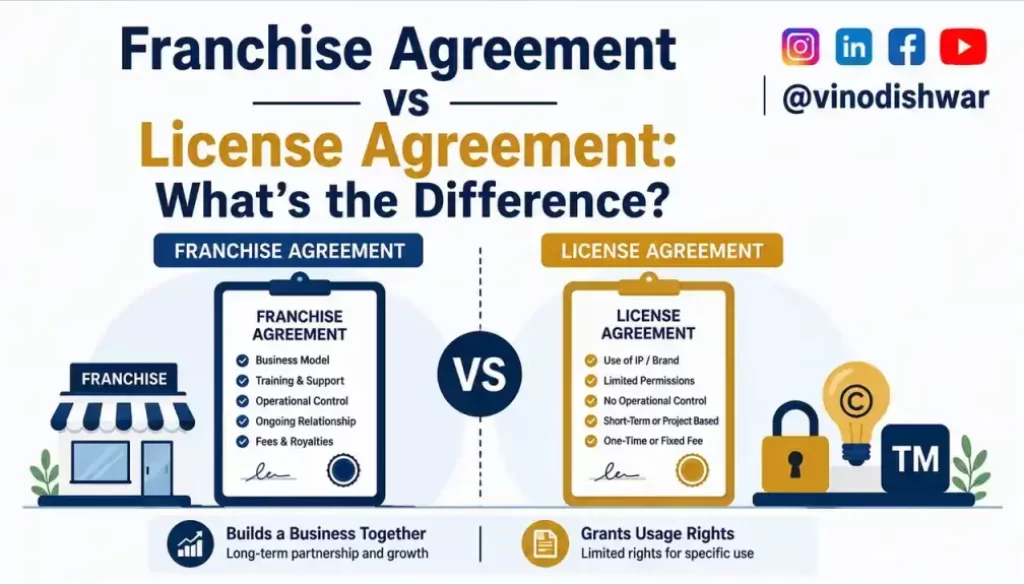
A franchise vs license agreement comparison helps businesses understand the difference between franchising and licensing. While both arrangements can provide rights to use intellectual property, branding, products, technology, or other business assets, they create fundamentally different commercial relationships.
The distinction becomes particularly important when a business is considering expansion through franchising, licensing, distribution, dealerships, or other partnership models.
A franchise generally involves much more than permission to use a trademark. It typically combines brand rights, a business system, operating standards, training, support, ongoing oversight, and a continuing commercial relationship.
A license agreement, by contrast, generally focuses on granting permission to use specified intellectual property or other rights under defined conditions.
In India, the legal characterization of an arrangement depends on its actual substance and contractual terms rather than simply the title given to the document. Indian businesses should therefore avoid assuming that calling an arrangement a “license” automatically makes it a licensing relationship.
Franchise Agreement vs License Agreement at a Glance
| Factor | Franchise Agreement | License Agreement |
|---|---|---|
| Primary purpose | Expansion of a business system | Permission to use specified rights/IP |
| Brand usage | Usually central | May or may not be included |
| Business system | Usually extensive | Usually limited |
| SOPs | Common | Usually limited |
| Training | Common | May be absent |
| Ongoing support | Usually expected | Often limited |
| Operational control | Generally higher | Generally lower |
| Territory | Often important | May be included |
| Royalties | Common | Common |
| Marketing standards | Usually detailed | May be limited |
| Quality control | Often extensive | Depends on license |
| Audit rights | Common | Depends on agreement |
| Franchisee relationship | Ongoing business relationship | Primarily rights-based relationship |
| Intellectual property | Usually includes multiple IP rights | Usually focused on specified IP |
| Scalability | Designed for replicating a business model | Designed for monetizing specific rights |
The precise terms depend on the agreement and applicable law.
What Is a Franchise Agreement?
A franchise agreement is a contractual arrangement under which a franchisor grants a franchisee specified rights to operate a business using the franchisor’s brand, intellectual property, business methods, systems, products, or services.
The franchisee typically receives access to a complete business model, rather than simply one intellectual property asset.
A franchise system may include:
- Brand
- Trademark
- Business model
- SOPs
- Operations manual
- Training
- Marketing system
- Technology
- Product specifications
- Supplier network
- Customer-service standards
- Quality-control systems
- Ongoing support
The franchisee generally pays an initial franchise fee and/or recurring royalties or other fees.
What Is a License Agreement?
A license agreement is a contract under which the owner or controller of a particular right grants another party permission to use that right under specified conditions.
The licensed asset could include:
- Trademark
- Copyright
- Patent
- Software
- Technology
- Content
- Design
- Character
- Brand asset
- Know-how
For example, a company might license a trademark to another business for use on a specific category of products.
The license may define:
- Permitted use
- Territory
- Duration
- Exclusivity
- Royalty
- Quality standards
- Reporting
- Approval rights
- Termination
The licensee does not necessarily receive the complete operating system of the licensor.
The Biggest Difference: Business System vs Specific Rights
The simplest way to understand the difference is:
Franchise
“Operate our business model using our brand and system.”
License
“Use our specified intellectual property or rights under these conditions.”
A franchise therefore typically involves a broader relationship.
1. Scope of Rights
Franchise Agreement
The franchisee typically receives a bundle of rights covering:
- Brand
- Business model
- Operating methods
- Systems
- Products/services
- Training
- Marketing
- Technology
The rights are generally integrated into a standardized business format.
License Agreement
A license may grant a much narrower right.
For example:
“You may use this trademark on approved products in India for three years.”
The license does not necessarily give the licensee access to the licensor’s complete business system.
2. Operational Control
This is one of the most significant differences.
Franchise
The franchisor generally maintains substantial control over how the business operates.
The franchisee may have to follow:
- SOPs
- Store standards
- Product specifications
- Customer-service procedures
- Staff standards
- Marketing guidelines
- Technology requirements
- Reporting requirements
License
A licensor may impose quality-control and permitted-use conditions, but the licensee may otherwise have considerably more operational independence.
The exact degree of control depends on the agreement.
3. Business Model
A franchise is usually designed to replicate a proven business model.
For example:
Brand ↓Business Model ↓SOPs ↓Training ↓Marketing ↓Technology ↓Franchisee ↓Replicated Business Unit
A license is generally designed to commercialize a particular intellectual property or right.
IP / Brand / Technology ↓ License ↓ Licensee ↓ Approved Usage
4. Training
Franchise
Training is commonly an important part of the franchise system.
It may include:
- Initial training
- Management training
- Staff training
- Pre-opening training
- Refresher training
- Technology training
License
Training may be provided, but it is not inherently the defining feature of a license arrangement.
5. Ongoing Support
Franchisors commonly provide continuing support.
This could include:
- Marketing
- Operations
- Technology
- Product development
- Training
- Quality control
- Business guidance
A license agreement may involve considerably less ongoing support.
6. Brand Standards
Brand consistency is generally central to a franchise.
The franchisor may control:
- Store design
- Signage
- Uniforms
- Packaging
- Customer experience
- Advertising
- Digital presence
A trademark license can also include quality-control requirements because unauthorized or uncontrolled use of a mark can create legal and brand risks.
Under India’s Trade Marks Act, 1999, registered trademarks receive statutory protection, and trademark arrangements should be structured with appropriate attention to the rights and obligations associated with trademark use.
7. SOPs and Operations Manuals
Franchise
SOPs are usually a core part of the model.
The franchisee may be required to follow detailed processes for:
- Sales
- Customer service
- Inventory
- Hygiene
- Product preparation
- Staffing
- Reporting
- Quality control
License
A license generally does not automatically include a comprehensive operating manual.
It can, however, impose specific usage and quality requirements.
8. Fees and Royalties
Both models can involve royalties.
Franchise Fees
A franchise system may charge:
- Initial franchise fee
- Royalty
- Marketing fee
- Technology fee
- Training fee
- Renewal fee
- Transfer fee
Licensing Fees
A license may involve:
- Upfront license fee
- Royalty
- Minimum guarantee
- Per-unit fee
- Sales-based royalty
Therefore, royalty payments alone do not make an arrangement a franchise.
9. Territory
Both agreements can contain territory provisions.
Franchise
Territory can be a major commercial component.
It may define:
- Exclusive territory
- Protected territory
- Non-exclusive territory
- Location radius
- Pin codes
- Delivery area
- Digital territory
- Online sales
License
A license may also define geographic restrictions, such as:
“The licensee may use the trademark in India.”
However, the territory may relate primarily to where the licensed IP can be used rather than where a complete business can operate.
10. Intellectual Property
Both structures can involve IP.
Franchise
The franchisee may receive rights to use:
- Trademarks
- Logos
- Copyrighted content
- Software
- Trade dress
- Business methods
- Proprietary systems
License
The license may focus on one or more specific IP assets.
For example:
Trademark license
Software license
Patent license
Copyright license
The exact rights depend on the IP and agreement
Franchise vs License: Practical Example
Imagine a successful coffee brand wants to expand.
Option A: Franchise
The company allows an entrepreneur to:
- Open a branded café
- Use the trademark
- Follow the store design
- Use approved recipes
- Follow SOPs
- Use approved suppliers
- Receive staff training
- Use the POS system
- Follow marketing guidelines
- Receive ongoing support
This is characteristic of a franchise business model.
Option B: Trademark License
The coffee company allows another manufacturer to:
Use its trademark on a packaged coffee product for a specified period and territory.
The manufacturer does not operate the coffee company’s café business system.
This is more characteristic of a license arrangement.
Can a Franchise Agreement Also Be a License?
Yes, a franchise agreement can contain significant licensing elements.
In fact, franchise agreements frequently grant licenses to use:
- Trademarks
- Copyright
- Software
- Designs
- Proprietary materials
However, a franchise relationship generally encompasses more than the IP license.
Think of it this way:
IP License = One component
Franchise System = Multiple integrated components
Franchise Agreement vs License Agreement in India
India does not have one comprehensive statute that universally defines every franchise relationship.
Instead, different laws can become relevant depending on the structure.
These may include:
- Indian Contract Act, 1872
- Trade Marks Act, 1999
- Copyright Act, 1957
- Patents Act, 1970
- Competition Act, 2002
- Consumer Protection Act, 2019
- Digital Personal Data Protection Act, 2023
- Tax laws
- Industry-specific regulations
The Indian Contract Act provides the general framework for contracts, while intellectual-property and competition laws may apply to particular provisions.
The Competition Act can also become relevant where arrangements contain restrictions relating to territory, exclusivity, suppliers, distribution, or pricing.
Important: The Label Is Not Everything
One of the biggest mistakes businesses make is assuming:
“If we call it a license agreement, it cannot be a franchise.”
That conclusion is not necessarily correct.
The substance of the relationship and the contractual rights and obligations matter.
If an arrangement involves a combination of:
- Trademark use
- Significant operational control
- A prescribed business format
- Continuing support
- Mandatory operating standards
- Payment obligations
- Business-system replication
it may warrant careful franchise-law and regulatory analysis regardless of what the document is called.
Businesses should obtain professional legal advice when structuring such arrangements.
Franchise vs License: Advantages and Disadvantages
Franchise Model
Advantages for the Brand
- Faster expansion
- Lower direct capital requirement
- Recurring revenue
- Standardized customer experience
- Wider geographic reach
- Local franchisee investment
Challenges
- Greater operational complexity
- Franchisee management
- Quality control
- Training requirements
- Compliance monitoring
- Brand reputation risks
Licensing Model
Advantages for the Brand
- Monetizes intellectual property
- Potentially simpler operational relationship
- Multiple licensees possible
- Lower day-to-day operational involvement
- Can create additional revenue streams
Challenges
- Less operational control
- Quality-control challenges
- Potential brand dilution
- IP misuse risk
- Licensee dependency
- Complex royalty tracking
Which Model Should Your Business Choose?
The answer depends on what you are trying to scale.
Choose Franchising When:
You want to replicate:
- A complete business model
- Store or outlet format
- Customer experience
- SOPs
- Training system
- Marketing system
- Technology
- Operational processes
Consider Licensing When:
You primarily want to commercialize:
- Trademark
- Patent
- Software
- Technology
- Content
- Design
- Character
- Product IP
without necessarily transferring the complete operating system.
Franchise Agreement vs License Agreement Checklist
Before selecting a model, ask:
Business Model
- Am I transferring a complete business system?
- Or only specific intellectual property?
Control
- How much operational control do I need?
- Do I need detailed SOP compliance?
Brand
- Is the trademark central to the arrangement?
- How will brand quality be controlled?
Support
- Will I provide ongoing training?
- Will I provide operational support?
Territory
- Does the partner need geographic exclusivity?
- How will online sales be handled?
Fees
- Initial fee?
- Royalty?
- Marketing contribution?
- Minimum guarantee?
Exit
- What happens when the agreement expires?
- What happens to the IP after termination?
Legal
- Has the arrangement been reviewed under applicable Indian law?
- Are IP rights properly documented?
- Have competition-law considerations been evaluated?
Common Mistakes Businesses Make
Mistake 1: Treating a License Like a Franchise
A business may grant a trademark and expect the licensee to operate exactly like a franchisee without properly documenting the broader relationship.
Better Approach
Define the intended commercial model and document the appropriate rights and obligations.
Mistake 2: Using a Generic Template
A licensing agreement downloaded from another jurisdiction may not reflect the actual IP, territory, fees, or regulatory environment.
Better Approach
Customize the agreement to the actual transaction.
Mistake 3: Focusing Only on the Trademark
A franchise involves much more than a trademark.
Better Approach
Document the complete franchise system, including:
- SOPs
- Training
- Marketing
- Technology
- Support
- Quality standards
Mistake 4: Ignoring Digital Rights
Modern agreements should consider:
- Websites
- Social media
- Online marketplaces
- Mobile apps
- Customer data
- Digital advertising
- Domains
Mistake 5: Ignoring Exit Rights
Both franchising and licensing arrangements should clearly address what happens after termination.
Franchise Agreement vs License Agreement: Quick Comparison
| Question | Franchise | License |
|---|---|---|
| Complete business system? | Usually | Usually not |
| Trademark use? | Usually | Often |
| Detailed SOPs? | Usually | Usually not |
| Training? | Common | Optional |
| Ongoing support? | Common | Optional |
| Operational control? | High | Usually lower |
| Marketing standards? | Extensive | May be limited |
| Royalty? | Common | Common |
| IP rights? | Multiple | Specified rights |
| Quality control? | Extensive | Depends |
| Business replication? | Yes | Not necessarily |
| Best suited for | Business expansion | IP commercialization |
How Franchise Alpha Can Help
Choosing between franchising and licensing is not simply a legal-document decision. It is a business-model decision.
At Franchise Alpha, we help businesses evaluate their expansion model and build the systems required for scalable growth.
Our approach can cover:
Strategy
- Franchise feasibility
- Business-model evaluation
- Unit economics
- Expansion strategy
- Territory planning
Operations
- SOP development
- Operations manuals
- Training systems
- Quality-control processes
Legal Coordination
- Franchise agreement requirements
- IP licensing structure
- Brand protection
- Compliance framework
- Contract coordination with qualified legal professionals
Marketing
- Franchise recruitment
- Brand positioning
- Lead generation
- Digital marketing
- Franchise marketing systems
Technology
- Franchise CRM
- Lead management
- Reporting
- Franchise portals
- Automation
- Digital Asset Management
The objective is to choose an expansion structure that matches the actual business model, rather than forcing the business into a one-size-fits-all contract.
Frequently Asked Questions
Is a franchise agreement the same as a license agreement?
No. A franchise agreement typically covers a broader business relationship involving a brand, business system, operating standards, support, and ongoing obligations. A license agreement generally grants permission to use specified rights or intellectual property under defined conditions.
Is every trademark license a franchise?
No. A trademark license by itself does not automatically mean that the relationship is a franchise. The actual contractual structure and substance of the relationship need to be considered.
Can a franchise agreement include a trademark license?
Yes. Trademark and other IP licensing provisions are commonly incorporated into franchise agreements.
Which is better: franchising or licensing?
Neither is universally better. Franchising may be more appropriate when a business wants to replicate an entire operating system. Licensing may be more appropriate when the primary objective is to commercialize specific intellectual property or rights.
Is licensing easier than franchising?
Licensing can be operationally simpler in some situations, but complexity depends on the IP, territory, quality controls, royalties, regulatory requirements, and other contractual terms.
Can a licensee use the licensor’s entire business model?
A license agreement can grant extensive rights, but if the arrangement effectively replicates a complete business system with significant control and continuing support, the business should obtain legal advice about whether a franchise structure or other regulatory considerations may apply.
Can franchisees own the franchisor’s trademark?
Generally, no. A franchisee normally receives contractual permission to use the franchisor’s intellectual property rather than ownership of it.
Do both franchise agreements and license agreements require royalties?
No particular fee structure is universally required. Both arrangements can use royalties, fixed fees, minimum guarantees, or combinations of payment structures.
Should a lawyer review a franchise or license agreement?
Yes. Legal review is particularly important where the agreement involves trademarks, patents, copyrights, exclusivity, territory restrictions, competition-law issues, substantial investment, or long-term obligations.
Conclusion
The key difference between a franchise agreement and a license agreement is the scope and nature of the relationship.
Licensing generally focuses more narrowly on the commercial use of specified rights or intellectual property.
For businesses in India, the correct structure should be determined by the actual commercial arrangement and applicable legal framework—not simply by the title of the agreement.
If your objective is to replicate a proven business model across locations, a properly structured franchise system may be appropriate. If your objective is primarily to monetize a trademark, technology, patent, copyright, or other intellectual property, licensing may be more suitable. For more insights Franchise Alpha and Webs Alpha
The right choice begins with understanding what exactly you are transferring, how much control you need, what support you will provide, and how the relationship will operate in practice.
Call to Action
Not Sure Whether to Franchise or License Your Business?
Before choosing a structure, evaluate your business model, intellectual property, operational system, investment model, support requirements, territory strategy, and expansion objectives.
Franchise Alpha can help you assess the appropriate expansion framework and build the strategy, operations, marketing, technology, and documentation required for scalable growth.
Book a Franchise Strategy Session
Get clarity on:
- Franchise vs Licensing Model
- Franchise Feasibility
- Commercial Structure
- Territory Strategy
- IP & Brand Protection
- SOP & Operations Requirements
- Franchise Marketing
- Expansion Roadmap
Choose the right model before you scale.