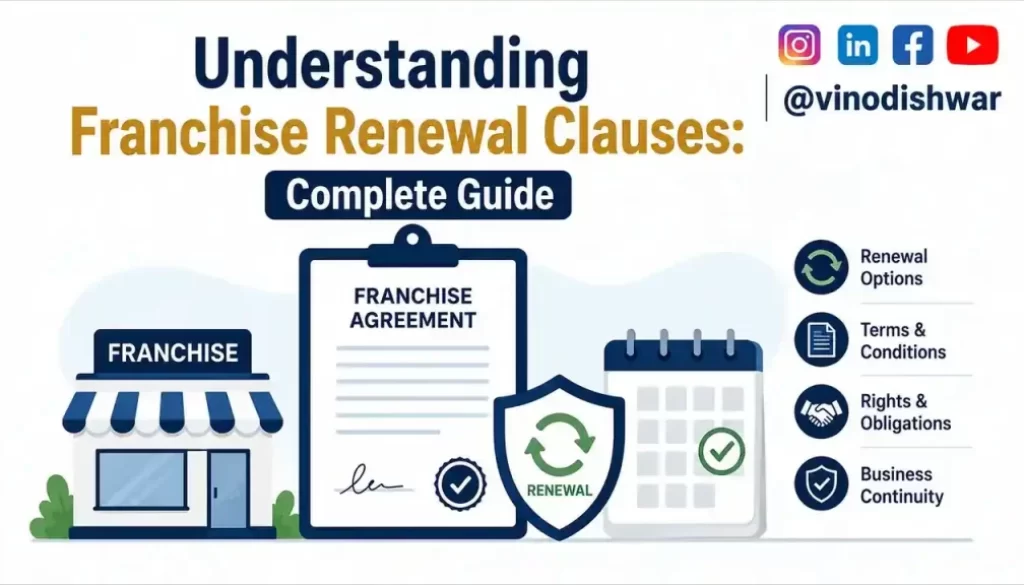
Understanding Franchise Renewal Clauses: Complete Guide
Franchise Renewal Clauses define how a franchise relationship can continue after the initial franchise agreement expires. They explain renewal terms, eligibility requirements, notice periods, fees, performance conditions, updated agreements, and other requirements that may apply when a franchisee wants to continue operating under the brand.
Most franchise relationships are established for a defined initial term, after which the parties may have the opportunity to continue the relationship through a renewal.
This is where the franchise renewal clause becomes extremely important.
A well-drafted renewal clause can provide clarity about:
- How long the renewal period lasts
- Whether renewal is automatic or conditional
- How much renewal costs
- When notice must be given
- What performance standards apply
- Whether the franchise agreement must be updated
- What happens if the franchisee does not qualify for renewal
For franchisors, renewal clauses help protect the franchise system from continuing relationships that no longer meet current standards.
For franchisees, they provide visibility into the conditions required to continue operating under the brand.
In India, the precise contractual structure should be reviewed in light of the Indian Contract Act, 1872 and other applicable laws.
What Is a Franchise Renewal Clause?
A franchise renewal clause is a provision in a franchise agreement that explains whether and under what conditions a franchisee can continue the franchise relationship after the initial contractual term expires.
For example:
Initial Term: 5 years
Renewal Term: 5 years
Renewal Notice: 180 days before expiry
Renewal Fee: Applicable renewal fee
Conditions: Compliance, performance, updated premises and execution of the then-current franchise agreement.
The exact structure can vary significantly between franchise systems.
Why Franchise Renewal Clauses Matter
A franchise agreement can represent a significant investment for both parties.
The franchisee may have invested in:
- Property
- Interiors
- Equipment
- Employees
- Inventory
- Marketing
- Technology
- Training
The franchisor has invested in:
- Brand development
- SOPs
- Training systems
- Marketing
- Technology
- Franchise support
- Network development
Renewal provisions help both sides understand what happens when the initial agreement reaches its end.
Franchise Agreement Term vs Renewal Term
These two concepts should not be confused.
Initial Term
The period covered by the original franchise agreement.
Example:
2026–2031
Renewal Term
An additional period granted after the initial term.
Are Franchise Renewals Automatic?
Not necessarily.
A renewal clause may be structured as:
Automatic Renewal
The agreement renews automatically unless one party gives notice.
Conditional Renewal
The franchisee can renew only if specific conditions are satisfied.
Mutual Renewal
Both parties must agree to renew.
Renewal at Franchisor Discretion
The franchisor has contractual discretion subject to the agreement and applicable law.
The precise drafting matters.
12 Key Elements of a Franchise Renewal Clause
A comprehensive renewal provision should consider the following.
1. Renewal Eligibility
The agreement should explain who qualifies for renewal.
Possible conditions include:
- No material defaults
- Payment of outstanding amounts
- Compliance with SOPs
- Required training
- Satisfactory performance
- Approved location
- Current licences
- Updated equipment
- Brand compliance
2. Renewal Notice Period
The franchisee may need to provide written notice within a specific period.
For example:
“The franchisee must provide written notice of its intention to renew not less than 180 days before expiry.”
The exact period should be commercially appropriate.
Why Notice Matters
A franchisor may need time to:
- Evaluate the franchisee
- Inspect the location
- Review performance
- Negotiate updated terms
- Prepare documents
- Plan network expansion
A franchisee needs enough time to determine whether renewal makes financial sense.
3. Renewal Term
The clause should specify how long the renewal period lasts.
Examples:
- 3 years
- 5 years
- 10 years
The renewal term does not necessarily need to match the original term.
4. Renewal Fee
Some franchise systems charge a renewal fee.
The agreement should clearly explain:
- Amount
- Calculation
- Payment deadline
- Taxes
- Refundability
- Whether the fee can change
Avoid vague language such as:
“A reasonable renewal fee may apply.”
If the amount cannot be fixed at signing, the agreement should establish a clear calculation mechanism.
5. Performance Conditions
Renewal may depend on the franchisee meeting certain standards.
These can include:
- Financial compliance
- Operational compliance
- Brand standards
- Training
- Customer-service standards
- Reporting
- Audit results
- Payment history
However, performance conditions should be drafted clearly rather than using vague terms such as “satisfactory performance” without meaningful criteria.
6. Compliance Requirements
A franchisee may need to demonstrate continued compliance with:
- Laws
- Licences
- Regulations
- Brand policies
- SOPs
- Safety standards
- Tax obligations
- Industry requirements
The exact requirements depend on the franchise model.
7. Updated Franchise Agreement
A franchisor may require the franchisee to sign the then-current version of the franchise agreement.
This can allow the franchise system to update provisions for:
- New technology
- New operating standards
- New compliance requirements
- Updated brand guidelines
- New reporting systems
However, the commercial and legal effect of requiring an updated agreement should be understood before signing.
8. Premises and Location Requirements
Physical franchises may have additional renewal requirements.
For example:
- Lease must remain valid
- Location must meet current standards
- Renovation may be required
- Equipment may need replacement
- Signage may need updating
- Store layout may need modernization
A renewal clause should address these requirements where relevant.
9. Refurbishment Requirements
Brands evolve.
A franchisor may require franchisees to refurbish their locations before renewal.
For example:
Initial Opening ↓5-Year Operating Period ↓Brand Review ↓Renovation / Upgrade ↓Renewal
The agreement should clearly explain:
- What triggers refurbishment
- Who determines the requirement
- Standards
- Estimated scope
- Timing
- Cost responsibility
10. Outstanding Defaults
A franchisee with unresolved material breaches may not qualify for renewal.
Potential issues include:
- Unpaid royalties
- Repeated SOP violations
- Brand misuse
- Reporting failures
- Regulatory violations
- Serious customer complaints
The agreement should explain how outstanding defaults affect renewal.
11. Renewal Territory
Territory rights should be considered separately during renewal.
Does renewal preserve the original:
- Territory?
- Exclusivity?
- Delivery area?
- Customer area?
- Online rights?
The agreement should avoid leaving these matters unclear.
12. Renewal and Transfer Rights
If the franchisee wants to sell the business at the end of the initial term, the agreement may need to address:
- Transfer
- Renewal
- New franchisee approval
- New agreement
- Transfer fees
- Buyer qualification
These provisions should work together.
Common Franchise Renewal Structures
Structure A: Fixed Renewal Option
5-Year Initial Term ↓5-Year Renewal Option ↓Renewal Conditions
The franchisee receives a defined renewal opportunity subject to contractual conditions.
Structure B: Multiple Renewal Options
5 Years ↓Renew 5 Years ↓Renew 5 Years ↓Renew 5 Years
This may provide long-term continuity while allowing periodic system reviews.
Structure C: Conditional Renewal
Initial Term ↓Eligibility Review ↓Conditions Met? ↙ ↘ Yes No ↓ ↓Renewal Expiry / Other Remedy
Structure D: Mutual Renewal
The parties negotiate and agree to continue the relationship.
This gives both parties flexibility but may provide less certainty to the franchisee.
Franchise Renewal Clause Example
A simplified educational example might look like:
Renewal: Subject to the franchisee satisfying the renewal conditions specified in this Agreement, the franchisee may request renewal for an additional term by providing written notice within the prescribed notice period before expiry. Renewal may be subject to payment of the applicable renewal fee, satisfaction of applicable operational and compliance standards, execution of the required renewal documentation, and completion of any specified refurbishment or training requirements.
This is only an illustrative structure, not a ready-to-use legal clause.
The final wording should be drafted by qualified legal counsel.
Franchise Renewal Checklist for Franchisors
Before approving renewal, a franchisor can review:
Financial
- Royalties paid
- No material outstanding dues
- Reporting completed
- Financial obligations satisfied
Operations
- SOP compliance
- Quality standards
- Training completed
- Audit performance
Brand
- Brand standards maintained
- Approved signage
- Approved marketing
- No unauthorized IP use
Location
- Lease valid
- Premises suitable
- Renovation requirements identified
- Equipment condition reviewed
Compliance
- Licences valid
- Regulatory requirements satisfied
- Safety standards met
- Data and operational compliance reviewed
Renewal
- Renewal notice received
- Renewal fee calculated
- Conditions satisfied
- Renewal documents prepared
Franchise Renewal Checklist for Franchisees
Before exercising a renewal option, franchisees should evaluate:
Financial
- What is the renewal fee?
- What will the royalty structure be?
- Will costs increase?
- Is the business still financially viable?
Contract
- Are you required to sign a new agreement?
- Are the terms changing?
- Are territory rights changing?
- Are new obligations being introduced?
Operations
- Is refurbishment required?
- Are new systems required?
- Is additional training required?
- Are operating standards changing?
Business
- Is the location still profitable?
- Is the market still attractive?
- Has competition increased?
- Does the brand still provide sufficient value?
Exit
- What happens if you do not renew?
- Can you sell the business?
- Can you transfer the franchise?
- What happens to your equipment and lease?
Franchise Renewal vs Franchise Extension
These terms are sometimes used interchangeably, but they can have different contractual meanings.
Renewal
A new contractual period begins after the existing term expires.
Extension
The existing contractual period is extended.
The actual legal effect depends on the wording of the agreement.
Always read the defined terms in the specific contract.
What Happens If the Franchisee Misses the Renewal Deadline?
This depends on the agreement.
For example, the contract may require notice:
180 days before expiry.
If the franchisee provides notice only 30 days before expiry, the consequences could depend on:
- Contract wording
- Notice provisions
- Any grace period
- Franchisor discretion
- Applicable law
- Circumstances of the delay
Franchisees should not assume that a missed deadline can automatically be ignored.
Can a Franchisor Refuse Renewal?
Potentially, depending on the contractual structure and applicable law.
The key question is:
What does the franchise agreement actually say?
If renewal is conditional, the franchisor may assess whether the conditions have been satisfied.
If the agreement provides a defined renewal right, the scope of that right needs to be analyzed carefully.
A lawyer should review the agreement before either party takes action based on a disputed renewal right.
Can Renewal Terms Be Changed?
Potentially, yes.
A renewal may involve:
- Updated franchise fees
- New royalty rates
- Updated technology requirements
- New brand standards
- New marketing obligations
- Updated SOPs
- Refurbishment requirements
- A new franchise agreement
The exact ability to change terms depends on the original agreement and the renewal structure.
Franchise Renewal and ROI
Renewal should not be treated as an automatic decision.
The franchisee should reassess:
Revenue
↓
Operating Costs
↓
Royalty + Marketing Fees
↓
Profitability
↓
Required Renewal Investment
↓
Expected Future Returns
This helps determine whether continuing the franchise remains commercially attractive.
Franchise Renewal and Brand Evolution
Renewal gives franchisors an opportunity to bring older locations up to current standards.
For example:
Year 1
Original store format
Year 3
Updated technology
Year 5
New brand identity
Renewal
Modernized location + updated SOPs + updated technology
This can help maintain consistency across a growing franchise network.
Franchise Renewal Mistakes to Avoid
Mistake 1: No Renewal Clause
The agreement reaches expiry without explaining what happens next.
Mistake 2: Vague Renewal Conditions
Terms such as “satisfactory performance” without meaningful criteria can create uncertainty.
Mistake 3: No Notice Deadline
Both parties are unsure when renewal must be requested.
Mistake 4: Undefined Renewal Fee
The franchisee discovers the fee only when renewal becomes relevant.
Mistake 5: Ignoring Refurbishment
Renewal suddenly requires major investment that was never clearly anticipated.
Mistake 6: Ignoring Updated Agreements
The franchisee assumes the old agreement continues unchanged.
Mistake 7: Ignoring Territory
The renewal document fails to clarify whether territory protections continue.
Mistake 8: Ignoring Digital Assets
Questions arise over websites, social accounts, customer data, and digital profiles.
Mistake 9: Failing to Review Performance
Renewal becomes automatic despite significant operational problems.
Mistake 10: Waiting Until the Last Minute
Both parties begin renewal discussions only days before expiry.
Franchise Renewal Decision Framework
A franchisee can evaluate renewal using five categories:
| Area | Key Question |
|---|---|
| Profitability | Is the franchise still financially attractive? |
| Brand | Is the brand continuing to generate customer demand? |
| Support | Is franchisor support valuable? |
| Investment | What additional capital is required? |
| Contract | Are the new terms commercially acceptable? |
Franchise Renewal and Legal Review
Renewal is an important point to review the entire contractual relationship.
The parties may need to reassess:
- Franchise agreement
- Amendments
- Operations manual
- Brand guidelines
- IP
- Territory
- Fees
- Marketing obligations
- Data provisions
- Technology
- Compliance
- Dispute provisions
The Indian Contract Act, 1872 remains an important part of the general contractual framework in India, while the applicability of other laws depends on the franchise arrangement.
How Franchise Alpha Supports Franchise Readiness
Franchise renewal is not only a legal event.
It is also a business-performance and franchise-system review.
At Franchise Alpha, businesses can evaluate franchise readiness across:
Franchise Strategy
- Business model
- Unit economics
- Territory
- Expansion strategy
Operations
- SOPs
- Training
- Quality control
- Franchisee performance
Marketing
- Brand performance
- Local marketing
- Lead generation
- Customer acquisition
Technology
- CRM
- Reporting
- Automation
- Digital systems
Franchise Documentation
- Agreement requirements
- Renewal framework
- Commercial terms
- Coordination with qualified legal professionals
The objective is to ensure that renewal decisions are based on commercial performance, system compliance, brand standards, and a clear contractual framework.
Frequently Asked Questions
What is a franchise renewal clause?
A franchise renewal clause is a provision that establishes whether and under what conditions a franchisee may continue the franchise relationship after the initial agreement expires.
Are franchise agreements automatically renewed?
Not necessarily. Renewal may be automatic, conditional, mutual, or structured in another way depending on the agreement.
What is a typical franchise renewal period?
There is no universal period. Renewal terms may vary based on the franchise model and agreement.
Is there usually a franchise renewal fee?
Some franchise systems charge a renewal fee, while others may use a different commercial structure. The agreement should clearly explain any applicable fee.
Can a franchisor refuse to renew a franchise?
The answer depends on the contractual renewal rights, conditions, applicable law, and circumstances. The specific agreement should be reviewed before determining whether renewal can be refused.
Conclusion
Understanding franchise renewal clauses is essential for both franchisors and franchisees.
A renewal clause is not simply a sentence saying:
“The franchise may be renewed.”
A properly structured provision should explain:
- When renewal can occur
- How renewal is requested
- How long the renewal lasts
- What conditions apply
- What fees are payable
- Whether the agreement changes
- Whether refurbishment is required
- What happens to territory rights
- What happens if renewal is refused
- What happens if the franchisee does not renew
For franchisors, renewal provides an opportunity to ensure that franchisees continue meeting the brand’s current standards.
For franchisees, renewal is an opportunity to evaluate whether continuing under the brand remains commercially worthwhile.
The most effective renewal process therefore combines legal clarity, operational performance, financial analysis, brand standards, and strategic planning.
Do not wait until the final weeks of the franchise term.
Start reviewing the renewal well in advance, understand the contractual conditions, evaluate the economics, and obtain professional legal advice where required. Visit Franchise Alpha and Webs Alpha
Call to Action
Planning to Renew Your Franchise?
Before signing a renewal, evaluate your franchise agreement, fees, territory, profitability, refurbishment requirements, SOPs, brand standards, technology, and future growth potential.
Franchise Alpha helps franchisors and franchise businesses build structured franchise systems covering strategy, operations, marketing, technology, and franchise development, with legal matters coordinated with qualified professionals.
Book a Franchise Strategy & Renewal Readiness Session
Get clarity on:
- Franchise Renewal Strategy
- Renewal Conditions
- Franchise Fees & Royalties
- Territory & Exclusivity
- SOP & Brand Compliance
- Franchisee Performance
- Refurbishment Requirements
- Franchise Agreement Review
- Future Expansion
Renew with clarity. Scale with confidence.