Is a Franchise Disclosure Document Mandatory in India? | 2026 Guide
Is a Franchise Disclosure Document (FDD) mandatory in India?
This is one of the most important questions for businesses planning to franchise their operations.
The short answer is:
No. As of 2026, India does not have a comprehensive central franchise law that generally requires every franchisor to provide a standardized Franchise Disclosure Document (FDD) before selling a franchise.
This differs from the United States, where the Federal Trade Commission’s Franchise Rule requires franchisors covered by the rule to provide prospective franchisees with a disclosure document containing 23 specified categories of information.
An important Indian government policy paper from the Economic Advisory Council to the Prime Minister (EAC-PM) similarly identifies the absence of a comprehensive franchise-specific law and states that Indian law does not impose general pre-sale disclosure requirements on franchisors.
However, saying “an FDD is not mandatory” does not mean “a franchisor can disclose nothing.”
Franchise businesses still need to consider contractual obligations, representations and misrepresentations, intellectual property, consumer protection, competition issues, taxation, sector-specific regulations and other applicable laws.
What Is an FDD?
A Franchise Disclosure Document (FDD) is a structured document designed to give a prospective franchisee material information about a franchise opportunity before entering into the franchise relationship.
An FDD can cover areas such as:
- Franchisor background
- Business experience
- Litigation
- Bankruptcy
- Initial fees
- Recurring fees
- Initial investment
- Supplier restrictions
- Franchisee obligations
- Financing
- Training and support
- Territory
- Intellectual property
- Renewal
- Termination
- Transfer
- Financial performance information
- Existing franchisees
- Financial statements
- Contracts
In the U.S., these are organized into the 23 disclosure items required under the FTC Franchise Rule.
Is FDD Legally Required in India?
No — Not as a Universal Statutory Requirement
India currently does not have a single comprehensive central franchise statute equivalent to the U.S. federal Franchise Rule.
The EAC-PM’s report specifically notes the absence of franchise-specific legislation and states that Indian law does not impose general pre-sale disclosure requirements on franchisors.
The Indian franchise ecosystem instead operates through a combination of:
- Contract law
- Intellectual property law
- Consumer protection law
- Competition law
- Tax laws
- Corporate laws
- Employment laws
- Data and technology laws
- Sector-specific regulations
The Indian Contract Act, 1872 provides the general legal framework governing contracts in India, including provisions concerning consent, fraud, misrepresentation, lawful agreements and contractual obligations.
Therefore, there is currently no general rule saying:
“Every franchise in India must issue an FDD containing 23 items before selling a franchise.”
Does India Have a Franchise Law?
India does not currently have a single, comprehensive franchise-specific law governing all franchise relationships nationwide.
The EAC-PM has highlighted this regulatory gap and the absence of a centralized franchise regulatory framework.
This is an important distinction for franchisors.
A franchise arrangement may involve multiple legal relationships rather than being governed by one dedicated franchise statute.
For example:
↓
Trademark Licence
↓
Property / Lease Arrangement
↓
Supply Agreement
↓
Employment & Labour Compliance
↓
Consumer-Facing Operations
Each component may bring its own legal considerations.
Why Do People Think an FDD Is Mandatory in India?
Much of the confusion comes from international franchise content.
In the United States, the FTC Franchise Rule requires covered franchisors to provide an FDD containing 23 specific disclosure items.
The FTC also states that prospective franchisees generally must receive the FDD at least 14 calendar days before signing a contract or paying money to the franchisor or its affiliate, subject to the rule’s requirements and exceptions.
That rule applies to the U.S. franchise regulatory framework.
It should not automatically be applied to an Indian franchise transaction.
India vs United States: FDD Requirements
| Factor | India | United States |
|---|---|---|
| Comprehensive federal franchise law | No | Yes |
| Standardized FDD requirement | No general requirement | Yes, under FTC Franchise Rule |
| Number of federal FDD items | No prescribed universal number | 23 |
| General pre-sale FDD requirement | No | Yes, for covered transactions |
| 14-day federal FDD waiting period | No equivalent universal FDD rule | Generally yes |
| Franchise agreement | Important | Important |
| Due diligence | Essential | Essential |
| State-specific franchise laws | Not equivalent to U.S. system | Yes |
The U.S. requirements above are based on the FTC’s current Franchise Rule materials.
If FDD Is Not Mandatory, Should Indian Franchisors Still Use One?
Yes, potentially — as a best practice, not because every Indian franchise is legally required to use a U.S.-style FDD.
A structured disclosure document can make the franchise process more transparent.
It can help a franchisor explain:
- Business model
- Investment
- Fees
- Royalties
- Territory
- Training
- Support
- Franchisee obligations
- Financial assumptions
- Risks
- Renewal
- Termination
- Transfer
It can also make the franchise sales process more consistent.
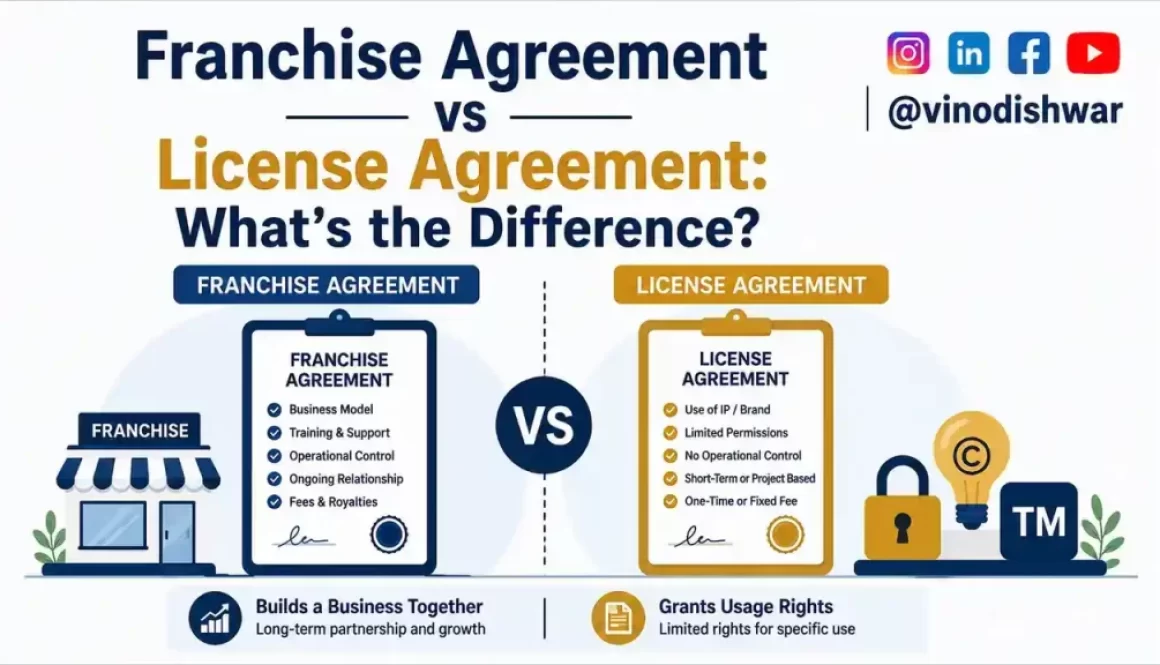
FDD Is Not the Same as a Franchise Agreement
This distinction is critical.
FDD
Primarily provides information and disclosure.
Franchise Agreement
Creates the contractual relationship between franchisor and franchisee.
| FDD / Disclosure | Franchise Agreement |
|---|---|
| Explains the opportunity | Establishes legal rights |
| Supports due diligence | Creates contractual obligations |
| Provides information | Governs relationship |
| Describes fees | Defines payment obligations |
| Explains risks | Sets contractual remedies |
| Helps decision-making | Becomes binding contract |
An Indian franchisor should not assume that a franchise agreement can replace appropriate disclosure.
What Should an Indian Franchise Disclosure Document Include?
Even though there is no universal statutory FDD format, an Indian franchisor can develop a structured Franchise Disclosure Pack.
1. Franchisor Information
Include:
- Legal name
- Company structure
- Ownership
- Business history
- Management
- Brand history
2. Franchise Business Model
Explain:
- Products/services
- Target customers
- Revenue model
- Operating format
- Location requirements
- Staffing model
- Technology requirements
3. Initial Investment
Clearly identify estimated costs:
- Franchise fee
- Property deposit
- Interiors
- Equipment
- Inventory
- Technology
- Licences
- Pre-opening expenses
- Working capital
Avoid presenting a single attractive investment number if significant additional costs are excluded.
4. Recurring Fees
Explain:
- Royalty
- Marketing contribution
- Technology fees
- Renewal fees
- Transfer fees
- Other charges
A prospective franchisee should understand the total cost of ownership, not just the initial franchise fee.
5. Territory
Explain whether the franchisee receives:
- Exclusive territory
- Protected territory
- Non-exclusive territory
- Defined operating area
Also clarify how the franchisor handles:
- New outlets
- Online sales
- Delivery
- Corporate customers
- Nearby franchisees
6. Training and Support
Explain precisely what is included.
For example:
Pre-Opening
- Site support
- Recruitment
- Training
- Setup
Launch
- Opening support
- Marketing
- Operational assistance
Ongoing
- Training
- Audits
- Marketing
- Technology
- Operational support
Avoid vague promises such as:
“Complete support will be provided.”
7. Financial Information
This is one of the most sensitive areas.
If a franchisor provides financial projections, it should clearly distinguish between:
Historical performance
and
Illustrative projections.
For example:
“Illustrative financial model based on the assumptions stated below.”
is very different from:
“Every franchise will earn ₹3 lakh per month.”
Financial claims should be properly supported and professionally reviewed where appropriate.
8. Franchisee Obligations
The disclosure should explain responsibilities involving:
- Staffing
- Procurement
- Marketing
- Reporting
- Quality control
- Technology
- Training
- Insurance
- Compliance
- Brand standards
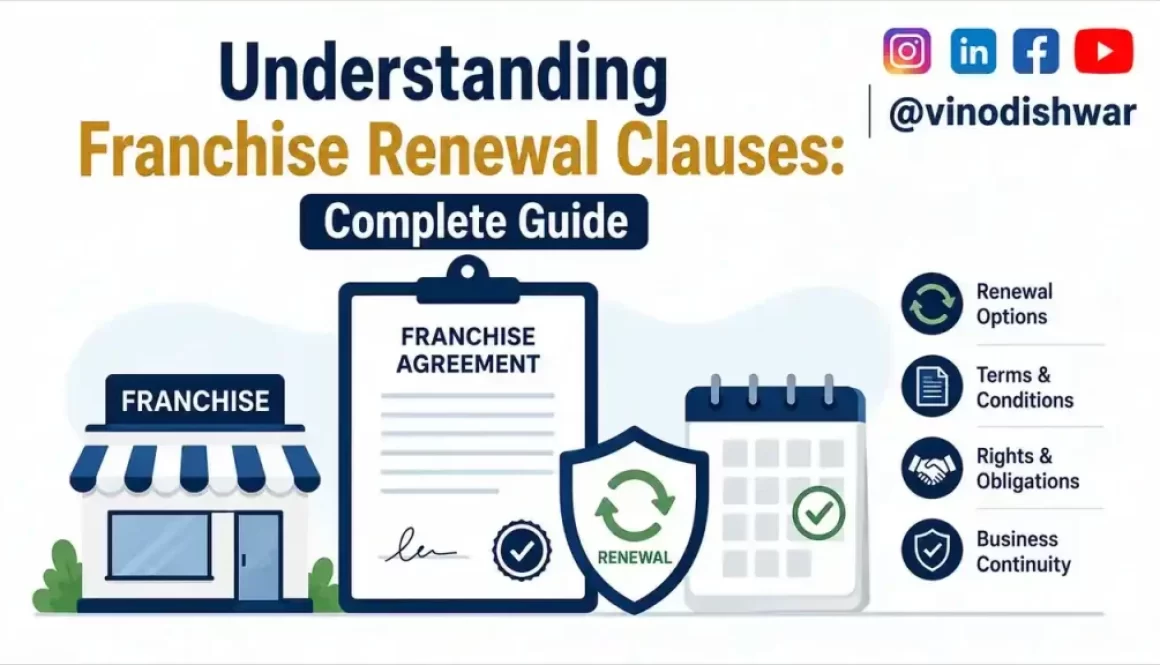
9. Renewal
Explain:
- Initial term
- Renewal rights
- Renewal conditions
- Renewal fee
- Refurbishment requirements
- Updated agreement requirements
10. Termination
Explain circumstances that may lead to termination, such as:
- Non-payment
- Serious contractual breaches
- Brand misuse
- Fraud
- Regulatory violations
- Repeated operational non-compliance
11. Transfer and Exit
The franchisee should understand:
- Whether transfer is permitted
- Approval requirements
- Transfer fees
- Buyer qualification
- Rights after termination
This is especially important for investors who may eventually want to sell their franchise.
What Happens If a Franchisor Does Not Provide an FDD?
Because there is no universal Indian statutory FDD requirement, the mere absence of an FDD does not automatically make an Indian franchise transaction illegal.
However, this does not mean that inaccurate or misleading statements are risk-free.
The Indian Contract Act includes provisions dealing with:
- Fraud
- Misrepresentation
- Free consent
- Voidability of contracts induced by certain forms of improper conduct
For example, the Act expressly defines fraud and misrepresentation and provides consequences for contracts affected by them.
Therefore, franchisors should be careful about:
- False revenue claims
- Misleading ROI statements
- Hidden costs
- False claims about territory
- Unsupported profitability promises
- Misrepresenting brand ownership
- Concealing material information
Does “No FDD Requirement” Mean No Disclosure Obligation?
No.
This is perhaps the most important point in this article.
There is a difference between:
A statutory FDD obligation
A law specifically requiring a particular disclosure document.
and
General legal obligations
Requirements arising from contracts, representations, applicable legislation and legal principles.
Therefore:
No mandatory FDD ≠ no legal responsibility for what you tell a franchisee.
A franchisor should ensure that information presented to prospective franchisees is accurate, consistent and supportable.
Franchise Marketing Claims Matter Too
Disclosure isn’t limited to a PDF.
Consider the entire franchise recruitment process:
Google Ad ↓Website ↓Franchise Brochure ↓Sales Presentation ↓WhatsApp / Email ↓Investor Meeting ↓Financial Model ↓Franchise Agreement
Every stage can influence the prospective franchisee’s decision.
If one channel says:
Investment: ₹20 lakh
while another document shows:
Actual estimated capital requirement: ₹35 lakh
the inconsistency needs to be addressed.
Is a Franchise Brochure Enough?
Usually, a brochure should not be treated as a substitute for a comprehensive disclosure framework.
A brochure is generally designed to market the opportunity.
A disclosure pack should help the prospect evaluate the opportunity.
Brochure
“Why invest in our franchise?”
Disclosure
“What do you need to know before investing?”
That distinction is particularly important when discussing:
- Costs
- Financial performance
- Risks
- Territory
- Contractual restrictions
- Renewal
- Termination
Should Indian Franchisors Create a 23-Item FDD?
Not necessarily.
The 23-item format comes from the U.S. federal franchise regime.
An Indian franchisor should not assume that copying those 23 items automatically creates legally compliant Indian documentation.
Instead, the better approach is:
Use the principles of comprehensive disclosure → adapt them to the Indian business and legal context → obtain professional legal review.
A structured Indian franchise disclosure pack could contain many of the same commercial categories without representing itself as a statutory U.S.-style FDD.
Can an Indian Franchisor Call Its Document an “FDD”?
There is an important distinction between:
Using “FDD” as a descriptive business term
and
Representing that the document is a legally required U.S.-style FDD.
For an Indian franchise system, terminology should be chosen carefully.
Possible alternatives include:
- Franchise Disclosure Document
- Franchise Disclosure Pack
- Franchise Information Document
- Franchise Offering Document
- Franchise Information Memorandum
The exact terminology should be reviewed by legal counsel based on the intended use and jurisdiction.
Franchisee Due Diligence in India
Because there is no universal statutory FDD regime, independent due diligence becomes particularly important.
A prospective franchisee should investigate:
Business
- How does the model make money?
- What is the target market?
- Who are competitors?
Investment
- What is the total capital requirement?
- How much working capital is required?
Fees
- What royalties apply?
- Are there marketing fees?
- Are there technology charges?
Performance
- Are financial claims historical or projected?
- What assumptions support them?
Contract
- What is the term?
- What are renewal conditions?
- What happens on termination?
- Can the franchise be transferred?
Franchise Network
- How many locations operate?
- How many have closed?
- Can current franchisees be contacted?
Questions Every Franchisee Should Ask
Before investing, ask:
- What is the complete investment—not just the franchise fee?
- What recurring fees will I pay?
- What assumptions support the financial projections?
- Is the territory exclusive?
- Can another franchise open nearby?
- What support is actually included?
- What happens if I want to sell the franchise?
- What happens when the franchise agreement expires?
- What circumstances can result in termination?
- Can I speak to current and former franchisees?
Is There a Mandatory 14-Day FDD Waiting Period in India?
No universal Indian FDD waiting period equivalent to the U.S. federal rule currently applies.
In the United States, the FTC says a prospective franchisee generally must receive the FDD at least 14 calendar days before signing a contract or paying money to the franchisor or its affiliate.
That 14-day federal requirement should not be presented as an Indian requirement.
For an Indian franchise transaction, timing should be determined based on the applicable contractual and legal framework.
Nevertheless, from a good-governance perspective, giving prospective franchisees adequate time to review disclosure materials is sensible.
What Is the Best Franchise Disclosure Process in India?
A practical process can look like this:
Franchise Business Model ↓Investment & Unit Economics ↓Legal & IP Review ↓Franchise Agreement ↓Disclosure Pack ↓Sales Team Training ↓Prospective Franchisee ↓Questions & Clarifications ↓Independent Due Diligence ↓Legal / Financial Review ↓Commercial Decision ↓Franchise Agreement & Investment
The goal is transparency and consistency.
Franchise Disclosure Checklist for Indian Franchisors
Corporate
- Company information verified
- Ownership documented
- Brand ownership verified
- Management information updated
Commercial
- Franchise fee documented
- Total investment calculated
- Working capital identified
- Royalty explained
- Marketing fees explained
Territory
- Territory clearly defined
- Exclusivity explained
- Online sales addressed
- Expansion policy documented
Operations
- Training documented
- Support documented
- Procurement requirements explained
- Technology requirements documented
Financial
- Historical figures identified
- Projections labelled
- Assumptions documented
- Costs included
Legal
- Franchise agreement reviewed
- IP ownership checked
- Material disputes reviewed
- Applicable sector regulations identified
Marketing
- Website claims checked
- Ad claims checked
- Sales scripts checked
- Financial claims supported
Franchise Disclosure Checklist for Franchisees
Before signing:
- Read all disclosure materials
- Read the franchise agreement
- Verify investment
- Calculate working capital
- Understand all recurring fees
- Verify territory
- Understand renewal
- Understand termination
- Understand transfer restrictions
- Speak to franchisees
- Research competitors
- Verify financial assumptions
- Obtain legal advice
- Obtain financial/tax advice where appropriate
Why Indian Franchisors Should Consider Voluntary Disclosure
Even without a universal statutory FDD requirement, structured disclosure can create a competitive advantage.
1. Builds Trust
Serious investors are more likely to proceed.
3. Reduces Misunderstandings
Expectations are established earlier.
4. Supports Franchise Sales
Sales teams have a consistent information framework.
5. Helps Franchisee Selection
Unqualified prospects may self-select out.
6. Improves Network Relationships
Franchisees begin the relationship with clearer expectations.
7. Supports Risk Management
Documented information can reduce inconsistencies across the sales process.
What Should Franchise Alpha Clients Do?
For a business preparing to franchise in India, the practical approach should not be:
“FDD isn’t mandatory, so we don’t need disclosure.”
A stronger approach is:
“FDD isn’t universally mandatory in India, so let’s build an appropriate, accurate and professionally reviewed disclosure framework for our franchise model.”
This framework can integrate:
Franchise Strategy
↓
Investment Model
↓
Franchise Agreement
↓
Disclosure
↓
Marketing
↓
Lead Qualification
↓
Franchise Sales
↓
Operations
This creates a more controlled franchise-development system.
Frequently Asked Questions
Is a Franchise Disclosure Document mandatory in India?
No. India does not currently have a comprehensive central franchise law that generally requires every franchisor to issue a standardized FDD before selling a franchise. The EAC-PM has specifically identified the absence of general pre-sale franchise disclosure requirements in India.
Is FDD mandatory for every franchise business?
No universal Indian FDD requirement currently applies to every franchise business.
However, other laws and contractual obligations may still apply depending on the transaction and industry.
Is there an Indian Franchise Disclosure Law?
India currently does not have a single comprehensive national franchise-disclosure law equivalent to the U.S. Franchise Rule.
Does India have a Franchise Law?
India does not currently have a single comprehensive franchise-specific law governing all franchise relationships. Franchise arrangements are instead affected by multiple areas of law and contractual arrangements.
Should Indian franchisors prepare an FDD anyway?
A structured disclosure document can be a valuable best practice even when not universally mandated. It can improve transparency, consistency and franchisee due diligence.
Is the U.S. FDD format mandatory in India?
No. The U.S. 23-item FDD framework arises from the U.S. FTC Franchise Rule and should not automatically be treated as an Indian legal requirement.
Is there a 14-day FDD rule in India?
There is no universal Indian equivalent to the U.S. federal 14-day FDD delivery requirement. The FTC’s 14-day requirement applies to the U.S. Franchise Rule.
Can a franchise agreement replace an FDD?
An agreement and a disclosure document serve different purposes. A franchise agreement establishes contractual rights and obligations, while disclosure provides information to support an informed decision.
What happens if a franchisor provides false information?
The absence of a mandatory FDD does not give a franchisor permission to make false or misleading representations. Indian contract law includes provisions concerning fraud, misrepresentation and free consent.
Should franchisees ask for disclosure information in India?
Yes. Prospective franchisees should request sufficient information to conduct meaningful business, financial and legal due diligence before investing.
Conclusion
Is a Franchise Disclosure Document mandatory in India?
Generally, no—not as a universal statutory requirement.
India currently lacks a comprehensive national franchise law requiring every franchisor to prepare and deliver a standardized FDD equivalent to the U.S. model. The EAC-PM has explicitly identified the absence of general pre-sale disclosure requirements and the broader lack of comprehensive franchise-specific legislation.
But that does not mean franchise disclosure is unimportant. Visit Franchise Alpha and Webs Alpha
For franchisors, the smarter approach is to develop a structured disclosure framework that accurately explains:
- Investment
- Fees
- Business model
- Territory
- Support
- Obligations
- Financial assumptions
- Risks
- Renewal
- Termination
- Transfer
For franchisees, the absence of a mandatory FDD makes independent due diligence even more important.
The objective should not be to create a document merely because another country requires one.
The objective should be to create a franchise process where:
The investor knows what they are buying, the franchisor knows what it is promising, and both parties understand the relationship before signing.
Call to Action
Planning to Franchise Your Business in India?
Don’t treat the absence of a mandatory FDD as an excuse for limited disclosure.
Build a professional franchise system with:
Clear Investment Structure + Franchise Disclosure + Strong Agreement + Franchise Marketing + Qualified Leads + Scalable Operations
Franchise Alpha helps businesses develop franchise models, franchise documentation, franchise marketing, lead generation, franchise sales systems and operational frameworks.
Build a Franchise Business Investors Can Understand and Trust.
Book a Franchise Strategy Session.