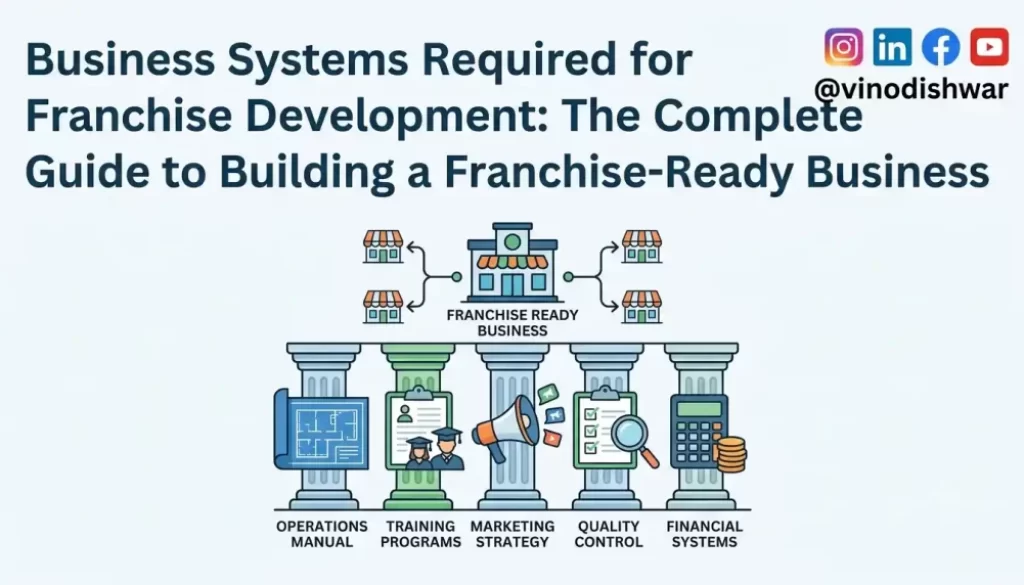
Business Systems Required for Franchise Development: The Complete Guide to Building a Franchise-Ready Business
Business Systems Required for Franchise Development are the foundation of every successful and scalable franchise business. Before expanding through franchising, businesses need standardized systems, documented processes, technology platforms, and operational controls that ensure every franchise location delivers the same customer experience and business performance. Without the right business systems, franchise expansion becomes difficult to manage and maintain consistently.
Successful franchise brands are built on systems—not on founders. While a strong product or service may attract customers, it is well-designed business systems that enable a company to replicate success across multiple locations.
Many businesses fail during franchise expansion because they attempt to grow without standardized processes, technology, reporting structures, or operational controls. As the number of outlets increases, inconsistencies become more visible, leading to operational inefficiencies, poor customer experiences, and franchisee dissatisfaction.
Business systems provide the framework that allows every franchise outlet to operate consistently, regardless of location or management. They streamline operations, improve communication, simplify training, and help franchisors maintain control as the network expands.
Whether you operate a restaurant, café, retail chain, salon, healthcare clinic, education center, fitness studio, manufacturing business, or service company, implementing the right business systems is essential before franchising.
This guide explains the core systems every franchise business needs, why they matter, and how they contribute to long-term franchise success.
What Are Business Systems Required for Franchise Development?
Business systems are the documented processes, operational frameworks, technology platforms, and management tools that enable a business to function consistently across multiple locations.
These systems define:
- How work is performed
- Who is responsible
- How quality is maintained
- How performance is measured
- How decisions are made
- How franchisees receive support
The goal is to create a business that delivers predictable results through repeatable processes.
Business Systems Required for Franchise Development: Why They Matter
A strong system enables businesses to:
- Deliver consistent customer experiences
- Reduce operational errors
- Improve franchisee success
- Standardize training
- Strengthen brand consistency
- Support faster expansion
- Simplify performance monitoring
- Increase long-term profitability
Without systems, growth becomes difficult to manage.
Essential Business Systems Required for Franchise Development
1. Standard Operating Procedure (SOP) System
SOPs provide step-by-step instructions for performing business activities consistently.
Typical SOP categories include:
- Opening procedures
- Closing procedures
- Customer service
- Cash handling
- Inventory management
- Equipment maintenance
- Safety procedures
- Cleaning schedules
Documented SOPs ensure every outlet follows the same operational standards.
2. Franchise Operations Manual
The Operations Manual serves as the primary reference guide for franchisees.
It includes:
- Brand standards
- Organizational structure
- Daily operations
- HR policies
- Marketing guidelines
- Compliance requirements
- Vendor management
- Reporting procedures
This manual ensures operational consistency throughout the franchise network.
3. Customer Relationship Management (CRM) System
A CRM system manages customer and franchise sales relationships.
Key functions include:
- Customer database
- Franchise lead management
- Sales pipeline
- Follow-up automation
- Email communication
- Customer support
- Reporting
CRM systems improve customer engagement and franchise sales efficiency.
4. Enterprise Resource Planning (ERP) System
ERP software integrates multiple business functions into one platform.
Common modules include:
- Finance
- Inventory
- Procurement
- HR
- Payroll
- Purchasing
- Reporting
ERP systems improve operational visibility and decision-making.
5. Point of Sale (POS) System
A POS system records every customer transaction.
Benefits include:
- Sales tracking
- Inventory updates
- Customer purchase history
- Billing
- Promotions
- Revenue reporting
POS systems provide accurate operational data across all franchise locations.
6. Inventory Management System
Inventory software helps control stock levels.
Functions include:
- Stock tracking
- Purchase orders
- Supplier management
- Waste control
- Product movement
- Automatic reorder alerts
Efficient inventory systems reduce costs and improve profitability.
7. Learning Management System (LMS)
Training should be standardized across every franchise location.
An LMS allows businesses to deliver:
- Franchisee onboarding
- Employee training
- Product knowledge
- Operational updates
- Compliance courses
- Assessments
- Certifications
Digital learning improves consistency while reducing training costs.
8. Financial Management System
Financial systems monitor business performance.
Typical functions include:
- Budgeting
- Profit & Loss reporting
- Cash flow management
- Expense tracking
- Royalty calculation
- Tax reporting
- Financial forecasting
Reliable financial reporting supports better business decisions.
9. Marketing Management System
A centralized marketing system ensures brand consistency.
It should manage:
- Campaign planning
- Digital advertising
- Social media
- Local marketing
- Brand assets
- Promotional calendars
- Lead generation
Standardized marketing strengthens brand visibility.
10. Quality Assurance System
Quality control protects customer experience.
The system should include:
- Operational audits
- Mystery shopping
- Customer feedback
- Compliance inspections
- Product quality reviews
- Corrective action plans
Quality assurance maintains brand reputation.
11. Communication System
Clear communication supports franchise success.
Communication tools should facilitate:
- Franchise announcements
- Operational updates
- Regional meetings
- Helpdesk support
- Knowledge sharing
- Document distribution
Strong communication improves collaboration.
12. Business Intelligence (BI) Dashboard
Executive dashboards consolidate performance data.
Track metrics such as:
- Sales
- Outlet performance
- Customer satisfaction
- Marketing ROI
- Franchise compliance
- Employee productivity
- Inventory turnover
- Profitability
Real-time insights enable proactive management.
Business Systems Roadmap
| System | Primary Purpose |
|---|---|
| SOP System | Standardize operations |
| Operations Manual | Document business processes |
| CRM | Manage customers and franchise leads |
| ERP | Integrate business functions |
| POS | Track sales and transactions |
| Inventory System | Control stock |
| LMS | Train employees and franchisees |
| Financial System | Monitor business performance |
| Marketing System | Standardize promotions |
| Quality Assurance | Maintain operational consistency |
| Communication Platform | Support franchise collaboration |
| BI Dashboard | Monitor KPIs and performance |
Practical Example
A growing premium restaurant brand plans to franchise nationally.
Instead of relying on manual operations, the company implements:
- Digital SOP library
- Franchise Operations Manual
- POS system
- Inventory software
- CRM platform
- Learning Management System
- Business Intelligence dashboard
- Quality audit software
Every franchisee follows identical operational procedures, receives standardized training, and reports performance through centralized technology.
As the network expands from 10 to 150 outlets, the business maintains consistent quality while improving operational efficiency.
Business Systems Framework
Successful Business
        │
        ▼
Business Process Documentation
        │
        ▼
Standard Operating Procedures
        │
        ▼
Operations Manual
        │
        ▼
Technology Systems
        │
        ▼
CRM & ERP Integration
        │
        ▼
POS & Inventory Management
        │
        ▼
Training System (LMS)
        │
        ▼
Marketing & Finance Systems
        │
        ▼
Quality Assurance
        │
        ▼
Business Intelligence Dashboard
        │
        ▼
Scalable Franchise Business
Common Mistakes
Avoid these common mistakes:
- Operating without documented systems
- Using different processes across locations
- Delaying technology implementation
- Weak franchisee training
- Manual reporting
- Poor communication
- Ignoring quality audits
- Lack of KPI monitoring
Businesses should implement systems before scaling.
How Franchise Development Consultants Help
Professional franchise consultants help businesses by:
- Conducting operational assessments
- Developing SOPs
- Creating Franchise Operations Manuals
- Implementing CRM and ERP systems
- Designing training programs
- Building KPI dashboards
- Standardizing reporting
- Supporting technology integration
Expert guidance accelerates franchise readiness while reducing operational risks.
Why Choose Franchise Alpha?
At Franchise Alpha, we help businesses build franchise-ready systems using our proprietary SOLEMN® Framework.
Strategy
Design business systems aligned with your expansion objectives.
Operations
Develop SOPs, Operations Manuals, workflow documentation, and scalable operational processes.
Legal
Ensure systems align with Franchise Agreements and compliance requirements.
Entrust
Reduce founder dependency through documented systems and leadership development.
Marketing
Implement centralized marketing systems for consistent brand communication.
Nitty-Gritty
Monitor KPIs, optimize operational performance, and continuously improve business systems.
Frequently Asked Questions
Why are business systems important before franchising?
Business systems ensure operational consistency, improve franchisee performance, reduce errors, and support scalable growth.
Which system is most important for franchise development?
Every system plays a role, but SOPs, Operations Manuals, CRM, POS, training systems, and financial reporting are considered essential foundations.
Can small businesses implement these systems?
Yes. Small businesses can begin with core systems such as SOPs, CRM, POS, and training before gradually adopting more advanced technologies.
Do business systems reduce founder dependency?
Yes. Standardized systems enable managers and franchisees to operate the business successfully without constant founder involvement.
Conclusion
Business systems are the engine that powers successful franchise development.
By documenting processes, implementing technology, monitoring performance, and standardizing operations, businesses create a repeatable model capable of expanding across cities, states, and international markets.
The stronger your business systems are before franchising, the easier it becomes to build a profitable, scalable, and sustainable franchise network.
Call to Action
Ready to Build Franchise-Ready Business Systems?
Book a Franchise Readiness Assessment with Vinod Ishwar and discover the systems your business needs before expanding through franchising.
Your assessment includes:
- Business Systems Audit
- SOP & Operations Manual Review
- Technology Assessment
- KPI & Reporting Evaluation
- Customized Franchise Systems Roadmap
Build the right systems today to create a scalable franchise business tomorrow.