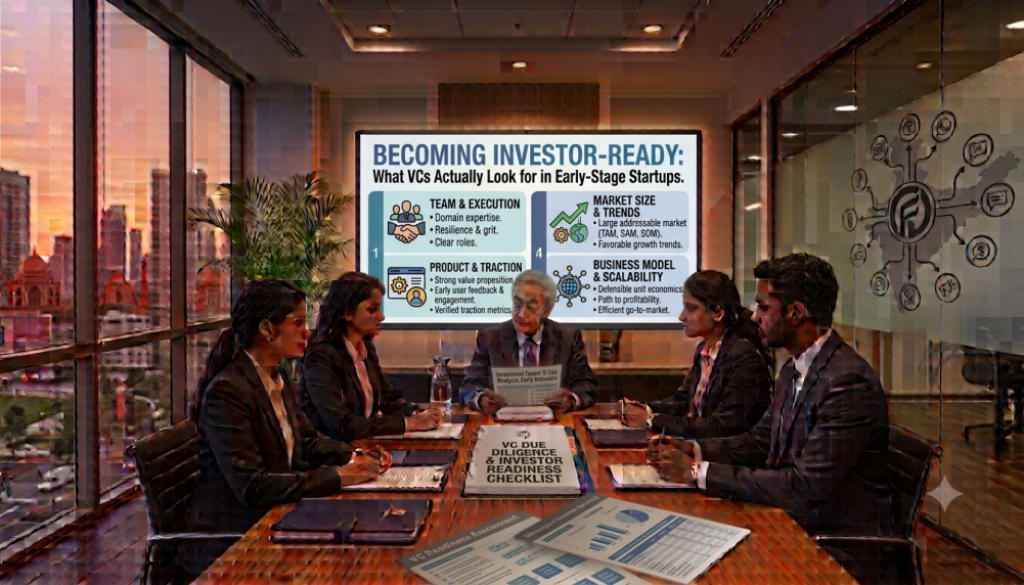
Becoming Investor-Ready: What VCs Actually Look for in Early-Stage Startups
Founders often prepare for fundraising by focusing heavily on the pitch deck — refining slides, polishing the narrative, rehearsing the delivery. These elements matter, but they represent only the surface of what investors actually evaluate. Genuine investor readiness runs much deeper, encompassing the underlying business fundamentals, founder credibility, and evidence of real traction that a polished presentation alone cannot substitute for.
What “Investor-Ready” Actually Means
Being investor-ready means your business has reached a point where its fundamentals — market opportunity, traction, team, and financial discipline — genuinely justify the confidence you’re asking investors to place in it. It’s less about performing readiness convincingly and more about having built something that withstands genuine scrutiny.
What Investors Actually Evaluate
1. Market Opportunity Size and Timing
Investors look for evidence of a genuinely large, growing market opportunity, along with a credible reason why now is the right time to pursue it — whether due to a technology shift, regulatory change, or evolving customer behavior.
2. Evidence of Traction
Concrete evidence that customers want what you’re building — revenue growth, user retention, engagement metrics, or partnership validation — carries far more weight than projections or enthusiasm alone. The specific traction metrics that matter vary by business model, but investors consistently prioritize demonstrated behavior over stated intent.
3. Founder-Market Fit
Investors assess whether the founding team has genuine insight into, and credibility within, the market they’re pursuing — whether through direct industry experience, deep customer understanding, or a track record of solving related problems.
4. Unit Economics and Path to Profitability
Even for early-stage, growth-focused startups, investors want to understand the underlying unit economics — customer acquisition cost, lifetime value, gross margins — and a credible, even if long-term, path toward sustainable profitability.
5. Team Completeness and Capability
Investors evaluate whether the founding team collectively has the skills necessary to execute the business plan, or a credible plan for acquiring those capabilities through hiring or advisors.
6. Clarity of Use of Funds
A specific, well-reasoned plan for how raised capital will be deployed — and what milestones it’s expected to achieve — demonstrates financial discipline and strategic clarity that vague, general plans fail to convey.
7. Cap Table and Legal Cleanliness
A clean, well-structured cap table, proper legal incorporation, and clear intellectual property ownership all matter significantly during due diligence — messy or ambiguous legal structures can derail otherwise promising funding conversations.
8. Coachability and Founder Communication
Investors often evaluate how founders respond to challenging questions and feedback during the fundraising process itself, as an indicator of how they’ll work with investors and navigate challenges after the investment is made.
Preparing for Investor Due Diligence
Beyond the pitch itself, founders should prepare organized documentation covering financial statements, cap table details, key contracts, intellectual property registrations, and any existing customer or partnership agreements. Disorganized or incomplete documentation during due diligence can significantly slow or derail a funding process, even when the underlying business is genuinely strong.
Common Investor Readiness Mistakes
- Focusing disproportionately on pitch deck design while underinvesting in the underlying business fundamentals.
- Presenting vanity metrics instead of metrics that genuinely demonstrate business health and traction.
- Overstating market size using inflated, disconnected total addressable market figures.
- Neglecting legal and cap table cleanliness, causing delays or complications during due diligence.
- Being defensive rather than genuinely engaged when investors raise challenging questions.
Key Takeaways
- Investor readiness extends far beyond pitch deck quality to underlying business fundamentals.
- Concrete traction evidence carries significantly more weight than projections or founder enthusiasm.
- Clean legal structure and cap table organization prevent costly due diligence delays.
- Founder-market fit and team capability are evaluated as seriously as the business idea itself.
- Honest internal readiness assessment before fundraising improves both preparation and outcomes.
Conclusion
Genuine investor readiness is built through disciplined business fundamentals, not performed through a polished pitch alone. Founders who invest in building real traction, clean structures, and credible plans consistently fare better in fundraising conversations than those relying primarily on presentation polish.