Scaling a Startup: Moving From Early Traction to Sustainable Growth
Reaching early traction — validated product-market fit, a growing customer base, initial revenue momentum — feels like the hardest part of building a startup. In many ways, though, it’s just the end of the beginning. Scaling a startup from early traction into a sustainable, larger organization requires a genuinely different set of skills, systems, and founder behaviors than what got the business to this point, and many promising startups stumble specifically during this transition.
Why Scaling Requires Different Skills Than Launching
In the earliest stages, founders often personally handle sales, product decisions, customer support, and virtually every other function, relying on hustle, instinct, and direct involvement. Scaling requires systematically transferring this knowledge and capability into repeatable processes, delegated responsibilities, and a growing team — a transition that many founders, understandably skilled at the hands-on early work, find genuinely difficult.
Key Shifts Required to Scale Successfully
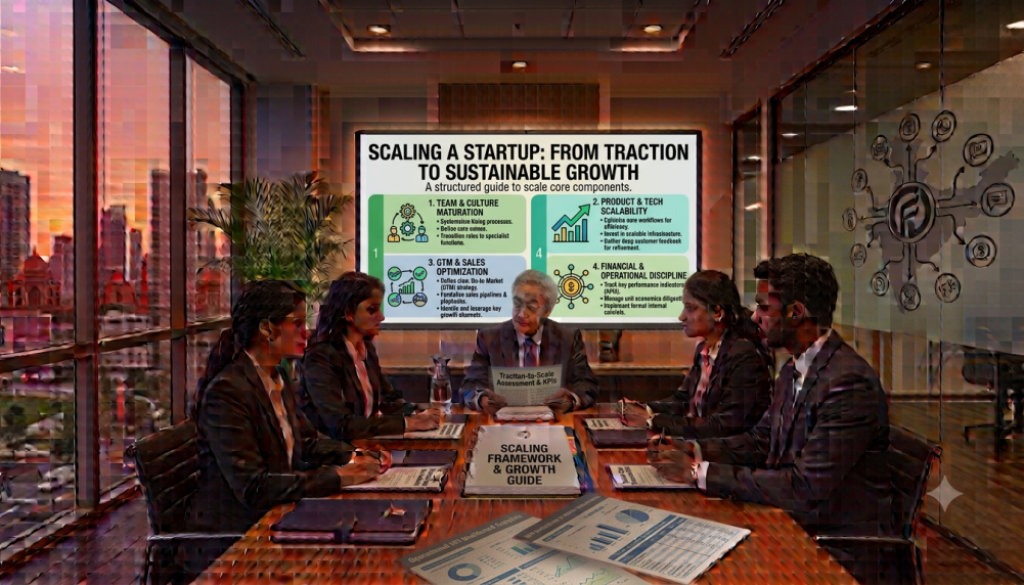
1. From Founder-Led to Systems-Led Operations
Processes that lived in the founder’s head — how to close a sale, how to onboard a customer, how to resolve common issues — need to be documented and systematized so they can be executed consistently by a growing team, not solely by the founder.
2. From Generalist to Specialist Roles
Early team members often wear many hats out of necessity. As the organization scales, roles typically need to become more defined and specialized, allowing individuals to develop deeper expertise and operate more efficiently within clearer boundaries.
3. From Instinct-Based to Data-Informed Decision-Making
Early-stage decisions are often made quickly, based on founder instinct and limited data. Scaling requires building the reporting and analytics infrastructure needed to make informed decisions systematically, across a growing range of business functions and team members.
4. From Direct Management to Layered Leadership
Founders can directly manage a handful of early employees, but scaling beyond a certain size requires building a management layer — team leads, department heads — who can extend the founder’s oversight without requiring direct involvement in every decision.
5. From Reactive to Proactive Planning
Early-stage startups often operate reactively, responding to immediate opportunities and challenges as they arise. Scaling requires more structured planning — budgeting, hiring plans, quarterly goals — balanced against the flexibility that startups still need to maintain.
Common Scaling Challenges
Maintaining Culture at Scale: The informal, close-knit culture of an early-stage team requires deliberate reinforcement as the organization grows, through clear articulation of values, consistent leadership behavior, and structured onboarding that transmits culture intentionally rather than assuming it will transfer naturally.
Cash Flow Management During Growth: Scaling often requires increased spending — hiring, infrastructure, marketing — ahead of corresponding revenue growth, making disciplined cash flow management and adequate financing critical during this phase.
Maintaining Product Quality and Customer Experience: As customer volume grows, maintaining the same quality of product and customer experience that drove early success requires deliberate investment in systems and team capability, not just organic scaling of existing informal processes.
Founder Role Evolution: Founders often need to consciously shift their own role — from doing the core work personally to building and leading the systems and teams that do it — a transition that can feel uncomfortable but is essential for sustainable scaling.
Signs You’re Ready to Scale
- Consistent, validated product-market fit demonstrated through retention and organic growth, not just paid acquisition.
- A repeatable, reasonably well-understood go-to-market process generating predictable results.
- Core unit economics that make sense at increased volume, not just in small-scale testing.
- Founder bandwidth and organizational systems capable of supporting increased complexity.
Key Takeaways
- Scaling a startup requires systematizing knowledge that previously lived primarily with the founder.
- Roles typically need to become more specialized as the organization grows beyond the earliest stages.
- Data-informed decision-making and layered leadership become increasingly necessary at scale.
- Culture requires deliberate reinforcement during growth, not assumption that it will transfer naturally.
- Founders need to consciously evolve their own role from hands-on execution to systems and team leadership.
Conclusion
The transition from early traction to sustainable scale is one of the most challenging phases in a startup’s life, requiring founders to develop genuinely new skills and letting go of some of the hands-on approaches that drove initial success. Approached deliberately, this transition sets the foundation for durable, long-term growth.