Startup Funding in India: A Practical Guide to Your Options
Startup funding India offers entrepreneurs multiple ways to finance and grow their businesses beyond traditional venture capital. From bootstrapping and angel investors to government schemes and bank loans, choosing the right funding option depends on your startup’s stage, business model, and long-term goals. Understanding these options helps founders make informed financial decisions.
Startup funding conversations in India are often dominated by venture capital headlines — large funding rounds, unicorn valuations, celebrated investor names. This visibility can create a misleading impression that VC funding is the default, or even necessary, path for every startup. In reality, most successful Indian businesses are built through a mix of funding sources, and choosing the right path for your specific business matters far more than following whatever gets the most media attention.
Understanding Startup Funding India Options
Choosing the right startup funding India option depends on your business goals, available capital, growth strategy, and willingness to share ownership with investors.
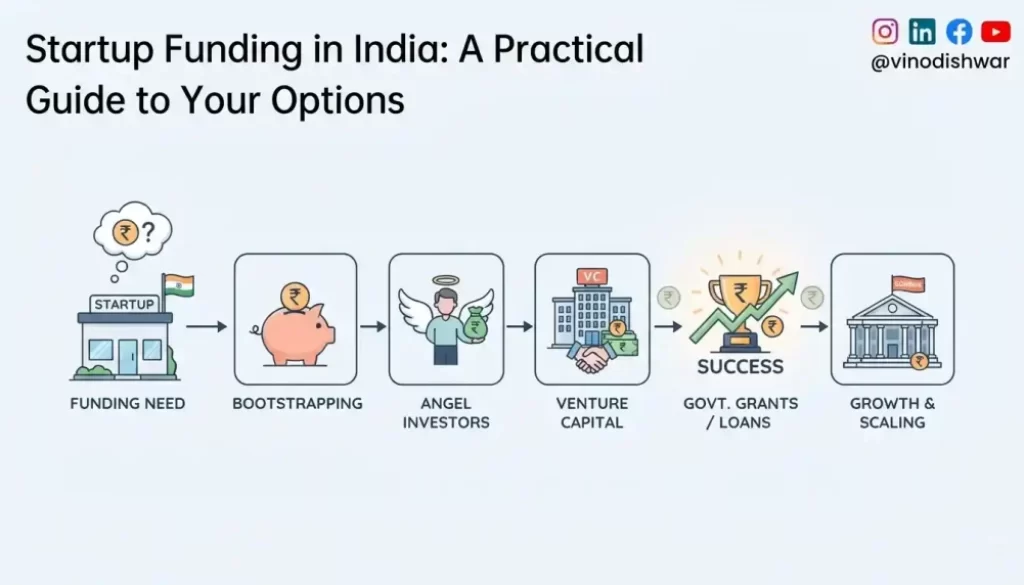
1. Bootstrapping
Funding the business through personal savings, revenue reinvestment, and disciplined cost management, without external capital. Bootstrapping preserves full ownership and control but requires patience, discipline, and often a slower growth trajectory in the early stages.
2. Friends and Family Funding
Early-stage capital from personal networks, often on informal or simplified terms. While accessible, this route carries real relationship risk if the business struggles, and should be approached with the same clarity and documentation as any other investment.
3. Angel Investors
Individual investors, often experienced entrepreneurs or industry professionals, who invest personal capital in early-stage startups in exchange for equity, typically bringing mentorship and networks alongside capital.
4. Venture Capital
Institutional investors funding startups with high growth potential in exchange for equity, typically across defined funding stages (seed, Series A, and beyond). VC funding suits businesses with genuinely large market opportunities and scalable models, but comes with expectations of rapid growth and eventual significant returns.
5. Government Schemes and Grants
India offers various government-backed schemes supporting startups — including funding support, tax benefits, and incubation assistance through initiatives like Startup India — which can provide non-dilutive or favorable-term capital for eligible businesses.
6. Bank Loans and NBFC Financing
Traditional debt financing, including MSME loan schemes, can suit businesses with predictable cash flows and collateral, offering capital without equity dilution, though typically requiring established revenue history.
7. Revenue-Based Financing
An increasingly available option in India where investors provide capital in exchange for a percentage of future revenue until a predetermined return is reached, suiting businesses with steady revenue but wanting to avoid equity dilution.
8. Crowdfunding
Raising smaller amounts of capital from a large number of individual backers, typically suited to consumer products with strong pre-launch appeal and marketing potential.
How to Choose the Right Startup Funding India Option
Consider Your Growth Trajectory: Venture capital suits businesses targeting rapid, large-scale growth with a credible path to significant market capture. Steadier, more moderate-growth businesses are often better served by bootstrapping, debt financing, or angel investment.
Consider Control and Ownership Priorities: Equity funding dilutes ownership and typically introduces investor expectations around growth pace and eventual exit. Founders prioritizing long-term control may prefer debt or revenue-based financing where viable.
Consider Your Industry and Business Model: Capital-intensive businesses (deep technology, manufacturing) often genuinely require external funding to reach viability, while service-based or lower-capital businesses may sustainably bootstrap much further before needing external capital.
Consider Your Stage and Traction: Different funding sources become realistically accessible at different stages — angel investors and grants often suit very early-stage startups, while venture capital typically requires demonstrated traction and a scalable, proven model.
Common Startup Funding India Mistakes
- Raising venture capital by default, without evaluating whether the business model genuinely fits VC-scale growth expectations.
- Taking funding from friends and family without proper documentation, risking relationships if the business struggles.
- Underestimating the time and effort required to raise funding, which can distract significantly from actually building the business.
- Over-diluting equity in early rounds, leaving insufficient ownership incentive for founders through later stages.
- Ignoring government schemes and grants that could provide favorable-term capital without equity dilution.
Key Takeaways
- Venture capital is one of many funding options, not the default path for every startup.
- Bootstrapping preserves ownership and control but requires patience and financial discipline.
- Government schemes and grants can provide favorable-term, non-dilutive capital for eligible startups.
- The right funding path depends on growth trajectory, industry, control priorities, and business stage.
- Raising funding, regardless of source, requires significant founder time and should be planned deliberately.
Conclusion
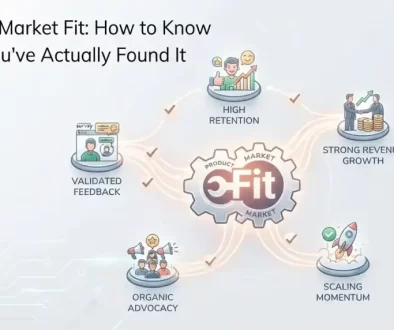
Every startup funding India decision should align with your long-term business vision, financial discipline, and operational growth plans. Before raising investment, founders should first validate product-market fit to ensure there is genuine customer demand.
Choosing the right funding path is a strategic decision that shapes your startup’s ownership structure, growth expectations, and operational flexibility for years to come. Evaluating your options thoughtfully, rather than defaulting to whichever path is most visible or fashionable, sets a stronger foundation for sustainable startup growth.