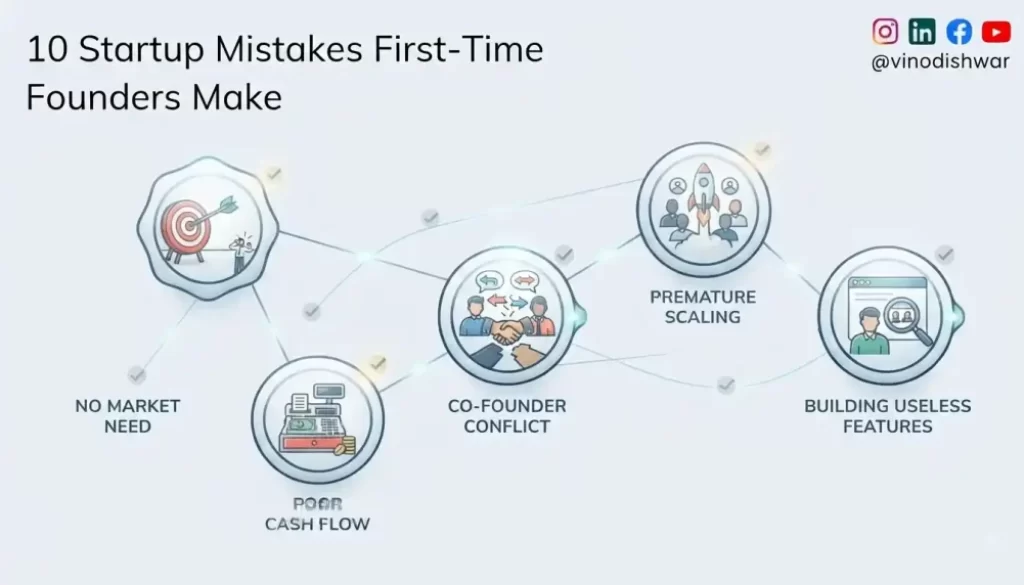
10 Startup Mistakes First-Time Founders Make
Startup mistakes are one of the biggest reasons promising businesses struggle during their early stages. First-time founders often face challenges related to validation, hiring, funding, team management, and business strategy. Understanding these common mistakes before they happen can help entrepreneurs make better decisions and build stronger, more sustainable companies.
Before making major decisions, founders should first understand how to achieve product-market fit because validating customer needs is one of the most important steps in building a successful startup.
Entrepreneurs should also understand basic compliance requirements through resources provided by the Ministry of Corporate Affairs.
1. Building Before Validating
Falling in love with a solution before confirming the problem is real and significant enough for customers to pay to solve. Avoid it by: validating demand through customer conversations and low-cost tests before building extensively.
2. Solving a Problem Only the Founder Has
Founders sometimes build solutions to problems that feel significant to them personally but don’t represent a widespread, urgent need in the broader market. Avoid it by: rigorously testing whether the problem is genuinely shared and significant across a large enough customer base.
3. Raising Funding Prematurely or Unnecessarily
Pursuing venture capital before the business model or traction genuinely justifies it, leading to unnecessary dilution, pressure for premature scaling, or difficulty raising at all. Avoid it by: evaluating whether your specific business genuinely needs and fits venture-scale funding before pursuing it.
Many first-time founders benefit from expert guidance during this stage. Professional startup consulting services can help entrepreneurs evaluate funding decisions, business models, and growth strategies before making critical commitments.
4. Hiring Too Fast, Too Early
Building out a large team before achieving product-market fit increases burn rate and organizational complexity before the business has validated what it’s actually optimizing for. Avoid it by: staying lean until core assumptions are validated, then scaling the team deliberately.
5. Ignoring Unit Economics
Focusing purely on growth metrics without understanding whether each customer is fundamentally profitable to acquire and serve. Avoid it by: tracking and understanding customer acquisition cost and lifetime value from an early stage, even if imprecisely.
6. Co-Founder Conflicts Left Unaddressed
Misaligned expectations, unclear equity splits, or unresolved disagreements between co-founders frequently derail otherwise promising startups. Avoid it by: having explicit, documented conversations about roles, equity, and decision-making early, and revisiting them as the business evolves.
7. Chasing Every Opportunity Simultaneously
Pursuing multiple customer segments, product directions, or business models at once, without focus, dilutes resources and slows genuine learning. Avoid it by: deliberately narrowing focus, even when it feels like leaving opportunities on the table.
8. Underestimating Go-to-Market Complexity
Assuming a great product will naturally attract customers without a deliberate, well-resourced go-to-market strategy. Avoid it by: treating customer acquisition as a core strategic priority from the earliest stages, not an afterthought once the product is built.
9. Ignoring Legal and Structural Fundamentals
Delaying proper incorporation, IP protection, contracts, and cap table management until problems arise, often creating costly complications later. Avoid it by: addressing core legal and structural fundamentals early, even on a lean budget.
10. Founder Burnout From Unsustainable Pace
Operating at an unsustainable personal pace for extended periods, leading to poor decision-making, health issues, or eventual founder departure. Avoid it by: building sustainable habits and support systems early, recognizing that startups are a long-term endeavor requiring endurance, not just short bursts of intensity.
Why These Startup Mistakes Are So Common
Most first-time founders make these mistakes not from lack of intelligence or effort, but from lack of pattern recognition that only comes from experience — their own, or borrowed through mentors, advisors, and structured guidance. This is precisely why experienced startup consultants and advisors can add significant value even to talented, capable founding teams.
Avoiding these startup mistakes requires founders to focus on validation, planning, financial discipline, and building strong operational systems from the beginning.
Key Takeaways
- Most startup failures stem from an accumulation of predictable, avoidable mistakes rather than a single catastrophic decision.
- Validation, disciplined hiring, and unit economics awareness prevent several of the most damaging early mistakes.
- Co-founder alignment and legal fundamentals deserve early, explicit attention, not deferred handling.
- Focus — resisting the pursuit of every available opportunity simultaneously — significantly improves early-stage learning and traction.
- Experienced mentorship and advisory support can help founders avoid costly, common pitfalls.
- Founders can explore startup resources and government initiatives through Startup India.
Conclusion
First-time founders don’t need to learn every lesson through painful personal experience. Recognizing these common startup mistakes in advance, and building deliberate habits and processes to avoid them, significantly improves the odds of building a resilient, successful business.
-Vinod Ishwar
Frequently Asked Questions (FAQs)
1. What are the most common startup mistakes made by first-time founders?
The most common startup mistakes made by first-time founders include building without validating the idea, ignoring customer needs, hiring too early, raising funding prematurely, poor financial planning, and failing to create scalable business systems.
2. Why do many startups fail in the early stages?
Many startups fail because founders do not properly validate market demand, misunderstand customer needs, run out of cash, lack a clear growth strategy, or fail to build the right team and operational processes.
3. How can founders avoid startup mistakes?
Founders can avoid startup mistakes by conducting market research, speaking with customers, testing ideas before investing heavily, tracking financial metrics, building strong teams, and seeking guidance from experienced mentors or consultants.
4. Why is validating a startup idea important?
Validating a startup idea helps founders understand whether customers actually need the product or service. It reduces the risk of spending time and money building something that does not solve a meaningful problem.
5. Should first-time founders raise funding immediately?
First-time founders should not raise funding immediately unless their business model, market opportunity, and growth potential justify it. Premature funding can create unnecessary pressure and reduce ownership through early dilution.