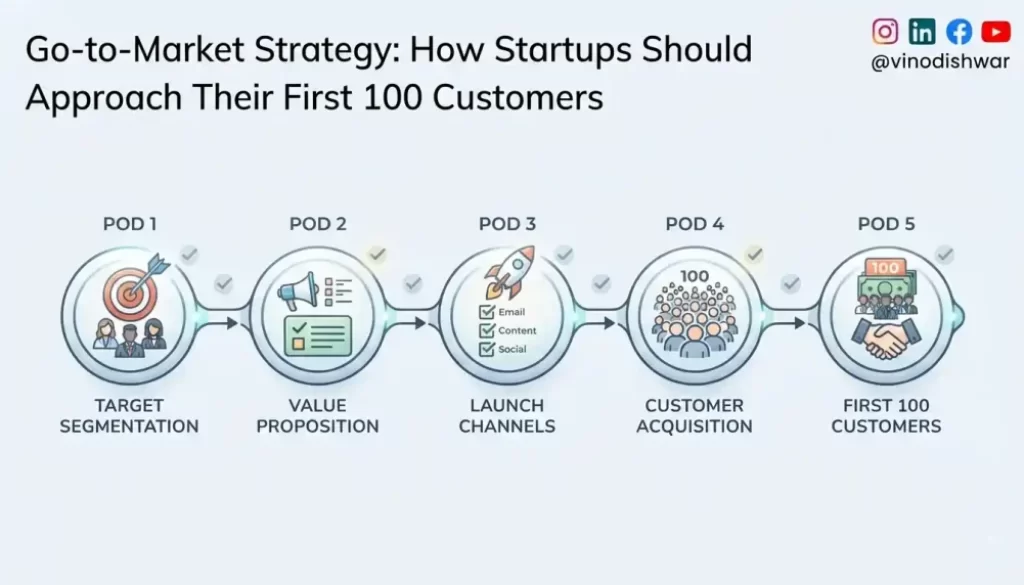
Go-to-Market Strategy: How Startups Should Approach Their First 100 Customers
A strong go-to-market strategy is essential for startups trying to acquire their first customers and build sustainable growth. Early-stage startups need a different approach than established companies because the focus is not only on customer acquisition but also on learning, testing, and refining their product positioning. Before executing a go-to-market strategy, founders should first validate their product-market fit and ensure there is genuine customer demand.
There’s a meaningful difference between the strategy that gets a startup its first 100 customers and the strategy that eventually scales it to 100,000. Many founders make the mistake of designing their go-to-market approach around scaled, later-stage tactics — broad advertising, extensive content marketing, large partnership deals — when what’s actually needed early on is something far more hands-on, targeted, and iterative.
Why an Early-Stage Go-to-Market Strategy Is Different
In the earliest stages, the goal isn’t just acquiring customers — it’s learning. Every early customer interaction provides invaluable insight into what messaging resonates, which features actually matter, what objections arise, and how to refine the product and positioning. Treating early customer acquisition purely as a numbers game, rather than a learning opportunity, wastes this critical early information.
Building an Effective Go-to-Market Strategy for Startups
1. Start With a Narrow, Specific Target Segment
Rather than targeting a broad market from day one, focus intensely on a narrow, well-defined customer segment where your solution’s value is most obvious and urgent. Winning a smaller, specific segment thoroughly builds stronger initial traction and referenceable success than spreading thin across a broad audience. Understanding customer needs early also helps founders avoid common startup mistakes that slow down growth.
2. Do Things That Don’t Scale
Early-stage founders often benefit enormously from manually, personally acquiring their first customers — direct outreach, personal networks, manual onboarding, hands-on customer support — even when these approaches clearly won’t scale to thousands of customers. This hands-on approach generates learning and trust that automated, scaled approaches can’t replicate early on.
3. Leverage Founder Networks and Credibility
Early customers often come through founder relationships, industry connections, and direct outreach rather than paid marketing. These relationship-based channels also tend to produce higher-quality feedback and more forgiving early adopters willing to work through inevitable early-stage rough edges.
4. Identify and Double Down on Your Strongest Channel
Rather than spreading effort evenly across many acquisition channels, closely track which channel is producing your best early customers — in terms of both acquisition cost and quality — and disproportionately invest further effort there before diversifying.
5. Turn Early Customers Into Advocates
Early customers who have a genuinely positive experience are your most credible source of new customers through referrals and testimonials. Actively nurturing these relationships, and making it easy for them to refer others, compounds your go-to-market efforts significantly.
6. Iterate Your Messaging Based on Real Conversations
Pay close attention to the specific language early customers use to describe their problem and your solution’s value — this authentic language, refined through real conversations, typically performs far better in marketing than internally generated messaging.
Common Early Go-to-Market Mistakes
- Trying to appeal to too broad a market before establishing strong traction in a specific segment.
- Relying primarily on paid advertising before understanding which messaging and channels actually convert.
- Avoiding manual, hands-on customer acquisition in favor of premature automation.
- Underinvesting in early customer relationships, missing valuable feedback and referral opportunities.
- Copying the go-to-market strategy of larger, established competitors without adjusting for early-stage constraints.
How a Go-to-Market Strategy Evolves After Early Traction
As your startup validates its strongest channels and messaging through early, hands-on efforts, the transition toward more scalable tactics — paid acquisition, content marketing, partnerships — should be built on the validated learnings from this early stage, rather than starting scaled efforts from assumptions alone. Having the right leadership and execution capability is essential when building an effective early-stage growth strategy. Founders can explore entrepreneurship resources and startup programs through Startup India.
Key Takeaways
- Early go-to-market strategy should prioritize learning alongside customer acquisition.
- Narrow, specific target segments build stronger initial traction than broad early targeting.
- Manual, hands-on acquisition approaches generate valuable trust and learning, even without scalability.
- Early customer relationships and referrals compound go-to-market effectiveness significantly.
- Scaled tactics should build on validated early-stage learnings, not replace the discovery process entirely.
Conclusion
Building a strong go-to-market strategy requires continuous testing, customer conversations, and improvements based on real market feedback.
The path to a startup’s first 100 customers looks fundamentally different from the path to its next 10,000 — and founders who recognize and embrace this distinction build stronger, more sustainable early traction. Prioritizing focused, hands-on, learning-oriented go-to-market efforts in the earliest stages sets a much stronger foundation for later, more scalable growth.
-Vinod Ishwar
Frequently Asked Questions (FAQs)
1. What is a go-to-market strategy for a startup?
A go-to-market strategy is a structured plan that helps a startup identify its target customers, position its product, choose effective marketing channels, and acquire customers successfully. It focuses on understanding the market and creating a repeatable path to growth.
2. Why is a go-to-market strategy important for early-stage startups?
A go-to-market strategy is important because early-stage startups need to understand their customers, test assumptions, identify effective acquisition channels, and build traction before investing heavily in growth.
3. How should startups get their first 100 customers?
Startups should get their first 100 customers by focusing on a specific target segment, conducting direct outreach, leveraging founder networks, talking to customers, and providing a personalized experience rather than relying only on automated marketing.
4. What is the difference between an early-stage and a scaled go-to-market strategy?
An early-stage go-to-market strategy focuses on learning, customer conversations, testing, and finding product-market fit. A scaled strategy focuses on expanding proven channels through advertising, partnerships, automation, and larger marketing campaigns.
5. Should startups focus on one customer segment initially?
Yes, startups should usually focus on a narrow customer segment initially. A specific target audience allows founders to understand customer problems better, refine messaging, and build stronger early traction.
6. Why should founders manually acquire their first customers?
Manually acquiring early customers helps founders understand customer needs, collect valuable feedback, improve their product, and build stronger relationships before investing in scalable acquisition methods.