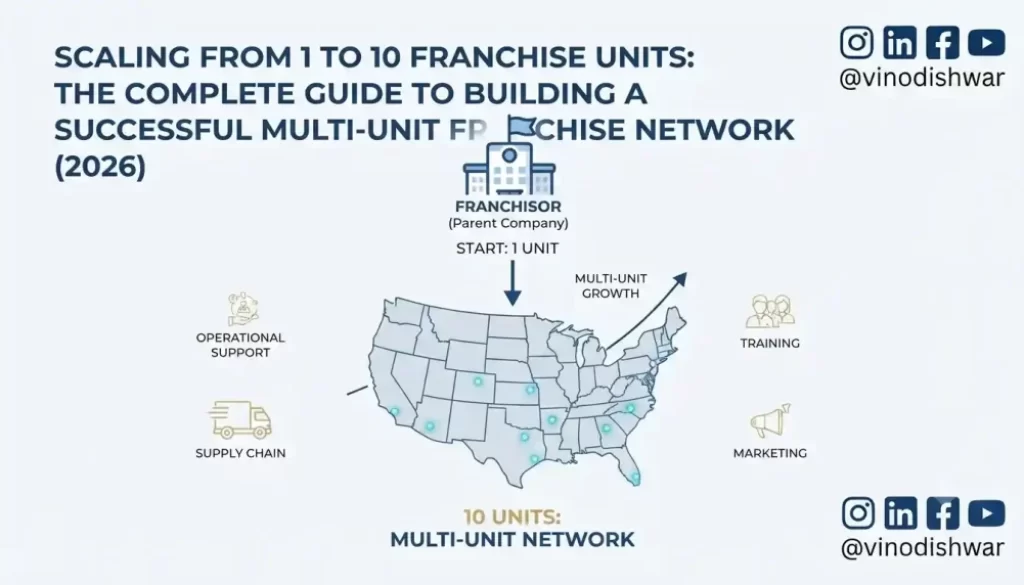
Scaling from 1 to 10 Franchise Units: The Complete Guide to Building a Successful Multi-Unit Franchise Network (2026)
Scaling from 1 to 10 Franchise Units is one of the most important milestones in franchise development. Opening the first franchise location is a major achievement, but building a profitable network of ten successful franchise units requires standardized systems, operational consistency, strong leadership, and a scalable growth strategy.
Opening the first franchise location is a major milestone—but scaling from one successful unit to a network of ten profitable franchise locations is where true franchise growth begins.
Many businesses successfully launch their first franchise but struggle to expand because they lack standardized systems, operational consistency, franchise recruitment processes, leadership structures, and scalable technology. As a result, growth becomes unpredictable, customer experience declines, and operational challenges increase.
Scaling from 1 to 10 franchise units requires a strategic approach that balances rapid expansion with quality control. Businesses must focus on repeatable operations, franchisee success, territory planning, performance measurement, and long-term brand protection.
Whether you’re franchising a restaurant, café, retail chain, salon, preschool, healthcare business, fitness center, manufacturing company, or service brand, this guide explains how to build a scalable franchise network that supports sustainable growth.
Important: Expansion should always comply with applicable franchise, licensing, employment, tax, consumer protection, and industry-specific regulations. Work with qualified legal, financial, and tax professionals throughout your expansion journey.
Why Scaling from 1 to 10 Franchise Units Is a Critical Growth Stage
The transition from a single franchise location to a network of ten units is often the most challenging stage of franchise development.
At this stage, businesses move from:
- Founder-led operations to system-driven management
- Manual processes to standardized workflows
- Local marketing to regional brand building
- Individual supervision to leadership teams
- Single-location reporting to network-wide analytics
The goal is to create a business that grows through systems—not founder dependency.
Benefits of Scaling from 1 to 10 Franchise Units
A successful multi-unit network can provide:
- Stronger brand recognition
- Greater purchasing power
- Increased operational efficiency
- Higher recurring royalty revenue
- Better supplier relationships
- More predictable cash flow
- Stronger investor confidence
- Improved market coverage
However, these benefits depend on disciplined execution and operational consistency.
Scaling from 1 to 10 Franchise Units Roadmap
Stage 1: Perfect Your Pilot Unit
Before expanding, ensure your first location consistently demonstrates:
- Profitable operations
- Documented SOPs
- High customer satisfaction
- Stable staffing
- Proven marketing strategies
- Reliable financial reporting
Your pilot unit should serve as the model for future franchise locations.
Stage 2: Standardize Operations
Create repeatable systems including:
- Operations Manual
- SOP library
- Training programs
- Quality control processes
- Brand Guidelines
- Technology standards
- Vendor management procedures
Standardization reduces variability across locations.
Stage 3: Build a Franchise Recruitment System
Recruit franchisees through a structured process:
- Lead generation
- Candidate qualification
- Discovery meetings
- Financial evaluation
- Due diligence
- Onboarding
Recruiting the right partners is more important than expanding quickly.
Stage 4: Develop Leadership
As the network grows:
- Hire regional managers
- Build support teams
- Delegate operational responsibilities
- Create escalation processes
- Define reporting structures
Leadership capacity must grow alongside the franchise network.
Stage 5: Plan Territories Strategically
Expansion should be based on:
- Population density
- Market demand
- Competition
- Logistics
- Infrastructure
- Demographics
Thoughtful territory planning reduces internal competition and supports sustainable growth.
Stage 6: Implement Technology
Invest in scalable systems such as:
- CRM
- POS
- ERP
- Inventory management
- Business intelligence dashboards
- Franchise portals
- Learning Management Systems (LMS)
Technology enables centralized oversight and consistent execution.
Stage 7: Strengthen Marketing
As the network expands:
- Develop national branding
- Execute regional campaigns
- Optimize SEO
- Build local marketing toolkits
- Standardize digital advertising
- Support franchisee marketing
Consistent marketing reinforces brand recognition across locations.
Stage 8: Monitor Performance
Track KPIs including:
- Unit revenue
- Royalty collection
- Customer satisfaction
- Franchisee profitability
- Operational compliance
- Marketing ROI
- Training completion
- Audit scores
Performance measurement drives continuous improvement.
Scaling from 1 to 10 Franchise Units Timeline
| Growth Stage | Focus |
|---|---|
| Unit 1 | Validate the business model |
| Units 2–3 | Document systems and processes |
| Units 4–5 | Strengthen recruitment and onboarding |
| Units 6–7 | Expand leadership and support teams |
| Units 8–10 | Optimize network performance and regional growth |
Each stage builds the foundation for the next level of expansion.
Building the Infrastructure for 10 Units
Operations
- Standardized SOPs
- Operations Manual
- Quality audits
- Compliance systems
Technology
- CRM
- POS
- ERP
- Reporting dashboards
- Franchise portal
Marketing
- National campaigns
- Local store marketing
- SEO
- Social media
- PR
Finance
- Royalty tracking
- Budget management
- Financial reporting
- Cash flow monitoring
Support
- Franchise Business Consultants
- Regional managers
- Marketing specialists
- Training teams
- Technical support
Scaling Checklist
Before expanding beyond one unit, ensure you have:
Business Systems
- Operations Manual
- SOPs
- Brand Guidelines
- Training modules
Recruitment
- Franchise website
- CRM
- Qualification framework
- Discovery process
Technology
- POS
- CRM
- Analytics dashboard
- LMS
Operations
- Vendor network
- Quality audits
- Compliance processes
- Support structure
Leadership
- Expansion roadmap
- Regional management plan
- Performance review process
- Communication framework
Practical Example
A specialty café brand successfully operated one flagship location and wanted to expand to ten franchise units across multiple cities.
The company implemented:
- Standardized Operations Manual
- Digital training platform
- Territory mapping
- CRM-based franchise recruitment
- Automated KPI dashboards
- Regional field support
- National marketing campaigns
- Quarterly operational audits
Within a structured expansion plan, the brand established multiple franchise locations while maintaining operational consistency and customer experience.
Scaling Framework
Pilot Unit
      │
      ▼
Standardized Systems
      │
      ▼
Franchise Recruitment
      │
      ▼
Training & Onboarding
      │
      ▼
Unit 2–3
      │
      ▼
Regional Support
      │
      ▼
Units 4–7
      │
      ▼
Technology & Analytics
      │
      ▼
Units 8–10
      │
      ▼
Continuous Improvement
Common Scaling Mistakes
Avoid these common pitfalls:
- Expanding before the pilot unit is fully optimized
- Inconsistent operating procedures
- Weak franchisee selection
- Insufficient training
- Poor territory planning
- Founder dependency
- Limited technology investment
- Lack of operational audits
- Ignoring franchisee feedback
Rapid growth without strong systems can weaken the franchise network.
Best Practices
- Validate the business model before expansion.
- Document every operational process.
- Recruit franchisees based on quality, not speed.
- Invest in scalable technology.
- Conduct regular operational audits.
- Monitor KPIs across every location.
- Provide continuous coaching and support.
- Review and refine systems as the network grows.
How Franchise Development Consultants Help
Experienced franchise development consultants help businesses:
- Build scalable franchise models
- Design expansion roadmaps
- Create Operations Manuals and SOPs
- Develop recruitment systems
- Plan territories
- Implement CRM and technology platforms
- Train leadership teams
- Coordinate legal documentation and compliance planning with qualified professionals
These capabilities help businesses scale efficiently while protecting brand consistency.
Why Choose Franchise Alpha?
At Franchise Alpha, we help businesses scale from their first franchise to multi-unit networks through our proprietary SOLEMN® Framework, integrating strategy, operations, governance, marketing, and technology.
Strategy
Develop a customized expansion roadmap from one unit to ten and beyond.
Operations
Standardize Operations Manuals, SOPs, quality control, onboarding, and franchise support.
Legal
Coordinate with qualified legal professionals to prepare compliant franchise agreements, intellectual property protections, and expansion documentation.
Entrust
Implement governance systems that maintain consistency, accountability, and operational excellence across the network.
Marketing
Generate qualified franchise leads through SEO, Google Ads, Meta Ads, content marketing, and local marketing systems.
Nitty-Gritty
Deploy CRM platforms, business intelligence dashboards, workflow automation, LMS platforms, and KPI reporting to support scalable growth.
Frequently Asked Questions
When should a business expand beyond its first franchise unit?
Expansion should begin only after the pilot unit demonstrates consistent operational success, documented systems, strong financial performance, and repeatable customer experience.
What is the biggest challenge when scaling to 10 franchise units?
The biggest challenge is maintaining operational consistency while expanding rapidly. Standardized systems, strong leadership, and effective support structures help address this challenge.
How important is technology in franchise scaling?
Technology plays a vital role by centralizing reporting, supporting communication, automating workflows, tracking KPIs, and improving operational consistency across multiple locations.
What should franchisors measure during expansion?
Key metrics include unit revenue, customer satisfaction, franchisee profitability, compliance scores, royalty collection, training completion, marketing performance, and operational audit results.
Conclusion
Scaling from 1 to 10 franchise units is a defining stage in the evolution of any franchise brand.
By building standardized systems, investing in leadership, implementing scalable technology, recruiting the right franchise partners, and maintaining operational excellence, businesses can transition from a single successful location to a thriving multi-unit franchise network.
The strongest franchise brands grow through disciplined execution, continuous improvement, and a commitment to franchisee success.
Call to Action
Ready to Scale from 1 to 10 Franchise Units?
Book a Franchise Readiness Assessment with Vinod Ishwar and discover how to create a structured franchise expansion roadmap for sustainable multi-unit growth.
Your assessment includes:
- Franchise Expansion Audit
- Operational Scalability Review
- Recruitment & Territory Assessment
- Technology & KPI Evaluation
- Customized Franchise Growth Roadmap
Build a scalable franchise network with systems designed for long-term success.