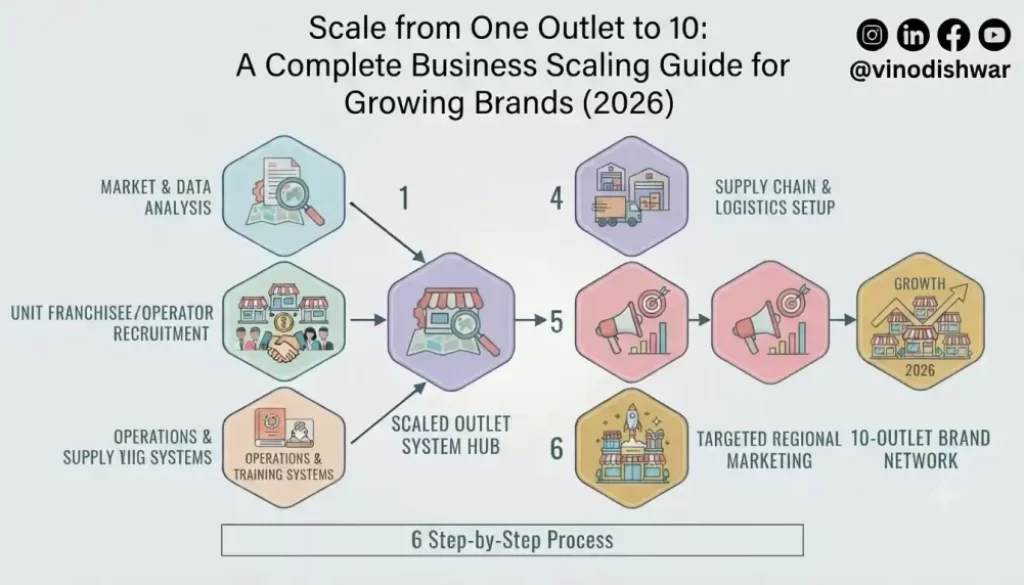
Scale from One Outlet to 10: A Complete Business Scaling Guide for Growing Brands (2026)
Introduction
Scale from One Outlet to 10 is the goal of many ambitious entrepreneurs, but achieving sustainable multi-location growth requires more than simply opening new branches. It demands proven systems, operational consistency, strong leadership, and a structured expansion strategy. Opening your first outlet proves your business idea works.
Opening your first outlet proves your business idea works.
Opening ten successful outlets proves your business is truly scalable.
Many entrepreneurs dream of expanding across multiple cities, but growth often brings new challenges. As locations increase, so do operational complexity, staffing issues, quality control, inventory management, customer expectations, and leadership demands.
Businesses that expand without proper systems often experience declining service quality, inconsistent customer experiences, rising costs, and founder burnout.
The solution is not working harder—it’s building a scalable business model.
Whether you plan to expand through company-owned outlets, franchising, or a hybrid model, your business must be designed to operate consistently across every location.
This guide explains how to scale from one outlet to ten using proven business systems, operational excellence, leadership development, and strategic planning.
Scale from One Outlet to 10: Why Scaling Is Different from Growth
Growth and scaling are often confused.
Growth usually means increasing revenue by increasing resources.
Scaling means increasing revenue faster than operating costs while maintaining quality and profitability.
A scalable business can:
- Replicate operations
- Maintain consistent customer experience
- Operate independently of the founder
- Expand into multiple markets
- Train new teams efficiently
- Protect brand standards
Scaling creates long-term business value. Working with an experienced Business Expansion Consultant can help you choose the right growth model.
Why Businesses Struggle After Their First Outlet
Common challenges include:
- Founder dependency
- No documented SOPs
- Weak middle management
- Inconsistent customer experience
- Poor inventory control
- Lack of financial reporting
- Weak recruitment systems
- Limited technology adoption
- Poor communication
- No expansion roadmap
Most businesses don’t fail because demand is low—they fail because systems cannot support growth. Research from the International Franchise Association (IFA) provides valuable guidance on scaling franchise businesses.
The 15-Step Framework to Scale from One Outlet to Ten
Step 1. Perfect Your First Outlet
Before expanding, ensure your flagship outlet consistently delivers:
- Strong profitability
- Repeat customers
- Efficient operations
- Standardized processes
- Positive customer reviews
Your first outlet becomes the blueprint for future locations.
Step 2. Document Every Process
Create Standard Operating Procedures (SOPs) for:
- Opening and closing
- Customer service
- Sales
- Inventory
- Purchasing
- Marketing
- HR
- Finance
- Quality control
If a process isn’t documented, it can’t be replicated consistently.
Step 3. Build an Operations Manual
Develop a comprehensive Operations Manual covering:
- Daily operations
- Brand standards
- Staff responsibilities
- Equipment usage
- Safety procedures
- Compliance requirements
- Performance expectations
The manual becomes the operating system for every outlet.
Step 4. Reduce Founder Dependency
Train managers to handle:
- Daily decisions
- Team leadership
- Customer issues
- Inventory
- Reporting
The business should continue operating even when the founder is absent.
Step 5. Standardize Customer Experience
Ensure every customer receives the same experience through:
- Uniform service standards
- Product consistency
- Store design
- Brand communication
- Staff behavior
Consistency builds trust.
Step 6. Invest in Technology
Implement:
- POS systems
- CRM software
- Inventory management
- HR software
- Financial dashboards
- Business analytics
Technology enables smarter decision-making.
Step 7. Build Leadership Teams
Develop department leaders for:
- Operations
- Sales
- Marketing
- Finance
- Human Resources
- Training
Strong leaders enable sustainable expansion.
Step 8. Create Training Systems
Standardize learning with:
- Training manuals
- Videos
- LMS platforms
- Practical assessments
- Certification programs
Training ensures every new outlet performs consistently.
Step 9. Strengthen Financial Controls
Track:
- Revenue
- Profit margins
- Inventory costs
- Labour costs
- Cash flow
- Outlet performance
Financial discipline supports profitable scaling.
Step 10. Develop Expansion Criteria
Choose new locations based on:
- Market demand
- Population
- Competition
- Accessibility
- Demographics
- Purchasing power
Expansion should be data-driven.
Step 11. Build a Replicable Launch Process
Standardize:
- Site selection
- Store design
- Vendor setup
- Recruitment
- Marketing launch
- Opening checklist
Every outlet should follow the same launch framework.
Step 12. Establish Performance Metrics
Measure KPIs including:
- Daily sales
- Customer satisfaction
- Employee productivity
- Inventory turnover
- Marketing ROI
- Profitability
Performance should be measurable across every outlet.
Step 13. Decide Your Expansion Model
Options include:
- Company-owned outlets
- Franchising
- Master Franchise
- Area Development
- Joint Ventures
Choose the model aligned with your long-term vision.
Step 14. Scale Carefully
Expand only when:
- Existing outlets are profitable
- Teams are stable
- Systems are proven
- Capital is available
- Leadership is ready
Sustainable growth is better than rapid expansion without structure.
Step 15. Continuously Improve
Successful businesses regularly:
- Review operations
- Update SOPs
- Improve training
- Analyze customer feedback
- Invest in innovation
Scaling is an ongoing process—not a one-time project.
Key Systems Required Before Opening the Second Outlet
Before expanding, ensure you have:
- Operations Manual
- SOP Library
- CRM System
- POS Software
- HR Policies
- Financial Reports
- Training Program
- Marketing Toolkit
- Vendor Network
- Performance Dashboard
Strong systems reduce expansion risk.
Common Scaling Mistakes
Avoid these common errors:
- Expanding too early
- Hiring without training
- Ignoring systems
- Weak financial controls
- Founder micromanagement
- Inconsistent branding
- Poor communication
- Lack of leadership development
Scaling without structure often leads to operational failure.
How Business Expansion Consultants Help
Experienced consultants help businesses by:
- Assessing expansion readiness
- Developing scaling strategies
- Creating SOPs
- Building Operations Manuals
- Standardizing customer experience
- Designing franchise models
- Improving operational systems
- Supporting multi-location growth
Professional guidance reduces risk and accelerates expansion.
The SOLEMN® Framework
At Franchise Alpha, businesses scale using the proprietary SOLEMN® Framework.
Strategy
Develop a long-term roadmap for multi-location expansion, profitability, and sustainable growth.
Operations
Standardize SOPs, Operations Manuals, training systems, technology, and quality control.
Legal
Protect intellectual property, ensure compliance, and establish scalable business agreements.
Entrust
Build leadership capability, strengthen organizational culture, and reduce founder dependency.
Marketing
Expand through digital marketing, local campaigns, brand positioning, and customer acquisition strategies.
Nitty-Gritty
Measure KPIs, optimize performance, refine systems, and continuously improve operational excellence.
This framework enables businesses to scale confidently while maintaining consistency across every outlet.
Frequently Asked Questions
When should I open my second outlet?
Expand only after your first outlet demonstrates consistent profitability, documented systems, stable operations, and a capable management team.
Is franchising the best way to scale?
Franchising is one of the most capital-efficient expansion models, but it requires strong systems, documentation, and operational readiness before implementation.
How important are SOPs when scaling?
SOPs ensure every outlet follows the same operational standards, reducing errors and maintaining consistent customer experiences.
Should the founder manage every outlet?
No. Successful scaling depends on leadership teams, standardized systems, and operational independence rather than founder involvement in daily activities.
Conclusion
Scaling from one outlet to ten is one of the biggest milestones in any entrepreneur’s journey.
Success is not determined by how quickly you open new locations—it is determined by how consistently each outlet performs.
Businesses that invest in systems, leadership, technology, training, and operational excellence create scalable organizations capable of long-term growth.
The goal is not simply to open more outlets—it is to build a business that performs consistently, profitably, and independently across every location.
Call to Action
Build a Scalable Multi-Outlet Business
Book a Business Scaling Strategy Session with Vinod Ishwar to evaluate your expansion readiness, develop scalable business systems, create SOPs, build an Operations Manual, and design a roadmap to grow from one outlet to ten and beyond.
Receive a customized business scaling blueprint designed for sustainable growth.