Scale from 10 to 100 Outlets: The Complete Blueprint for National Business Expansion (2026)
Introduction
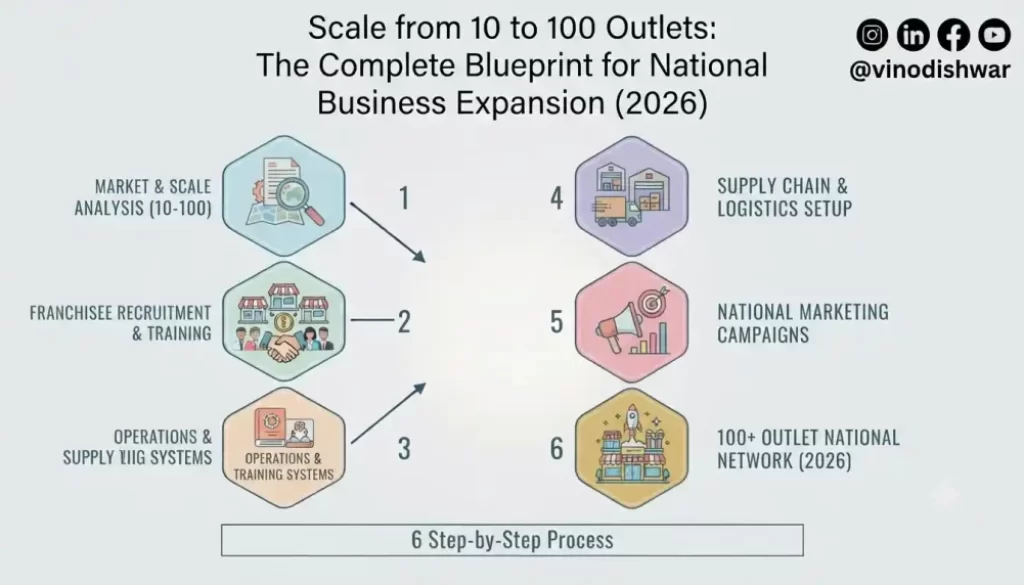
Scale from 10 to 100 Outlets is one of the biggest milestones in business growth. Growing from one outlet to ten proves your business can be replicated, while growing from ten outlets to one hundred proves your organization can scale into a national brand.
Growing from one outlet to ten proves your business can be replicated.
Growing from ten outlets to one hundred proves your organization can scale into a national brand.
At this stage, expansion is no longer about opening more locations—it is about building an enterprise capable of managing hundreds of employees, multiple regional teams, complex supply chains, advanced technology systems, standardized operations, and consistent customer experiences across an entire country.
Many businesses successfully reach ten outlets but struggle to expand further because their systems, leadership, and infrastructure were never designed for enterprise-level growth.
Scaling from 10 to 100 outlets requires a completely different mindset. Businesses planning Franchise Development should first establish scalable systems and operational consistency.
It requires strategic planning, organizational maturity, automation, leadership development, operational excellence, and scalable business systems.
This guide explains how successful brands build the foundation for nationwide expansion.
What Does It Mean to Scale from 10 to 100 Outlets?
Scaling from 10 to 100 outlets means transforming your business from a growing company into a professionally managed enterprise capable of operating consistently across multiple cities, regions, or countries.
This stage focuses on:
- Enterprise leadership
- Regional management
- Standardized operations
- Technology integration
- Brand governance
- Financial scalability
- Supply chain optimization
- Performance management
- Franchise expansion
- Sustainable growth
The objective is to create a business that grows without sacrificing quality, profitability, or customer experience.
Why Businesses Stall After 10 Locations
Common reasons include:
- Founder-centric decision making
- Weak middle management
- Inconsistent operations
- Limited technology
- Poor reporting systems
- Weak supply chain
- No regional leadership
- Inadequate training
- Poor communication
- Lack of strategic planning
Growth slows when organizational capability fails to keep pace with expansion.
The 15-Step Framework to Scale from 10 to 100 Outlets
Step 1. Build an Enterprise Leadership Team
Move beyond owner-led management by appointing leaders for:
- Operations
- Finance
- Marketing
- Human Resources
- Technology
- Supply Chain
- Franchise Development
Leadership drives scalable growth.
Step 2. Standardize Every Business Process
Create documented systems covering:
- Daily operations
- Customer service
- Quality assurance
- Inventory
- HR
- Finance
- Marketing
- Procurement
- Compliance
Every outlet should operate identically.
Step 3. Upgrade Your Operations Manual
Expand documentation into a comprehensive enterprise manual including:
- Regional operations
- Crisis management
- Audit procedures
- Expansion standards
- Performance benchmarks
Enterprise documentation reduces operational variation.
Step 4. Create Regional Management Structures
Assign regional managers responsible for:
- Operational excellence
- Staff performance
- Quality control
- Financial reporting
- Compliance
Regional leadership enables faster decision-making.
Step 5. Invest in Enterprise Technology
Implement:
- ERP systems
- Advanced CRM
- Business Intelligence dashboards
- AI-powered analytics
- Inventory automation
- Workforce management software
Technology becomes the backbone of large-scale operations. Businesses evaluating enterprise CRM and automation solutions can explore Zoho CRM for scalable customer relationship management.
Step 6. Strengthen Supply Chain Management
Develop:
- Centralized procurement
- Vendor partnerships
- Warehouse systems
- Logistics planning
- Demand forecasting
Efficient supply chains improve profitability and consistency.
Step 7. Build a Franchise or Expansion Division
Create dedicated teams for:
- Franchise recruitment
- Territory management
- Business development
- Investor relations
- Expansion planning
Expansion requires specialized expertise. Many growing brands work with a Business Expansion Consultant to develop structured expansion systems.
Step 8. Develop Leadership Pipelines
Create internal programs for:
- Manager development
- Executive coaching
- Succession planning
- Performance reviews
Future leaders should be developed before they are needed.
Step 9. Implement Performance Dashboards
Track KPIs such as:
- Sales per outlet
- Profitability
- Customer satisfaction
- Employee productivity
- Operational compliance
- Marketing performance
Real-time insights improve decision-making.
Step 10. Strengthen Brand Governance
Maintain consistency through:
- Brand guidelines
- Marketing approvals
- Store design standards
- Customer experience audits
Protecting the brand becomes increasingly important at scale.
Step 11. Optimize Financial Management
Monitor:
- Cash flow
- Expansion budgets
- Capital allocation
- ROI
- Cost controls
- Regional profitability
Financial discipline supports sustainable expansion.
Step 12. Expand into New Regions Strategically
Prioritize markets based on:
- Demographics
- Competition
- Infrastructure
- Consumer demand
- Economic growth
Expansion decisions should be driven by market intelligence.
Step 13. Build Continuous Training Systems
Provide:
- Leadership academies
- Online learning platforms
- Certification programs
- Refresher training
- Operations workshops
Training ensures consistent execution across all locations.
Step 14. Reduce Operational Complexity
Simplify:
- Product offerings
- Reporting structures
- Approval processes
- Vendor management
Complexity slows growth.
Step 15. Create a Long-Term Expansion Roadmap
Plan for:
- 100+ locations
- International expansion
- Master franchise opportunities
- Digital transformation
- Innovation
Think beyond today’s growth targets.
Enterprise Systems Required to Scale from 10 to 100 Outlets
A national business should have:
- ERP Platform
- CRM System
- Operations Manual
- SOP Library
- LMS Training Platform
- HRMS
- BI Dashboards
- Audit Systems
- Supply Chain Software
- Franchise Management Platform
Enterprise systems create enterprise performance.
Common Mistakes When You Scale from 10 to 100 Outlets
Avoid:
- Expanding without leadership
- Weak technology
- Inconsistent customer experience
- Poor financial controls
- Founder dependency
- Weak regional management
- Lack of governance
- Inadequate training
Scaling requires structure—not shortcuts.
How Business Expansion Consultants Help
Experienced consultants assist by:
- Designing national expansion strategies
- Building enterprise systems
- Creating franchise growth plans
- Developing SOPs
- Strengthening leadership
- Implementing technology
- Optimizing operations
- Supporting nationwide expansion
Professional guidance reduces risk while accelerating growth.
The SOLEMN® Framework
At Franchise Alpha, enterprise expansion is built using the proprietary SOLEMN® Framework.
Strategy
Design long-term national expansion roadmaps, market entry strategies, and sustainable growth plans.
Operations
Standardize enterprise operations, SOPs, technology systems, quality management, and performance reporting.
Legal
Strengthen governance through franchise agreements, intellectual property protection, compliance frameworks, and corporate policies.
Entrust
Develop executive leadership, regional management teams, succession planning, and organizational culture.
Marketing
Expand nationally through integrated branding, digital marketing, investor acquisition, regional campaigns, and public relations.
Nitty-Gritty
Continuously measure KPIs, optimize operational efficiency, strengthen profitability, and refine expansion systems.
This framework enables businesses to scale confidently from regional success to national leadership.
Frequently Asked Questions
How do businesses scale from 10 to 100 outlets?
Businesses achieve large-scale growth by building enterprise leadership, standardizing operations, investing in technology, strengthening supply chains, and implementing structured expansion systems.
What is the biggest challenge after 10 outlets?
The most common challenge is transitioning from founder-led management to professionally managed systems with regional leadership and standardized processes.
Should expansion continue through franchising or company-owned outlets?
The best model depends on capital, operational capability, industry, and long-term business objectives. Many successful brands use a hybrid approach.
Why hire a Business Expansion Consultant?
A consultant helps develop scalable systems, improve operational efficiency, reduce expansion risks, and create a roadmap for sustainable national growth.
Conclusion
Scaling from 10 to 100 outlets is one of the most significant transformations a business can undertake.
Success requires far more than opening additional locations—it requires building an enterprise capable of delivering consistent quality, operational excellence, and strong financial performance across an expanding network.
Businesses that invest in leadership, technology, standardized systems, and strategic planning position themselves for long-term success. Professional Franchise Consulting helps businesses create sustainable expansion roadmaps while reducing operational risk.
The ultimate goal is not simply to become larger—it is to become stronger, more resilient, and more scalable.
Call to Action
Build Your National Expansion Blueprint
Book a Business Expansion Strategy Session with Vinod Ishwar to assess your readiness for large-scale expansion, strengthen your business systems, build enterprise operations, and create a roadmap to grow from 10 outlets to 100 and beyond.
Receive a customized enterprise growth strategy designed for sustainable nationwide expansion.