Intellectual Property in Franchising: A Complete Guide
A franchise is more than a physical outlet or business model. Much of its value comes from the intellectual property (IP) behind the brand.
The trademark customers recognize, the logo displayed at the location, the operating manuals used by franchisees, proprietary recipes, software, marketing materials and business processes can all form part of a franchisor’s intellectual property.
For franchisors, protecting this IP is essential. For franchisees, understanding what they can use—and what they do not own—is equally important.
A strong franchise system should clearly define ownership, permitted use, protection and post-termination obligations relating to intellectual property.
Learn more about the franchise development process and the key steps involved in building a scalable franchise system.
What Is Intellectual Property in Franchising?
Intellectual property in franchising refers to the intangible assets that help distinguish and operate a franchise business.
These can include:
- Trademarks
- Brand names
- Logos
- Trade dress
- Copyrighted content
- Operating manuals
- Trade secrets
- Recipes
- Business processes
- Software
- Websites
- Marketing materials
- Training materials
- Proprietary technology
The franchisor generally grants the franchisee permission to use relevant IP under defined contractual conditions.
The franchisee does not automatically acquire ownership of that IP. A structured franchise analysis and feasibility review can help identify the systems, processes and competitive advantages that should be protected before expansion.
Why Intellectual Property Matters in Franchising
A successful franchise depends on consistency.
Customers expect the same brand experience across locations.
IP helps maintain that consistency through:
- Brand identity
- Standardized processes
- Marketing materials
- Product presentation
- Technology
- Training
- Proprietary systems
If franchisees use brand assets incorrectly, the entire franchise network can suffer.
Poor IP management can lead to:
- Brand dilution
- Customer confusion
- Unauthorized use
- Counterfeit branding
- Loss of competitive advantage
- Legal disputes
That is why IP protection should be part of the franchise strategy from the beginning.
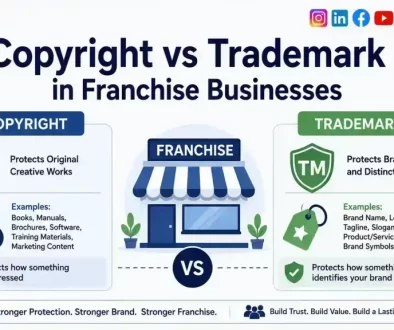
1. Trademarks
Trademarks are among the most valuable IP assets in a franchise.
They can include:
- Brand name
- Logo
- Tagline
- Product names
- Service marks
- Distinctive symbols
In India, trademark protection is primarily governed by the Trade Marks Act, 1999.
Before expanding through franchising, brands should consider whether their key trademarks are appropriately protected in relevant classes and territories.
A franchisor should also monitor unauthorized use of its trademarks.
2. Copyright
Copyright may protect original creative works used within the franchise.
Examples include:
- Website content
- Brochures
- Advertisements
- Photographs
- Videos
- Training materials
- Franchise manuals
- Graphics
- Software code
- Written content
Franchise agreements should clearly state how copyrighted materials can be accessed, copied, modified or distributed.
3. Trade Secrets and Confidential Information
Some of a franchise’s most valuable assets may not be publicly visible.
Examples include:
- Recipes
- Formulas
- Customer databases
- Pricing strategies
- Supplier information
- Marketing strategies
- Business processes
- Proprietary methods
- Expansion plans
These assets may be protected through confidentiality obligations and appropriate contractual controls.
Franchisees and their employees should understand which information is confidential and how it must be handled.
4. Franchise Manuals and SOPs
Operations manuals are central to many franchise systems.
They may contain:
- Operating procedures
- Customer service standards
- Staff processes
- Quality standards
- Inventory procedures
- Technology instructions
- Safety procedures
- Brand standards
The manual can represent significant intellectual property because it captures the franchisor’s accumulated knowledge.
Franchisees should receive access under clearly defined terms rather than unrestricted ownership.
5. Brand Guidelines
Brand guidelines help franchisees use the brand consistently.
They can specify:
- Logo usage
- Colours
- Fonts
- Photography
- Signage
- Packaging
- Social media standards
- Advertising formats
- Tone of voice
This protects the visual and verbal identity of the franchise across multiple locations.
6. Technology and Software
Modern franchise systems increasingly depend on technology.
Relevant IP may include:
- POS systems
- Mobile applications
- Websites
- Franchise management platforms
- CRM systems
- Proprietary software
- Databases
- Digital tools
The franchise agreement should clarify whether technology is:
- Licensed
- Subscription-based
- Proprietary
- Third-party
- Developed specifically for the franchise
It should also address data access and usage after termination.
7. IP Licensing in a Franchise Agreement
A franchise agreement should clearly establish the franchisee’s right to use relevant IP.
It should address:
- Which IP can be used
- Where it can be used
- How it can be used
- Duration of use
- Brand standards
- Restrictions
- Approval procedures
- Consequences of misuse
For example, a franchisee may receive the right to use a trademark only for operating the approved franchise business.
That does not generally give the franchisee ownership of the trademark.
8. Franchisee Responsibilities
Franchisees should be required to protect the franchisor’s IP.
Their responsibilities may include:
- Following brand guidelines
- Using approved marketing materials
- Protecting confidential information
- Avoiding unauthorized modifications
- Reporting infringement
- Using approved technology
- Preventing unauthorized copying
These obligations should be clearly documented.
9. Protecting IP Across Multiple Locations
As a franchise network grows, IP management becomes more complex.
A franchisor may have hundreds of locations using:
- Logos
- Signage
- Packaging
- Websites
- Social media accounts
- Advertising
- Digital assets
A centralized brand management system can help ensure consistency.
Regular audits can identify:
- Incorrect logos
- Unapproved designs
- Unauthorized claims
- Improper trademark use
- Outdated marketing materials
10. IP After Franchise Termination
IP rights should not become unclear when a franchise agreement ends.
The franchisee may need to:
- Stop using trademarks
- Remove signage
- Stop using branded materials
- Return manuals
- Delete confidential information
- Deactivate technology access
- Remove branding from websites
- Stop using proprietary systems
Post-termination obligations should be clearly established in the franchise agreement.
Common Franchise IP Mistakes
Franchisors should avoid:
- Failing to protect important trademarks
- Giving franchisees unclear IP rights
- Allowing unauthorized brand modifications
- Sharing confidential information without safeguards
- Using third-party content without proper rights
- Failing to monitor infringement
- Ignoring IP after franchise termination
- Allowing inconsistent brand usage across locations
Early IP planning can prevent expensive problems later.
Franchise IP Protection Checklist
Before expanding through franchising, review:
- Brand name protection
- Trademark portfolio
- Logo protection
- Copyright ownership
- Franchise manuals
- SOPs
- Confidential information
- Trade secrets
- Software ownership/licensing
- Website content
- Marketing assets
- Franchise IP licence
- Brand guidelines
- Franchisee IP obligations
- Post-termination IP requirements
- IP infringement monitoring
How Franchise Alpha Can Help
A scalable franchise system requires more than a strong brand. It requires processes that protect and consistently deploy the brand’s intellectual property.
Franchise Alpha helps businesses develop franchise systems covering:
- Franchise strategy
- Franchise development
- Franchise documentation
- Franchise marketing
- Brand implementation
- Franchise operations
- Training
- Franchise sales
- Lead generation
Intellectual property agreements and legal protections should be prepared or reviewed by qualified IP and franchise lawyers.
Frequently Asked Questions
What is intellectual property in franchising?
It includes the trademarks, copyrights, trade secrets, manuals, technology, brand assets and proprietary systems used to operate and differentiate a franchise.
Does a franchisee own the franchisor’s trademark?
Generally, no. A franchisee normally receives contractual permission or a licence to use the franchisor’s trademark under specified conditions.
Why are trademarks important for franchises?
Trademarks help identify the franchise brand and create consistency and recognition across locations.
Can franchise manuals be protected as intellectual property?
Original manuals and other creative materials may have copyright protection, while confidential operational information may also be protected through contractual confidentiality measures and applicable law.
What happens to IP when a franchise ends?
The franchisee will generally be required to stop using the franchisor’s IP and comply with post-termination obligations specified in the franchise agreement.
Conclusion
Intellectual property is one of the most valuable assets in a franchise business.
The brand name may attract customers, but the systems, content, technology, processes and proprietary knowledge behind the brand can create the foundation for scalable growth.
For franchisors, the priority should be to identify, protect, license and monitor IP.
For franchisees, the priority should be to understand exactly what they are permitted to use and what obligations apply.
When intellectual property is properly managed, franchisors can protect brand consistency, preserve competitive advantage and build a stronger franchise network. Visit Franchise Alpha and Webs Alpha
Build a Franchise Brand That Can Scale Securely
Franchise Alpha helps businesses create structured franchise models, documentation, marketing, operations and growth systems designed for sustainable expansion.
Protect your brand. Systemize your business. Build your franchise network.