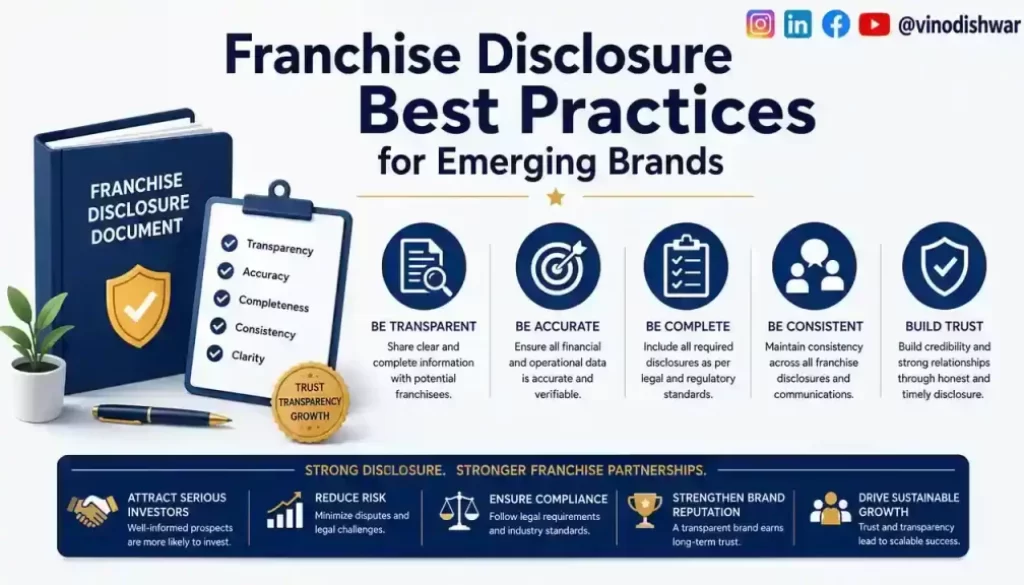
Franchise Disclosure Best Practices for Emerging Brands
Franchising can help an emerging brand expand faster without relying entirely on company-owned locations. However, attracting franchise investors requires more than a strong product, attractive branding, or a successful pilot location. Franchise disclosure best practices help emerging brands clearly communicate the investment, business model, franchisee responsibilities, support, risks and other important aspects of the opportunity.
Potential franchisees want clarity.
They need to understand how much they will invest, what they receive, what they are responsible for, what support is available, and what risks they should consider.
That makes franchise disclosure an important part of building investor confidence.
For emerging brands, a well-structured disclosure process can establish credibility early, improve franchise lead quality, reduce misunderstandings, and create stronger relationships with franchisees.
What Is Franchise Disclosure?
Franchise disclosure is the process of providing prospective franchisees with important information about the franchise opportunity before they commit.
A comprehensive disclosure framework can cover:
- Franchisor information
- Business model
- Initial investment
- Franchise and recurring fees
- Territory
- Training
- Ongoing support
- Franchisee obligations
- Intellectual property
- Financial information
- Renewal
- Termination
- Transfer
- Business risks
For Indian brands, it is important to distinguish between good disclosure practices and statutory requirements. India does not currently have a single comprehensive central franchise disclosure law requiring every franchisor to issue a standardized U.S.-style FDD. However, transparent and professionally reviewed disclosure can still be an important franchise best practice.
Why Disclosure Matters for Emerging Brands
Established franchise brands may already have years of franchisee performance, market data, and brand recognition.
Emerging brands often have less history.
This creates a natural question in the investor’s mind:
“Why should I trust this franchise opportunity?”
A professional disclosure process can help answer that question.
It demonstrates that the franchisor understands its own business model and is prepared to discuss both opportunities and limitations.
Transparency can become a competitive advantage.
1. Clearly Explain the Franchise Business Model
Start with the fundamentals.
Prospective franchisees should understand:
- What the business sells
- Target customer
- Revenue sources
- Operating format
- Required location
- Staffing model
- Sales channels
- Technology requirements
- Key differentiators
Avoid assuming that investors understand your business simply because they like the brand.
The disclosure should explain how the franchise actually operates and generates revenue.
2. Provide a Realistic Investment Estimate
One of the biggest disclosure mistakes is focusing only on the franchise fee.
A franchisee’s actual investment may include:
| Cost | Example |
|---|---|
| Franchise Fee | ₹X |
| Property Deposit | ₹X |
| Interiors | ₹X |
| Equipment | ₹X |
| Technology | ₹X |
| Initial Inventory | ₹X |
| Licences | ₹X |
| Pre-Opening Marketing | ₹X |
| Working Capital | ₹X |
Clearly distinguish between mandatory costs, estimated costs, and optional expenses.
This gives investors a more realistic picture of the capital required.
3. Explain Every Recurring Fee
Emerging brands should disclose recurring costs before the investor reaches the agreement stage.
These may include:
- Royalty
- Marketing contribution
- Technology fees
- Software subscriptions
- Renewal fees
- Training fees
- Transfer fees
- Procurement-related charges
Explain how each fee is calculated, when it is payable, and what it covers.
Unexpected fees can quickly damage investor confidence.
4. Be Precise About Territory
Territory is particularly important for franchise investors.
Clearly explain whether the territory is:
- Exclusive
- Protected
- Non-exclusive
- Radius-based
- Population-based
- Location-specific
Also address potential conflicts involving:
- Online sales
- Delivery
- E-commerce
- Corporate accounts
- Future locations
Never use the word “exclusive” without defining what exclusivity actually means.
5. Define Training and Support
Emerging brands often promote statements such as:
“Complete training and support.”
But investors need specifics.
Explain:
Initial Training
- Duration
- Location
- Curriculum
- Participants
Ongoing Support
- Operations
- Marketing
- Technology
- Recruitment
- Training
- Site support
- Business reviews
Also identify services that may involve additional charges.
Clear expectations create stronger franchise relationships.
6. Separate Facts From Projections
Emerging brands may have limited historical data.
That makes it especially important to distinguish between:
Actual performance
and
Illustrative projections.
If financial models are provided, clearly state the assumptions behind:
- Revenue
- Gross margin
- Rent
- Staff costs
- Marketing
- Royalty
- Working capital
- Break-even
- Payback
Never present projected results as guaranteed returns.
A transparent financial model can build more confidence than an exaggerated promise.
7. Disclose Business Risks
No franchise is risk-free.
Emerging brands should discuss material challenges such as:
- Market competition
- Location dependency
- Staffing
- Supply chain
- Seasonality
- Regulatory requirements
- Customer acquisition
- Technology dependence
- Brand maturity
Investors generally understand that risks exist.
What can damage trust is discovering important risks only after investing.
8. Explain Franchisee Responsibilities
Disclosure should make clear what the franchisee must do.
Responsibilities may include:
- Hiring employees
- Following SOPs
- Maintaining quality
- Completing training
- Paying fees
- Participating in marketing
- Purchasing approved products
- Using required technology
- Maintaining records
- Complying with applicable laws
This helps filter out investors whose expectations do not match the franchise model.
9. Keep Marketing Claims Consistent
Your website, brochure, presentation, sales team, financial model, and franchise agreement should not tell different stories.
For example, if the marketing brochure says:
“Investment from ₹15 lakh”
but the realistic total investment is ₹25–₹30 lakh, the difference can create distrust.
Create a central source of approved franchise information and train the sales team to use it consistently.
10. Explain Renewal, Termination and Transfer
Investors should understand what happens throughout the entire franchise lifecycle—not just at the beginning.
Explain:
- Initial franchise term
- Renewal conditions
- Renewal fees
- Termination circumstances
- Notice and cure periods
- Transfer process
- Transfer fees
- Buyer approval
- Post-termination obligations
These terms should align with the actual franchise agreement.
11. Protect Intellectual Property
Emerging brands often depend heavily on their brand identity and proprietary systems.
Disclosure should explain the franchisee’s permitted use of:
- Trademarks
- Logos
- Brand guidelines
- Copyrighted materials
- SOPs
- Trade secrets
- Technology
- Marketing assets
The franchisee should understand that permission to use brand intellectual property does not generally mean ownership is transferred.
12. Build a Due Diligence-Friendly Process
Do not treat investor questions as obstacles.
Encourage prospective franchisees to evaluate:
- Investment assumptions
- Franchise agreement
- Business model
- Existing locations
- Market demand
- Operating costs
- Franchisee experiences
- Legal obligations
A confident franchisor should be prepared for reasonable questions.
The process can be:
Franchise Interest ↓Initial Qualification ↓Franchise Presentation ↓Disclosure ↓Investor Questions ↓Due Diligence ↓Agreement Review ↓Investment Decision
13. Update Disclosure Information Regularly
Emerging businesses evolve quickly.
Investment costs may change. New products may be introduced. Territories may change. Technology may be upgraded.
Review disclosure materials whenever there are material changes to:
- Fees
- Investment
- Business model
- Support
- Territory
- Financial assumptions
- Contracts
- Compliance requirements
Outdated information can create unnecessary risk.
Common Disclosure Mistakes by Emerging Brands
Avoid these common mistakes:
- Focusing only on the franchise fee
- Hiding working capital requirements
- Making guaranteed income claims
- Using vague territory promises
- Promising undefined support
- Providing unsupported financial projections
- Ignoring business risks
- Using inconsistent sales materials
- Copying a foreign FDD without adapting it
- Allowing sales representatives to make unauthorized promises
Professional documentation and sales-team training can help prevent many of these problems.
Franchise Disclosure Checklist
Before launching franchise recruitment, review:
- Franchisor information
- Business model
- Investment estimate
- Franchise fee
- Recurring fees
- Territory
- Training
- Support
- Supplier requirements
- Technology requirements
- Marketing obligations
- Intellectual property
- Financial assumptions
- Material risks
- Renewal
- Termination
- Transfer
- Franchise agreement
- Compliance requirements
How Franchise Alpha Can Help Emerging Brands
For an emerging brand, franchising should be treated as a business system, not simply a method of selling franchise units.
Franchise Alpha helps businesses build structured franchise systems covering:
- Franchise strategy
- Franchise model development
- Investment planning
- Franchise documentation
- Franchise marketing
- Lead generation
- Franchise sales
- Investor qualification
- Operations manuals
- Franchisee training
- Ongoing support
Legal documentation and legal opinions should be prepared or reviewed by appropriately qualified legal professionals.
Frequently Asked Questions
Is franchise disclosure mandatory in India?
India does not currently have a single comprehensive central law requiring every franchisor to issue a standardized FDD. However, appropriate disclosure and transparent communication remain important franchise best practices.
What should an emerging brand disclose?
At minimum, prospective franchisees should receive clear information about the business model, investment, fees, territory, training, support, obligations, risks, financial assumptions, and key contractual terms.
Should emerging brands provide financial projections?
They may provide illustrative financial models where appropriate, but assumptions should be clearly explained and projections should never be presented as guaranteed results.
Why is transparency important for new franchise brands?
Emerging brands have less historical franchise data, so transparent communication can help establish credibility and allow investors to conduct meaningful due diligence.
Should franchise disclosure match the franchise agreement?
Yes. Marketing and disclosure materials should be consistent with the actual contractual terms.
Conclusion
For emerging brands, franchise disclosure is more than documentation—it is a trust-building tool.
Investors want to know what they are buying, how much they need to invest, what responsibilities they will have, what support they can expect, and what risks may exist.
A transparent disclosure process can help emerging brands attract better-qualified franchisees while reducing misunderstandings and building stronger long-term relationships. Visit Franchise Alpha and Webs Alpha
The goal should not be to make every franchise opportunity look perfect.
The goal should be to make the opportunity clear, credible and understandable.
Build a Franchise Investors Can Trust
Franchise Alpha helps emerging and established brands develop scalable franchise models, documentation, marketing, lead generation, sales systems and operational frameworks.
Build your franchise foundation before you scale your franchise network.