Growth Strategy for SMEs: The Complete Guide to Scaling Small & Medium Enterprises (2026)
Introduction
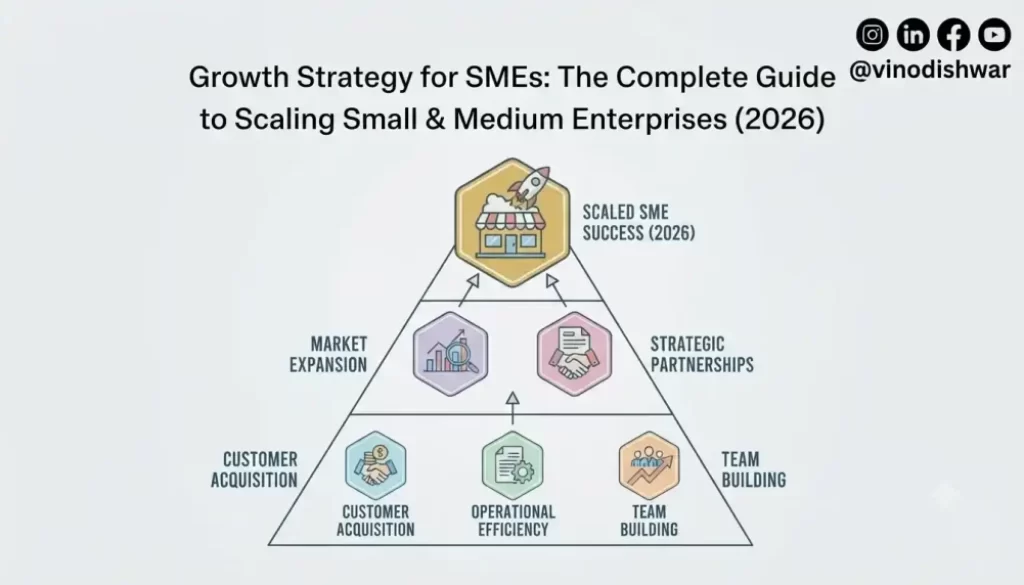
A well-planned Growth Strategy for SMEs is essential for businesses that want to increase revenue, improve profitability, and scale sustainably. Small and Medium Enterprises (SMEs) are the backbone of every economy. They generate employment, drive innovation, and contribute significantly to economic growth. However, while many SMEs successfully launch and survive the early years, only a small percentage manage to scale into large, sustainable businesses.
Small and Medium Enterprises (SMEs) are the backbone of every economy. They generate employment, drive innovation, and contribute significantly to economic growth. However, while many SMEs successfully launch and survive the early years, only a small percentage manage to scale into large, sustainable businesses.
The biggest challenge isn’t starting a business—it’s growing it.
Most SMEs eventually reach a plateau where sales stagnate, profits decline, operations become inefficient, and founders become overwhelmed with daily responsibilities. Without a structured growth strategy, businesses often struggle to move beyond this stage.
A well-designed Growth Strategy for SMEs helps businesses increase revenue, improve profitability, build scalable systems, enter new markets, and prepare for long-term expansion.
Whether you’re in retail, manufacturing, healthcare, education, hospitality, technology, professional services, or consumer products, this guide explains how to scale your SME into a high-performing business.
Why a Growth Strategy for SMEs Matters
An SME Growth Strategy is a structured roadmap that enables small and medium businesses to achieve sustainable growth through improved operations, stronger leadership, strategic expansion, technology adoption, and scalable business systems.
Growth strategies may include:
- Business expansion
- New product launches
- Market diversification
- Franchising
- Digital transformation
- Operational improvement
- Strategic partnerships
- Geographic expansion
- Process automation
- Leadership development
The objective is profitable and sustainable business growth.
Why SMEs Need a Growth Strategy
A structured strategy helps SMEs:
- Increase revenue
- Improve profitability
- Build scalable operations
- Reduce founder dependency
- Expand into new markets
- Strengthen customer retention
- Improve operational efficiency
- Attract investors
- Increase business valuation
- Build long-term sustainability
Growth should be intentional—not accidental. An effective Growth Strategy for SMEs enables businesses to overcome operational challenges, improve efficiency, and prepare for long-term expansion.
The 15-Step SME Growth Strategy Framework
Step 1. Define Your Growth Vision
Set clear objectives for:
- Revenue targets
- Market expansion
- Customer acquisition
- Profitability
- Team growth
- Long-term business goals
Every successful expansion begins with a clear vision.
Step 2. Assess Your Current Business
Evaluate:
- Financial performance
- Operational efficiency
- Customer satisfaction
- Team capability
- Market position
- Competitive advantage
Understanding your starting point enables better planning.
Step 3. Strengthen Business Systems
Develop:
- SOPs
- Operations Manual
- HR Policies
- Financial controls
- CRM processes
- Reporting systems
Strong systems create scalable businesses.
Step 4. Reduce Founder Dependency
Empower managers to handle:
- Operations
- Sales
- Customer service
- Team management
- Daily decision-making
Businesses scale when leadership is shared.
Step 5. Build a Strong Leadership Team
Develop leaders responsible for:
- Operations
- Sales
- Marketing
- Finance
- Human Resources
- Customer Success
Leadership is essential for sustainable growth.
Step 6. Improve Financial Management
Track:
- Cash flow
- Profit margins
- Operating expenses
- Customer acquisition cost
- Return on investment
- Revenue growth
Financial discipline supports expansion.
Step 7. Invest in Technology
Adopt:
- ERP
- CRM
- Accounting Software
- HRMS
- Inventory Systems
- Business Intelligence Dashboards
Technology improves efficiency and decision-making.
Step 8. Expand Your Customer Base
Grow through:
- Digital marketing
- SEO
- Paid advertising
- Referral programs
- Strategic partnerships
- Customer retention initiatives
Customer acquisition fuels business growth.
Step 9. Diversify Revenue Streams
Increase income by:
- Launching new products
- Introducing premium services
- Subscription models
- Cross-selling
- Upselling
Diversification reduces business risk.
Step 10. Expand into New Markets
Explore:
- New cities
- New states
- International opportunities
- Franchise expansion
- Distribution partnerships
Expansion increases long-term growth potential.
Step 11. Standardize Customer Experience
Ensure consistent:
- Service quality
- Product quality
- Brand communication
- Customer support
- Complaint resolution
Consistency builds customer loyalty.
Step 12. Measure Business Performance
Track KPIs including:
- Revenue growth
- Profitability
- Customer retention
- Employee productivity
- Marketing ROI
- Operational efficiency
Data-driven decisions improve outcomes.
Step 13. Build a Scalable Culture
Promote:
- Accountability
- Innovation
- Continuous learning
- Collaboration
- Customer-centric thinking
Culture drives sustainable success.
Step 14. Prepare for Expansion
Before scaling, ensure:
- Strong systems
- Financial stability
- Leadership capability
- Operational readiness
- Market demand
Preparation reduces expansion risk. Following a structured Growth Strategy for SMEs ensures that expansion is supported by strong systems, capable leadership, and sustainable business processes.
Step 15. Continuously Improve
Review and optimize:
- Processes
- Technology
- Customer experience
- Leadership
- Business strategy
Continuous improvement keeps SMEs competitive.
Essential Systems for a Growth Strategy for SMEs
A scalable SME should have:
- Standard Operating Procedures (SOPs)
- Operations Manual
- CRM Platform
- ERP System
- HR Management System
- Financial Dashboard
- Performance Scorecards
- Marketing Automation
- Customer Feedback System
- Business Intelligence Reporting
These systems enable sustainable growth.
Common SME Growth Mistakes
Avoid these common pitfalls:
- Founder dependency
- Lack of documented systems
- Weak financial planning
- Hiring too quickly
- Poor customer experience
- No technology adoption
- Expanding without preparation
- Ignoring performance metrics
Structured growth minimizes these risks.
How SME Growth Consultants Help
Professional consultants help SMEs by:
- Assessing business readiness
- Developing growth strategies
- Standardizing operations
- Creating SOPs
- Building leadership capability
- Improving financial planning
- Supporting business expansion
- Preparing businesses for franchising
Expert guidance accelerates growth while reducing risk.
The SOLEMN® Framework
At Franchise Alpha, SME Growth Strategies are developed using the proprietary SOLEMN® Framework.
Strategy
Define long-term business goals, expansion priorities, competitive positioning, and growth roadmaps.
Operations
Standardize SOPs, Operations Manuals, technology systems, reporting, and operational excellence.
Legal
Strengthen governance, protect intellectual property, develop business agreements, and ensure regulatory compliance.
Entrust
Develop leadership teams, reduce founder dependency, strengthen culture, and improve organizational capability.
Marketing
Accelerate growth through branding, digital marketing, lead generation, customer acquisition, and retention strategies.
Nitty-Gritty
Measure KPIs, optimize operational efficiency, strengthen profitability, and continuously improve business performance.
This framework enables SMEs to grow systematically while building a resilient, scalable organization.
Frequently Asked Questions
What is an SME Growth Strategy?
An SME Growth Strategy is a structured plan that helps small and medium businesses increase revenue, improve operations, expand into new markets, and achieve sustainable long-term growth.
When should an SME focus on growth?
SMEs should prioritize growth after establishing consistent revenue, stable operations, strong customer demand, and scalable business systems.
What is the biggest obstacle to SME growth?
The most common challenges include founder dependency, weak systems, poor financial planning, limited leadership, and lack of operational standardization.
Why hire an SME Growth Consultant?
An SME Growth Consultant helps businesses develop scalable systems, improve profitability, prepare for expansion, and create a customized long-term growth strategy.
Conclusion
Growing an SME requires more than increasing sales—it requires building a business that can operate efficiently, profitably, and independently as it expands.
Businesses that invest in systems, leadership, technology, financial discipline, and strategic planning create sustainable competitive advantages and long-term success.
The goal isn’t simply to become a larger business—it is to become a stronger, more scalable, and more valuable business.
Call to Action
Accelerate Your SME Growth
Book an SME Growth Strategy Session with Vinod Ishwar to assess your business, identify growth opportunities, strengthen operations, develop scalable systems, and build a customized roadmap for long-term success.
Receive a comprehensive business growth blueprint tailored to your industry, goals, and expansion plans.