Business Scaling Mistakes: 25 Common Reasons Businesses Fail to Scale (2026)
Introduction
Business Scaling Mistakes are one of the biggest reasons promising companies fail to achieve sustainable growth. Every entrepreneur dreams of growing their business from a single successful operation into a scalable, profitable enterprise. However, scaling a business is far more complex than simply increasing sales or opening new locations.
Every entrepreneur dreams of growing their business from a single successful operation into a scalable, profitable enterprise. However, scaling a business is far more complex than simply increasing sales or opening new locations.
In reality, many businesses struggle during the scaling phase because they expand without the right systems, leadership, financial controls, or operational discipline. Rapid growth without preparation often creates operational chaos, declining customer satisfaction, inconsistent quality, and shrinking profit margins.
The biggest challenge isn’t getting bigger—it’s getting better while growing.
Understanding the most common Business Scaling Mistakes helps founders avoid expensive setbacks and build businesses capable of sustainable long-term growth.
Whether you’re planning to expand through multiple locations, franchising, digital channels, or international markets, this guide highlights the mistakes to avoid and the systems required for successful scaling.
What Are Business Scaling Mistakes?
Business Scaling Mistakes are strategic, operational, financial, or leadership errors that prevent a business from growing sustainably.
Common causes include:
- Weak operational systems
- Founder dependency
- Poor financial planning
- Lack of documentation
- Inconsistent customer experience
- Hiring without structure
- Expanding too quickly
- Ineffective leadership
Most scaling failures occur because businesses grow faster than their infrastructure.
Why Business Scaling Mistakes Cause Companies to Fail
Businesses often fail because they focus only on growth while ignoring scalability.
Sustainable scaling requires:
- Standardized operations
- Strong leadership
- Financial discipline
- Technology integration
- Process documentation
- Data-driven decision-making
Growth without systems eventually creates bottlenecks.
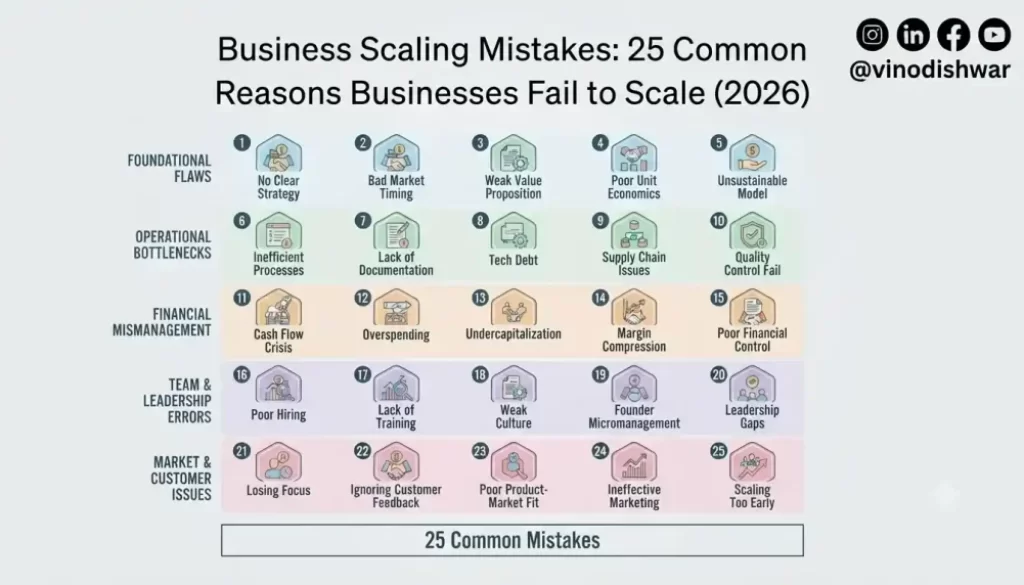
The 25 Most Common Business Scaling Mistakes
1. Expanding Too Early
Opening new locations before proving profitability creates unnecessary financial pressure.
2. Founder Dependency
When every decision depends on the founder, growth slows dramatically.
3. No Standard Operating Procedures (SOPs)
Without documented processes, every employee performs tasks differently.
4. Weak Leadership Team
Scaling requires leaders—not just employees.
5. Hiring Too Quickly
Rapid hiring without proper onboarding leads to inconsistent performance.
6. Ignoring Company Culture
A strong culture is essential for managing larger teams successfully.
7. Poor Cash Flow Management
Growing businesses often fail due to cash flow shortages rather than lack of sales.
8. Lack of Financial Planning
Expansion without budgeting increases financial risk.
9. Weak Customer Experience
Growth should never compromise customer satisfaction.
10. Inconsistent Brand Standards
Customers expect the same quality across every location.
11. Poor Technology Adoption
Manual processes become inefficient as businesses grow.
12. No Performance Metrics
Businesses cannot improve what they do not measure.
13. Expanding Without Market Research
Every market has different customer expectations and competitive dynamics.
14. Weak Inventory Management
Inventory inefficiencies reduce profitability and customer satisfaction.
15. No Operations Manual
An Operations Manual provides consistency across teams and locations.
16. Ignoring Customer Feedback
Customer insights identify improvement opportunities before problems escalate.
17. Weak Delegation
Founders who refuse to delegate become growth bottlenecks.
18. Poor Recruitment Strategy
Hiring the wrong people affects culture, productivity, and customer experience.
19. Inadequate Training
Employees require structured learning programs to maintain operational consistency.
20. Lack of Business Intelligence
Decisions should be based on accurate business data—not assumptions.
21. Ignoring Risk Management
Every expansion strategy should include contingency planning.
22. Weak Marketing Systems
Growth requires predictable lead generation and customer acquisition.
23. No Scalability Roadmap
Businesses should expand according to a structured strategic plan.
24. Poor Communication
As organizations grow, communication systems become increasingly important.
25. Focusing on Revenue Instead of Profitability
Higher sales do not always result in stronger businesses.
Sustainable growth requires healthy profit margins.
Essential Systems to Avoid Business Scaling Mistakes
Every scalable business should develop:
- Standard Operating Procedures (SOPs)
- Operations Manual
- ERP Platform
- CRM System
- HR Management System
- Financial Dashboard
- Business Intelligence Reports
- Performance Scorecards
- Training Programs
- Quality Assurance Framework
Systems reduce complexity and improve consistency.
Warning Signs Your Business Isn’t Ready to Scale
Watch for these indicators:
- Founder handles every decision
- Processes are undocumented
- Customer complaints are increasing
- Cash flow is unstable
- Team performance is inconsistent
- Technology is outdated
- Leadership capability is limited
- Expansion decisions are reactive
Address these issues before pursuing aggressive growth.
How Business Consultants Prevent Scaling Mistakes
Experienced consultants help businesses by:
- Assessing scalability
- Developing growth strategies
- Creating SOPs
- Standardizing operations
- Building leadership teams
- Improving financial planning
- Designing expansion roadmaps
- Reducing operational risk
Professional guidance accelerates sustainable growth. Growth Strategy for SMEs
The SOLEMN® Framework
At Franchise Development →https://franchisealpha.com/franchise-development/ scalable businesses are developed using the proprietary SOLEMN® Framework.
Strategy
Define long-term growth objectives, expansion priorities, and competitive positioning.
Operations
Standardize SOPs, Operations Manuals, reporting systems, technology platforms, and quality management.
Legal
Strengthen governance, agreements, compliance, and intellectual property protection.
Entrust
Develop leadership capability, reduce founder dependency, and build accountable management teams.
Marketing
Implement scalable lead generation, branding, digital marketing, and customer acquisition systems.
Nitty-Gritty
Measure KPIs, optimize profitability, improve operational efficiency, and continuously refine business performance.
This framework enables businesses to scale systematically while avoiding common growth mistakes.
Frequently Asked Questions
What is the biggest business scaling mistake?
Founder dependency is one of the most common mistakes because it limits delegation and slows decision-making.
Why do businesses struggle during scaling?
Businesses often lack systems, leadership, documented processes, financial planning, and technology required to support growth.
How can businesses scale successfully?
Successful scaling requires standardized operations, strong leadership, financial discipline, technology adoption, and continuous performance monitoring.
Why hire a Business Growth Consultant?
A consultant helps businesses identify growth bottlenecks, develop scalable systems, reduce operational risks, and create structured expansion strategies.
Conclusion
Scaling a business is one of the most rewarding—and challenging—stages of entrepreneurship.
Businesses that avoid common scaling mistakes build stronger systems, better leadership teams, healthier financial foundations, and more consistent customer experiences.
Growth should never be rushed.
It should be planned, measured, standardized, and continuously improved.
The businesses that scale successfully are those that prepare before they expand.
Call to Action
Avoid Costly Business Scaling Mistakes
Book a Business Scaling Strategy Session with Vinod Ishwar to assess your growth readiness, identify operational bottlenecks, strengthen leadership, standardize business systems, and create a customized roadmap for sustainable expansion.
Receive a strategic scaling blueprint designed to help your business grow confidently and profitably.