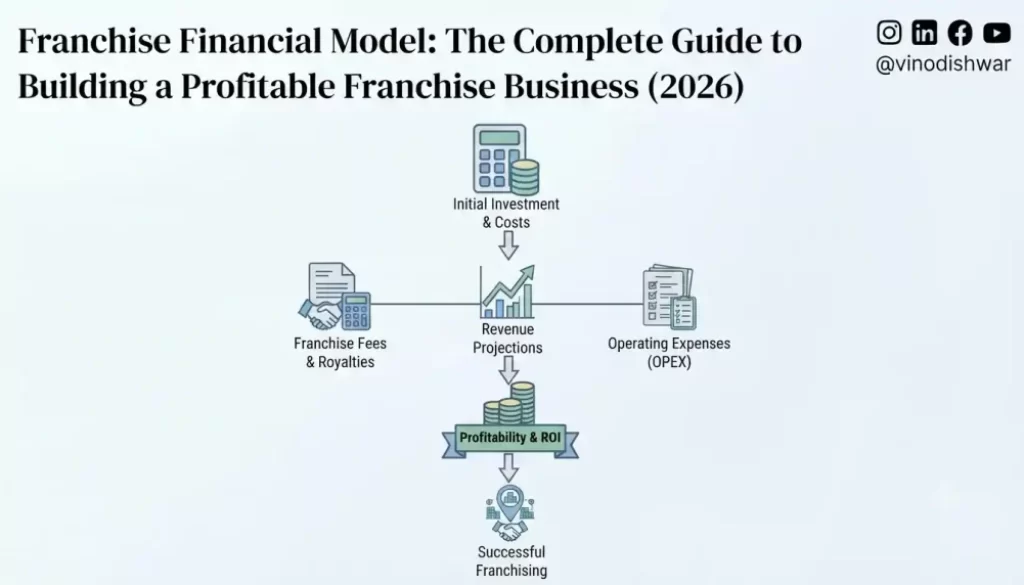
Franchise Financial Model: The Complete Guide to Building a Profitable Franchise Business (2026)
Introduction
A successful franchise is built on more than a great brand and efficient operations—it requires a strong financial model.
Many businesses decide to franchise because they see rapid expansion opportunities. However, without a carefully designed financial framework, even the most successful concepts can struggle with profitability, franchisee satisfaction, and long-term sustainability.
A franchise financial model defines how both the franchisor and franchisee generate revenue, recover investments, manage operating costs, and achieve profitability.
It provides clarity on franchise fees, royalty structures, startup investments, operating expenses, break-even analysis, and long-term financial performance.
Whether you are preparing to franchise your business or evaluating a franchise opportunity, understanding the franchise financial model is essential for making informed decisions.
In this guide, you’ll learn how franchise financial models work, their essential components, and best practices for creating a financially sustainable franchise system.
What Is a Franchise Financial Model?
A franchise financial model is a structured framework that forecasts the financial performance of both the franchisor and the franchisee.
It outlines:
- Initial investment
- Franchise fee
- Royalty structure
- Operating expenses
- Revenue projections
- Profit margins
- Break-even analysis
- Cash flow
- Return on investment (ROI)
A strong financial model ensures that both parties benefit from long-term business growth.
Why Is a Financial Model Important?
A professionally developed financial model helps businesses:
- Evaluate franchise profitability
- Attract quality investors
- Build franchisee confidence
- Forecast cash flow
- Reduce financial risks
- Support expansion decisions
- Determine sustainable royalty structures
- Improve long-term business planning
Without financial planning, franchise expansion can quickly become unprofitable.
15 Essential Components of a Franchise Financial Model
1. Initial Franchise Investment
Estimate the total capital required to establish a new franchise outlet.
Typical investment categories include:
- Franchise fee
- Interior fit-out
- Equipment
- Technology
- Initial inventory
- Licenses
- Working capital
- Marketing launch
Clear investment estimates improve investor confidence.
2. Franchise Fee Structure
The franchise fee represents the one-time payment made by the franchisee for the right to operate under the brand. Before deciding your franchise fee, it’s important to build a strong Franchise Business Model.
The fee should reflect:
- Brand value
- Training provided
- Support systems
- Intellectual property
- Market positioning
3. Royalty Model
Royalties provide recurring income for the franchisor.
Common royalty structures include:
- Percentage of sales
- Fixed monthly royalty
- Hybrid royalty model
The royalty should support ongoing franchise services while remaining financially sustainable. A well-designed royalty structure should be supported by a comprehensive Franchise Operations Manual.
4. Marketing Contribution
Many franchise systems establish a marketing fund.
These contributions support:
- National advertising
- Digital campaigns
- Brand development
- Promotional activities
Transparent fund management builds franchisee trust.
5. Revenue Projections
Estimate expected sales based on:
- Market demand
- Customer volume
- Pricing strategy
- Seasonality
- Local demographics
Conservative assumptions improve financial planning.
6. Cost Structure
Identify both fixed and variable operating expenses.
Examples include:
- Rent
- Salaries
- Utilities
- Inventory
- Marketing
- Maintenance
- Insurance
- Technology subscriptions
Understanding costs improves profitability forecasting.
7. Gross Profit Analysis
Calculate the relationship between revenue and the direct cost of delivering products or services.
Higher gross margins provide greater financial flexibility.
8. Operating Profit Forecast
Forecast operating profitability after accounting for recurring expenses.
This helps determine long-term financial sustainability.
9. Break-Even Analysis
Estimate how long it takes for a franchise outlet to recover its investment.
This analysis helps potential franchisees evaluate investment risk.
10. Cash Flow Forecast
Cash flow planning ensures sufficient working capital throughout the business lifecycle.
Monthly cash flow forecasts help identify funding requirements before problems occur.
11. Return on Investment (ROI)
ROI measures the financial return generated from the franchise investment.
Most investors evaluate:
- Investment recovery period
- Annual returns
- Long-term profitability
12. Unit Economics
Unit economics measure the profitability of one franchise location.
Key metrics include:
- Revenue per outlet
- Gross margin
- EBITDA
- Customer acquisition cost
- Customer lifetime value
Healthy unit economics support scalable expansion. Strong Business Systems help improve unit economics and operational efficiency.
13. Financial KPIs
Track performance using key financial indicators such as:
- Revenue growth
- Profit margins
- Average transaction value
- Inventory turnover
- Operating expenses
- Cash conversion cycle
Regular KPI reviews improve decision-making.
14. Expansion Forecast
Financial planning should include projections for:
- New franchise openings
- Territory expansion
- Multi-unit growth
- Future capital requirements
Expansion forecasts support long-term strategic planning.
15. Risk Analysis
Evaluate potential financial risks including:
- Market fluctuations
- Rising operating costs
- Economic downturns
- Supply chain disruptions
- Changing consumer demand
Scenario planning improves financial resilience.
Common Franchise Financial Models
Businesses often choose between several financial structures.
Fixed Franchise Fee
A one-time payment with recurring support fees.
Percentage Royalty
Royalty based on monthly gross revenue.
Hybrid Model
Combination of fixed fees and percentage royalties.
Performance-Based Model
Royalties linked to business performance or profitability.
Common Financial Planning Mistakes
Businesses frequently make these mistakes:
- Unrealistic revenue forecasts
- Underestimating startup costs
- Poor working capital planning
- Weak royalty structures
- Ignoring cash flow
- Limited profitability analysis
- No risk planning
Professional financial modelling helps avoid these issues. Businesses should first understand the complete Franchise Development Process before designing their financial model.
How Franchise Consultants Help
Experienced franchise consultants assist businesses by:
- Building financial models
- Designing royalty structures
- Calculating franchise investments
- Forecasting profitability
- Evaluating unit economics
- Preparing investor presentations
- Supporting franchise expansion planning
Expert financial planning improves franchise success.
The SOLEMN® Framework
At Franchise Alpha, financial planning is integrated into the proprietary SOLEMN® Framework.
Strategy
Assess financial viability and expansion goals.
Operations
Develop efficient operational systems that improve profitability.
Legal
Align financial structures with franchise agreements and compliance.
Entrust
Support franchisees through financial planning, training, and performance management.
Marketing
Develop sustainable marketing investment strategies.
Nitty-Gritty
Continuously monitor financial performance using KPIs, audits, and business analytics.
This framework helps businesses create financially sustainable franchise systems.
Frequently Asked Questions
What is a franchise financial model?
A franchise financial model forecasts the investment, revenue, expenses, profitability, cash flow, and return on investment for both franchisors and franchisees.
Why is financial modelling important before franchising?
Financial modelling helps determine whether the franchise is commercially viable, profitable, and attractive to potential franchise investors.
What are unit economics in franchising?
Unit economics measure the financial performance of a single franchise outlet, including revenue, operating costs, and profitability.
Who should prepare a franchise financial model?
Businesses should work with experienced franchise consultants and financial professionals to develop realistic, scalable, and investor-ready financial models.
Conclusion
A franchise financial model is one of the most important foundations of successful franchise expansion.
It provides clarity, builds investor confidence, protects profitability, and ensures that both franchisors and franchisees benefit from sustainable long-term growth.
The strongest franchise brands are built on realistic financial planning, transparent revenue structures, healthy unit economics, and disciplined financial management.
Before offering franchise opportunities, every business should invest in developing a professional financial model that supports scalable expansion.
Call to Action
Build a Financially Sustainable Franchise
Book a Franchise Financial Model Assessment with Vinod Ishwar to evaluate your business economics, design a profitable royalty structure, develop investment projections, and create a scalable financial model that supports successful franchise expansion.
Receive a customized financial roadmap designed for long-term franchise success.