Franchise Compliance Checklist: The Complete Guide to Building a Compliant Franchise System (2026)
Franchise Compliance Checklist is one of the most important tools for maintaining consistency across a growing franchise network. A well-designed Franchise Compliance Checklist helps franchisors ensure every outlet follows legal requirements, operational standards, brand guidelines, financial processes, and customer service expectations. As your business expands, using a structured Franchise Compliance Checklist reduces risk, improves accountability, and supports sustainable franchise growth.
As a franchise network grows, maintaining consistency becomes one of the biggest challenges. Every franchise location must follow the same operational procedures, brand standards, legal obligations, and customer service expectations. Without structured compliance systems, inconsistencies can damage brand reputation, reduce customer trust, and increase legal risk.
Franchise compliance is about ensuring every franchisee operates according to the franchisor’s established standards while complying with applicable laws and regulations.
A comprehensive franchise compliance checklist provides a structured framework for monitoring performance, identifying risks, conducting audits, and continuously improving franchise operations.
Whether you operate a restaurant, café, retail business, salon, preschool, healthcare clinic, fitness center, manufacturing company, or service business, compliance should be embedded into every aspect of your franchise system.
This guide explains the essential components of franchise compliance, practical checklists, audit frameworks, and best practices for maintaining a high-performing franchise network.
Important: Compliance obligations vary depending on your country, state, industry, and franchise model. Always consult qualified legal and regulatory professionals regarding applicable laws.
What is a Franchise Compliance Checklist?
Franchise compliance refers to the process of ensuring that franchisees consistently follow:
- Franchise Agreement
- Operations Manual
- Standard Operating Procedures (SOPs)
- Brand Guidelines
- Quality Standards
- Financial reporting requirements
- Applicable laws and regulations
- Health and safety requirements
- Marketing standards
Compliance protects the integrity of the franchise system while promoting a consistent customer experience.
Why a Franchise Compliance Checklist Matters
Strong compliance systems help businesses:
- Protect brand reputation
- Improve customer satisfaction
- Reduce operational risks
- Increase franchisee accountability
- Maintain product and service consistency
- Improve operational efficiency
- Support sustainable franchise expansion
- Reduce legal disputes
High-performing franchise networks treat compliance as an ongoing management process rather than a one-time exercise.
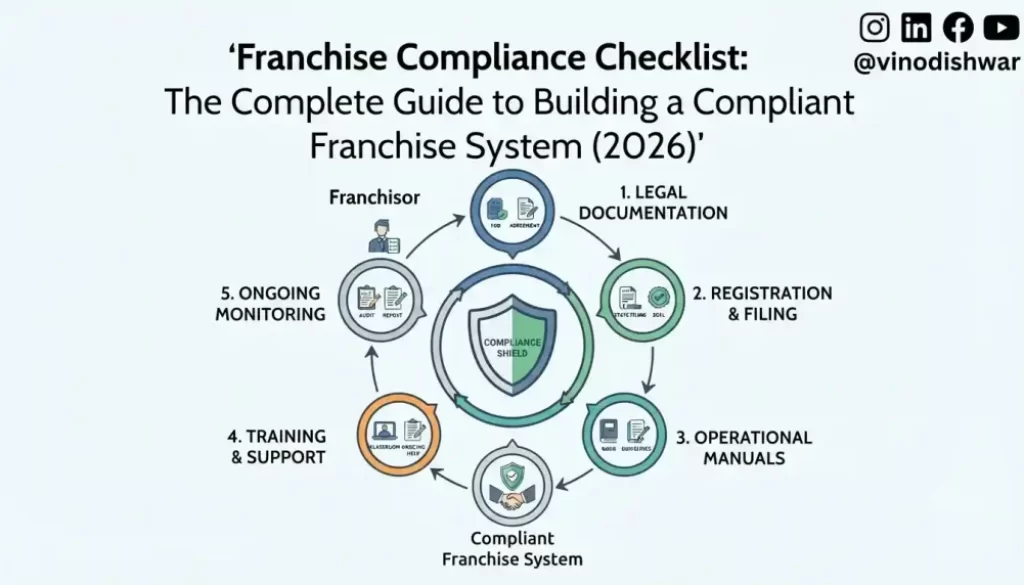
Franchise Compliance Checklist: Five Essential Pillars
1. Legal Compliance
Ensure adherence to:
- Franchise Agreement
- Intellectual property licensing
- Employment laws
- Consumer protection laws
- Data privacy regulations
- Industry-specific regulations
- Tax obligations
Legal compliance should be reviewed regularly with qualified advisors.
2. Operational Compliance
Verify that every location follows:
- Standard Operating Procedures
- Operations Manual
- Service workflows
- Product preparation standards
- Inventory procedures
- Equipment maintenance
- Opening and closing routines
Operational consistency is the backbone of franchising.
3. Brand Compliance
Monitor compliance with:
- Logo usage
- Store design
- Uniform standards
- Marketing materials
- Brand colors
- Customer experience
- Digital branding
- Social media guidelines
Brand consistency strengthens customer trust.
4. Financial Compliance
Review:
- Royalty payments
- Marketing fund contributions
- Financial reporting
- Sales reporting
- Accounting procedures
- Inventory reconciliation
- Audit documentation
Accurate reporting supports informed business decisions.
5. Quality & Customer Compliance
Evaluate:
- Product quality
- Customer service
- Cleanliness
- Hygiene
- Complaint resolution
- Mystery shopping results
- Customer satisfaction scores
Quality directly impacts long-term franchise success.
Step-by-Step Franchise Compliance Process
Step 1: Document Standards
Develop:
- Operations Manual
- SOPs
- Brand Guidelines
- Compliance policies
- Audit procedures
Every franchisee should have access to the latest documentation.
Step 2: Train Franchisees
Training should cover:
- Operational procedures
- Brand standards
- Legal responsibilities
- Customer service
- Safety protocols
- Technology systems
Regular refresher training helps maintain consistency.
Step 3: Conduct Routine Audits
Schedule:
- Weekly operational reviews
- Monthly compliance inspections
- Quarterly business audits
- Annual performance evaluations
Audits identify issues before they become significant problems.
Step 4: Monitor KPIs
Track measurable indicators such as:
- Audit scores
- Customer satisfaction
- Sales performance
- Complaint resolution time
- Inventory accuracy
- Employee turnover
- Compliance completion rate
Use dashboards to compare performance across locations.
Step 5: Implement Corrective Actions
When non-compliance is identified:
- Document the issue.
- Determine the root cause.
- Develop a corrective action plan.
- Assign responsibility.
- Set deadlines.
- Re-audit to verify improvements.
Step 6: Continuously Improve
Review compliance systems regularly and update procedures as:
- Laws change
- Business models evolve
- Technology improves
- Customer expectations shift
Continuous improvement keeps the franchise network competitive.
Comprehensive Franchise Compliance Checklist
Legal Compliance
- Franchise Agreement executed
- Trademark licensing documented
- Intellectual property protections in place
- Required business licenses obtained
- Insurance policies active
- Regulatory requirements reviewed
- Employment compliance verified
- Data privacy policies implemented
Operational Compliance
- Operations Manual available
- SOPs implemented
- Staff training completed
- Equipment maintenance schedule followed
- Inventory procedures followed
- Opening/closing checklists completed
- Quality standards maintained
Brand Compliance
- Logo used correctly
- Store appearance consistent
- Signage approved
- Uniform standards followed
- Marketing materials approved
- Social media aligned with brand guidelines
Financial Compliance
- Royalty payments current
- Marketing contributions paid
- Financial reports submitted
- Sales accurately reported
- Accounting records maintained
- Audit documents available
Customer Experience Compliance
- Customer complaints tracked
- Response times monitored
- Mystery shopping completed
- Customer satisfaction measured
- Service standards maintained
- Hygiene standards verified
Technology Compliance
- POS systems updated
- CRM maintained
- Cybersecurity practices followed
- Software licenses current
- Data backups completed
Health & Safety Compliance
- Safety inspections completed
- Fire safety equipment maintained
- Food safety procedures followed (where applicable)
- Workplace safety standards met
- Emergency procedures documented
Practical Example
A growing multi-city retail franchise experienced inconsistent customer experiences.
The franchisor introduced:
- Digital compliance checklists
- Monthly operational audits
- Quarterly brand inspections
- KPI dashboards
- Mystery shopping
- Compliance scorecards
- Corrective action tracking
- Refresher training programs
Within one year, compliance scores improved, customer complaints declined, and overall franchise performance became more consistent.
Franchise Compliance Framework
Franchise Agreement
        │
        ▼
Operations Manual
        │
        ▼
Standard Operating Procedures
        │
        ▼
Training Programs
        │
        ▼
Compliance Audits
        │
        ▼
KPI Monitoring
        │
        ▼
Corrective Actions
        │
        ▼
Continuous Improvement
        │
        ▼
High-Performing Franchise Network
Common Franchise Compliance Mistakes
Avoid these common mistakes:
- Expanding without documented standards
- Conducting irregular audits
- Ignoring customer feedback
- Delaying corrective actions
- Allowing inconsistent branding
- Weak financial reporting
- Poor staff training
- Outdated Operations Manuals
- Inadequate legal review
Strong compliance systems reduce operational risk and protect long-term brand value.
How Franchise Development Consultants Help
Experienced franchise development consultants assist businesses by:
- Building franchise compliance frameworks
- Developing Operations Manuals and SOPs
- Designing audit checklists
- Creating KPI dashboards
- Standardizing reporting systems
- Supporting franchise governance
- Coordinating with legal and regulatory professionals
- Preparing businesses for scalable franchise expansion
Professional guidance helps businesses establish practical compliance systems that support sustainable growth.
Why Choose Franchise Alpha?
At Franchise Alpha, we help businesses build franchise-ready compliance systems using our proprietary SOLEMN® Framework, ensuring operational consistency, legal readiness, and scalable governance.
Strategy
Develop a structured compliance roadmap aligned with your expansion goals.
Operations
Create Operations Manuals, SOPs, audit programs, and reporting systems.
Legal
Support documentation readiness and coordinate with qualified legal professionals for compliance requirements.
Entrust
Develop governance frameworks that improve accountability and franchisee performance.
Marketing
Protect brand consistency through documented branding and marketing standards.
Nitty-Gritty
Implement KPI dashboards, compliance scorecards, audit systems, and continuous improvement processes.
Frequently Asked Questions
What is franchise compliance?
Franchise compliance is the process of ensuring franchisees follow the Franchise Agreement, Operations Manual, SOPs, brand standards, and applicable legal and regulatory requirements.
Why is a franchise compliance checklist important?
A compliance checklist helps maintain operational consistency, reduce risks, improve accountability, protect the brand, and support sustainable franchise growth.
How often should franchise compliance audits be conducted?
Many franchisors conduct monthly operational audits, quarterly business reviews, and annual comprehensive evaluations. The appropriate frequency depends on the business model, industry, and level of risk.
What should a franchise compliance audit include?
An audit may include legal compliance, operational standards, financial reporting, brand consistency, customer service, health and safety, technology systems, and quality assurance.
Conclusion
Franchise compliance is not simply about enforcing rules—it is about building a culture of consistency, accountability, and continuous improvement.
Businesses that invest in structured compliance systems are better positioned to protect their brand, support franchisees, improve customer satisfaction, and achieve sustainable growth.
As your franchise network expands, a well-designed compliance framework becomes one of your most valuable operational assets.
Call to Action
Ready to Build a High-Performing Franchise Compliance System?
Book a Franchise Readiness Assessment with Vinod Ishwar and discover how to strengthen your franchise network with practical compliance systems, operational governance, and scalable business processes.
Your assessment includes:
- Franchise Compliance Audit
- Operations Manual Review
- SOP Assessment
- Brand Compliance Evaluation
- Customized Franchise Compliance Roadmap
Build a franchise network that grows with consistency, accountability, and confidence.