Founder Dependency and Franchise Failure: Why Businesses Must Build Systems Before Franchising (2026)
Founder Dependency and Franchise Failure are closely connected because businesses that rely heavily on their founders struggle to scale successfully. A business may have a strong product or loyal customers, but without documented systems, SOPs, trained teams, and standardized operations, franchise expansion becomes difficult. This guide explains how Founder Dependency and Franchise Failure impact business growth and how to build a franchise-ready organization.
Many successful businesses fail as franchises—not because their products are poor or demand is low, but because the business depends too heavily on its founder.
If customers only trust the founder, employees rely on the founder for every decision, suppliers negotiate only with the founder, or operational knowledge exists only in the founder’s mind, the business is not franchise-ready.
Franchising is built on systems, processes, and repeatability—not on individual talent. Every franchise outlet should be able to operate successfully without the founder being physically present.
Founder dependency is one of the most overlooked reasons for franchise failure. Businesses that scale successfully first transform founder knowledge into documented systems, standardized training, and operational excellence.
This guide explains what founder dependency is, why it causes franchise failure, how to identify it, and the steps required to build a scalable franchise business.
What is Founder Dependency?
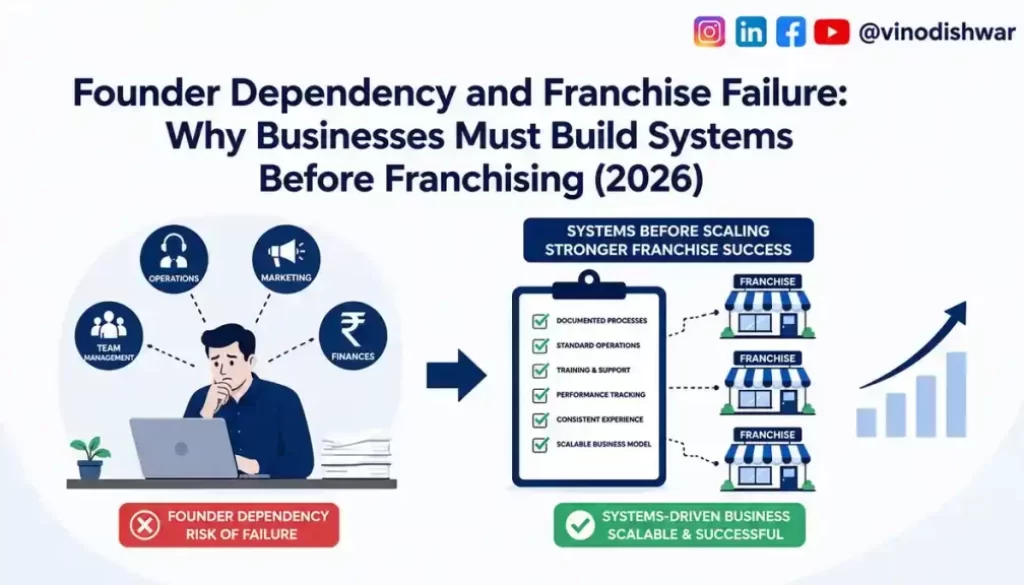
Founder dependency occurs when the success of a business relies primarily on the founder’s personal involvement rather than documented systems and trained teams.
The founder becomes responsible for:
- Daily operations
- Customer relationships
- Sales decisions
- Hiring
- Vendor management
- Problem-solving
- Quality control
- Strategic planning
Without the founder, business performance declines significantly.
Why Founder Dependency is Dangerous
While founder involvement is common during the startup phase, it becomes a major obstacle when expanding.
A franchise business must allow different owners and managers to produce the same results using standardized systems.
If every decision requires founder approval, growth becomes slow, inconsistent, and difficult to manage.
Why Founder Dependency Causes Franchise Failure
1. Inconsistent Customer Experience
Customers expect the same experience across every franchise location.
If only the founder knows how to deliver exceptional service, franchisees struggle to maintain quality.
This damages customer trust and brand reputation.
2. Poor Knowledge Transfer
Many founders operate using years of personal experience.
Without documentation:
- Employees learn differently
- Franchisees receive inconsistent training
- Operational mistakes increase
Knowledge must be converted into repeatable systems.
3. Slow Decision-Making
Businesses dependent on the founder often delay decisions involving:
- Pricing
- Marketing
- Hiring
- Purchasing
- Customer complaints
As franchise networks grow, delayed decisions reduce operational efficiency.
4. Difficult Franchisee Support
Franchisees require ongoing guidance.
If all support comes directly from the founder:
- Response times increase
- Franchisee satisfaction decreases
- Expansion slows
Professional franchise support systems solve this challenge.
5. Limited Scalability
One founder can effectively manage only a limited number of locations.
Without standardized systems, expanding from:
- 1 outlet to 10
- 10 outlets to 100
- National expansion
- International franchising
becomes increasingly difficult.
6. Operational Inconsistency
Founder-led businesses often rely on verbal instructions.
Different outlets develop different methods.
Standardization disappears.
Customers notice the difference.
7. Employee Dependency
Employees frequently rely on the founder for:
- Problem-solving
- Customer approvals
- Operational guidance
- Conflict resolution
This prevents managers from developing leadership capabilities.
8. Investor Concerns
Potential franchisees and investors evaluate business scalability.
Heavy founder dependency raises questions such as:
- Can this business operate independently?
- Are systems documented?
- Is training standardized?
- Will support continue without the founder?
These concerns reduce investor confidence.
Signs Your Business Has Founder Dependency
Ask yourself these questions:
- Do customers ask specifically for you?
- Can your team operate successfully without you?
- Are business processes documented?
- Can managers make decisions independently?
- Do franchisees rely on you daily?
- Are SOPs available?
- Is operational knowledge documented?
- Can a new outlet launch without your direct involvement?
If the answer to several questions is No, your business likely has founder dependency.
How to Eliminate Founder Dependency
Step 1: Document Every Business Process
Create written procedures for:
- Operations
- Sales
- Customer service
- Marketing
- Finance
- HR
- Inventory
- Quality control
Documentation converts personal knowledge into organizational knowledge.
Step 2: Develop Standard Operating Procedures (SOPs)
Every recurring task should have an SOP.
Include:
- Objectives
- Responsibilities
- Step-by-step procedures
- Quality standards
- Performance measures
SOPs reduce reliance on individual experience.
Step 3: Build a Franchise Operations Manual
Develop a comprehensive Operations Manual covering:
- Daily operations
- Brand standards
- Technology usage
- HR policies
- Marketing guidelines
- Financial reporting
- Compliance requirements
The manual becomes the operational blueprint for every franchisee.
Step 4: Standardize Training
Training should not depend on the founder.
Develop:
- Training manuals
- Video tutorials
- Online learning modules
- Certification programs
- Assessments
Consistent training creates confident franchisees.
Step 5: Implement Business Systems
Use technology to automate operations.
Examples include:
- CRM
- POS
- ERP
- Inventory management
- Learning Management Systems (LMS)
- Business Intelligence dashboards
Systems reduce manual dependence.
Step 6: Empower Leadership
Train managers to make operational decisions.
Delegate responsibility for:
- Staff management
- Customer service
- Daily reporting
- Inventory
- Sales performance
Leadership development reduces founder involvement.
Step 7: Establish Performance Metrics
Track business performance using KPIs.
Monitor:
- Sales
- Customer satisfaction
- Compliance scores
- Employee productivity
- Profit margins
- Inventory turnover
Performance data enables proactive management.
Step 8: Create a Franchise Support Structure
Develop dedicated teams for:
- Franchise training
- Operations
- Marketing
- Technology
- Quality assurance
- Business development
Support should come from systems—not solely from the founder.
Founder Dependency Reduction Framework
| Stage | Objective |
|---|---|
| Document Processes | Capture business knowledge |
| SOP Development | Standardize operations |
| Operations Manual | Create operational consistency |
| Training Systems | Transfer knowledge efficiently |
| Technology Integration | Automate business processes |
| Leadership Development | Delegate decision-making |
| KPI Monitoring | Measure performance objectively |
| Franchise Support | Scale assistance beyond the founder |
Practical Example
A premium café chain grew to five successful outlets, but every location depended on the founder for supplier approvals, customer complaints, hiring decisions, and operational guidance.
Before franchising, the company invested in:
- 250+ SOPs
- A comprehensive Franchise Operations Manual
- A Learning Management System (LMS)
- CRM and POS integration
- Regional operations managers
- Monthly quality audits
Within two years, the founder shifted from managing daily operations to focusing on strategic growth. Franchisees received consistent support through documented systems rather than direct founder involvement, enabling successful expansion across multiple cities.
Founder Dependency Framework
Founder Knowledge
        │
        ▼
Process Documentation
        │
        ▼
Standard Operating Procedures
        │
        ▼
Operations Manual
        │
        ▼
Training Systems
        │
        ▼
Technology Integration
        │
        ▼
Leadership Development
        │
        ▼
Performance Monitoring
        │
        ▼
Franchise Support Systems
        │
        ▼
Scalable Franchise Business
Common Mistakes
Businesses often struggle because they:
- Keep operational knowledge undocumented
- Make every decision personally
- Fail to delegate authority
- Delay SOP development
- Ignore manager training
- Depend on verbal communication
- Lack operational reporting
- Expand before standardizing systems
Removing founder dependency should be a priority before franchising.
How Franchise Development Consultants Help
Experienced franchise consultants help businesses by:
- Conducting franchise readiness assessments
- Identifying founder dependency risks
- Documenting business processes
- Developing SOPs and Operations Manuals
- Creating franchise training systems
- Designing organizational structures
- Implementing business technology
- Building scalable franchise support systems
Professional guidance ensures your business is prepared for sustainable expansion.
Why Choose Franchise Alpha?
At Franchise Alpha, we help businesses reduce founder dependency using our proprietary SOLEMN® Framework, creating franchise systems that operate independently and consistently.
Strategy
Assess business readiness and identify founder-dependent processes.
Operations
Develop SOPs, Operations Manuals, and standardized workflows.
Legal
Align operational systems with franchise agreements and compliance requirements.
Entrust
Build leadership capabilities and reduce reliance on founder involvement.
Marketing
Create centralized marketing systems that work across every franchise location.
Nitty-Gritty
Implement KPIs, audits, reporting systems, and continuous operational improvement.
Frequently Asked Questions
What is founder dependency?
Founder dependency occurs when a business relies heavily on the founder’s personal involvement rather than documented systems, trained teams, and standardized processes.
Why does founder dependency cause franchise failure?
Because franchisees cannot replicate success if critical knowledge, decision-making, and operations depend on one individual instead of scalable business systems.
How can businesses reduce founder dependency?
Businesses should document processes, develop SOPs, create Operations Manuals, implement technology, standardize training, and empower managers.
Can a founder-dependent business become franchise-ready?
Yes. With structured documentation, operational systems, leadership development, and professional franchise planning, founder-dependent businesses can successfully transition into scalable franchise models.
Conclusion
Founder dependency is one of the greatest barriers to successful franchise development.
Businesses that rely on one person’s experience, decisions, or relationships struggle to deliver consistent results across multiple locations. By documenting knowledge, standardizing operations, implementing technology, and building capable leadership teams, companies create a franchise system that thrives independently of its founder.
The goal of franchising is not to replicate the founder—it is to replicate the business system.
Call to Action
Ready to Reduce Founder Dependency Before Franchising?
Book a Franchise Readiness Assessment with Vinod Ishwar and discover how to transform your founder-led business into a scalable franchise system.
Your assessment includes:
- Founder Dependency Audit
- Business Process Mapping
- SOP & Operations Manual Review
- Leadership & Delegation Assessment
- Customized Franchise Readiness Roadmap
Build a business that grows through systems—not founder dependence.