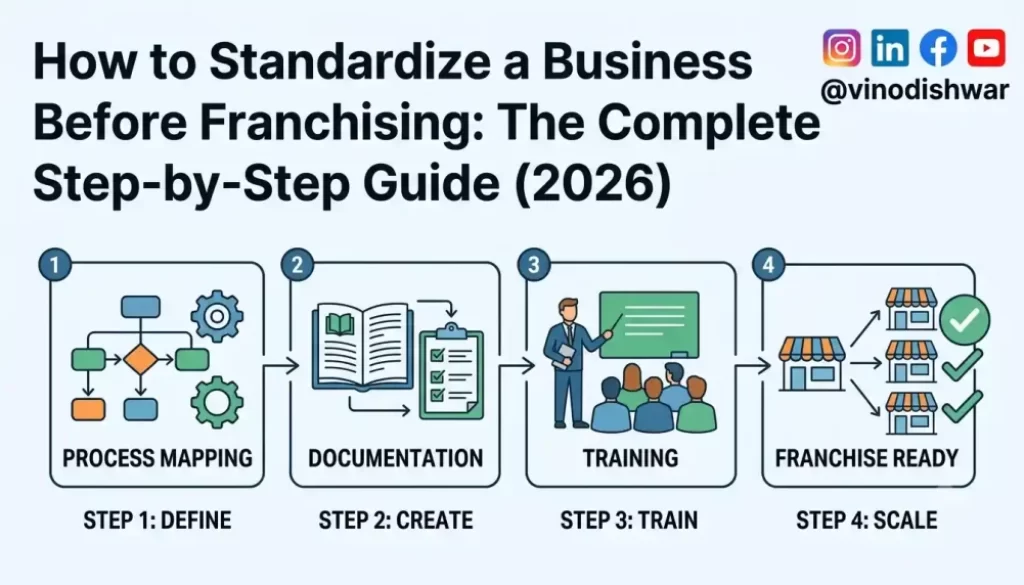
How to Standardize a Business Before Franchising: The Complete Step-by-Step Guide (2026)
How to Standardize a Business Before Franchising is one of the most important steps in building a successful franchise. Many entrepreneurs believe that once their business becomes profitable, it is ready to franchise. In reality, profitability is only one part of the equation. The real test of franchise readiness is whether the business can deliver the same customer experience, operational efficiency, and financial performance across multiple locations without relying on the founder.
Many entrepreneurs believe that once their business becomes profitable, it is ready to franchise. In reality, profitability is only one part of the equation. The real test of franchise readiness is whether the business can deliver the same customer experience, operational efficiency, and financial performance across multiple locations without relying on the founder.
This is where business standardization becomes essential. Learn more about Operations & Systemization before building your franchise systems.
Standardization transforms a successful business into a repeatable operating model by documenting every process, defining clear standards, implementing systems, and reducing dependency on individuals. It ensures that every franchise outlet can operate consistently regardless of location or management.
Whether you own a restaurant, café, retail store, salon, preschool, healthcare clinic, fitness center, cloud kitchen, or service business, standardization is the foundation of successful franchising.
This guide explains how to standardize a business before franchising, the systems you need, common mistakes to avoid, and best practices for building a scalable franchise-ready organization.
What Does How to Standardize a Business Before Franchising Mean?
Business standardization is the process of documenting, organizing, and optimizing every operational activity so it can be consistently replicated across multiple business locations.
Instead of relying on memory or experience, standardized businesses operate using documented systems that define exactly how every task should be performed.
These systems ensure that customers receive the same quality, service, and experience regardless of which outlet they visit.
Why Standardizing a Business Before Franchising is Essential
A standardized business can:
- Deliver consistent customer experiences
- Reduce operational errors
- Simplify employee training
- Improve franchisee performance
- Increase operational efficiency
- Protect brand reputation
- Support faster expansion
- Reduce founder dependency
Without standardization, each franchise outlet may operate differently, weakening the brand and creating operational challenges.
Signs Your Business Needs Standardization
Your business likely requires better systems if:
- The founder approves every decision.
- Employees perform the same task differently.
- Customer experiences vary between locations.
- Training takes too long.
- Mistakes occur frequently.
- Reports are inconsistent.
- New employees struggle to learn processes.
- Business performance depends on specific individuals.
These issues become more significant as the business expands.
Step 1: Document Every Business Process
Start by listing every recurring activity in the business.
Examples include:
Operations
- Opening procedures
- Closing procedures
- Cleaning schedules
- Equipment maintenance
Sales
- Customer greeting
- Billing
- Upselling
- Payment processing
Inventory
- Ordering
- Receiving goods
- Stock management
- Waste control
Human Resources
- Recruitment
- Employee onboarding
- Attendance
- Performance reviews
Marketing
- Campaign execution
- Social media posting
- Local promotions
- Customer engagement
Documenting processes creates the foundation for franchise operations.
Step 2: Develop Standard Operating Procedures (SOPs)
Convert documented processes into easy-to-follow SOPs.
Every SOP should include:
- Objective
- Scope
- Responsible person
- Required tools
- Step-by-step procedure
- Quality standards
- Safety guidelines
- Performance metrics
Well-designed SOPs reduce errors and improve consistency.
Step 3: Create a Franchise Operations Manual
The Operations Manual becomes the central guide for franchisees.
Typical sections include:
- Brand standards
- Organizational structure
- Daily operations
- Customer service
- Sales processes
- Inventory management
- Marketing guidelines
- HR policies
- Technology usage
- Compliance requirements
A comprehensive manual ensures every franchise outlet follows identical standards. A comprehensive Operations Manual works alongside effective Franchise Territory Planning.
Step 4: Standardize Customer Experience
Customers should enjoy the same experience across every location.
Define standards for:
- Greeting customers
- Service quality
- Product presentation
- Response time
- Complaint handling
- Store cleanliness
- Brand communication
Consistency builds customer trust and strengthens the brand.
Step 5: Implement Technology
Technology supports operational consistency.
Essential tools include:
- Point-of-Sale (POS)
- Customer Relationship Management (CRM)
- Inventory management software
- HR systems
- Learning Management System (LMS)
- Accounting software
- Business intelligence dashboards
Automation reduces manual errors and improves decision-making.
Step 6: Build a Training System
Training ensures employees and franchisees understand standardized processes.
Training should cover:
- Business operations
- Product knowledge
- Customer service
- Technology platforms
- Brand standards
- Compliance
- Safety procedures
Continuous learning maintains operational excellence.
Step 7: Define Key Performance Indicators (KPIs)
Measure operational success using KPIs.
Examples include:
- Daily sales
- Customer satisfaction
- Average order value
- Inventory turnover
- Employee productivity
- Complaint resolution time
- Profit margins
- Franchise compliance
Regular performance tracking helps identify improvement opportunities.
Step 8: Establish Quality Control Systems
Monitor operational quality through:
- Internal audits
- Mystery shopping
- Customer feedback
- Compliance inspections
- Hygiene checks
- Product quality evaluations
Consistent quality strengthens customer loyalty.
Step 9: Reduce Founder Dependency
Founder dependency is one of the biggest obstacles to franchising.
Delegate responsibilities by:
- Defining organizational roles
- Empowering managers
- Documenting decision-making processes
- Automating routine approvals
- Building leadership teams
A franchise-ready business operates independently of the founder’s daily involvement. Businesses planning rapid expansion should also create a Regional Franchise Development Strategy.
Step 10: Test the System Before Franchising
Before franchising, validate your systems by:
- Opening another company-owned outlet
- Training new managers using SOPs only
- Measuring operational consistency
- Collecting customer feedback
- Refining documentation
Testing ensures systems work in real-world conditions before franchise expansion. How to Standardize a Business Before Franchising is only complete after your systems have been tested in real business conditions.
Business Standardization Checklist
Before franchising, ensure you have:
- Business process documentation
- Standard Operating Procedures (SOPs)
- Franchise Operations Manual
- Employee training program
- Customer service standards
- Technology systems
- KPI dashboard
- Quality control process
- Organizational structure
- Founder-independent operations
Practical Example
A successful café operates one profitable location.
The owner wants to franchise but discovers that:
- Recipes exist only in the chef’s memory.
- Inventory ordering varies weekly.
- Customer service differs by employee.
- Marketing depends on the founder.
The business spends six months creating SOPs, documenting recipes, implementing POS software, developing an Operations Manual, launching an online training platform, and defining KPIs.
After testing these systems in a second company-owned outlet, the café successfully begins franchising with confidence.
Business Standardization Framework
Successful Business
        │
        ▼
Process Documentation
        │
        ▼
Standard Operating Procedures
        │
        ▼
Operations Manual
        │
        ▼
Customer Experience Standards
        │
        ▼
Technology Integration
        │
        ▼
Training Systems
        │
        ▼
KPI Monitoring
        │
        ▼
Quality Assurance
        │
        ▼
Founder Independence
        │
        ▼
Franchise-Ready Business
Common Standardization Mistakes
Avoid these common mistakes:
- Expanding without SOPs
- Inconsistent customer service
- Weak documentation
- Overreliance on the founder
- Lack of employee training
- Ignoring technology
- Poor performance monitoring
- Delaying quality audits
Businesses should systemize operations before accelerating expansion.
How Franchise Development Consultants Help
Professional franchise consultants assist businesses by:
- Conducting franchise readiness assessments
- Developing SOPs
- Preparing Franchise Operations Manuals
- Designing organizational structures
- Creating training systems
- Defining KPIs
- Implementing operational technology
- Supporting franchise standardization
Expert guidance helps businesses reduce risk while building scalable franchise systems. Learn how Franchise Development Services help businesses build scalable franchise systems.
Why Choose Franchise Alpha?
At Franchise Alpha, we help businesses become franchise-ready using our proprietary SOLEMN® Framework.
Strategy
Develop customized franchise growth strategies aligned with your long-term vision.
Operations
Create SOPs, Operations Manuals, workflow documentation, and scalable operational systems.
Legal
Prepare franchise documentation that aligns with operational standards and compliance requirements.
Entrust
Reduce founder dependency by implementing leadership systems and repeatable business processes.
Marketing
Support operational excellence with standardized franchise marketing systems.
Nitty-Gritty
Monitor KPIs, optimize operations, and improve long-term franchise performance.
Frequently Asked Questions
Why should a business be standardized before franchising?
Standardization ensures that every franchise location follows the same processes, maintains consistent quality, and delivers a uniform customer experience.
What documents are required to standardize a business?
Typical documents include Standard Operating Procedures (SOPs), a Franchise Operations Manual, workflow charts, training manuals, quality standards, and KPI reports.
How long does business standardization take?
Depending on business size and complexity, standardization usually takes between 3 to 6 months, though larger organizations may require more time.
Can a small business standardize before franchising?
Yes. In fact, standardization is especially valuable for small and medium-sized businesses because it prepares them for scalable and sustainable growth.
Conclusion
Standardization is the bridge between a successful single-location business and a successful franchise network. Businesses that understand How to Standardize a Business Before Franchising build stronger, more scalable franchise systems with greater long-term success.
By documenting processes, implementing technology, training teams, monitoring performance, and reducing founder dependency, businesses create a repeatable operating model that supports long-term franchise success.
The stronger your systems are before franchising, the easier it becomes to scale while maintaining quality, profitability, and brand consistency. Before launching your franchise, also read our Franchise Revenue Models guide to build a sustainable business.
Call to Action
Ready to Standardize Your Business for Franchising?
Book a Franchise Readiness Assessment with Vinod Ishwar and discover how to prepare your business for successful franchise expansion.
Your assessment includes:
- Business Standardization Audit
- SOP & Operations Manual Review
- Founder Dependency Assessment
- Training & Technology Evaluation
- Customized Franchise Standardization Roadmap
Build a business that can be replicated, scaled, and franchised with confidence.