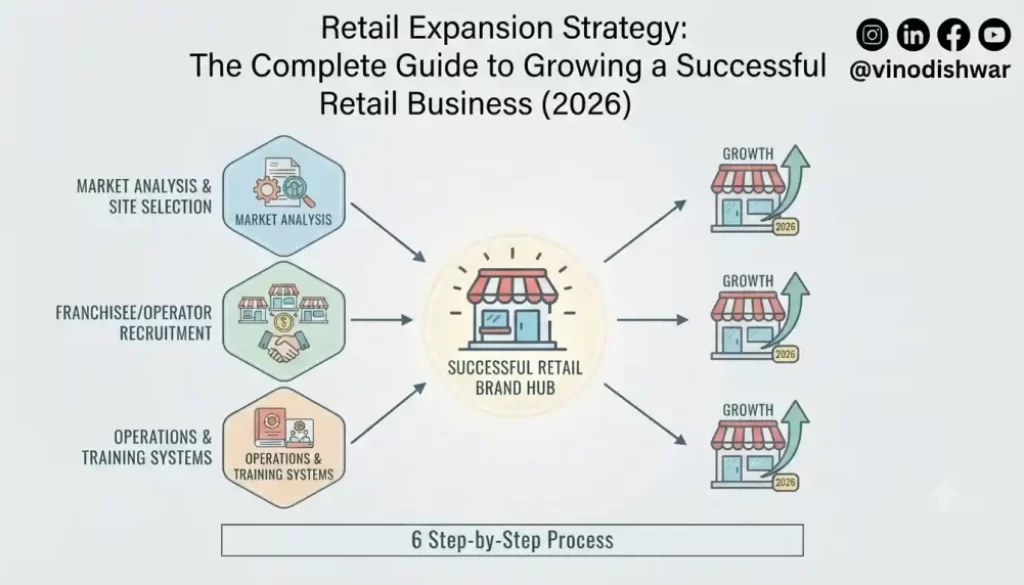
Retail Expansion Strategy: The Complete Guide to Growing a Successful Retail Business (2026)
Introduction
Retail Business Expansion is one of the most effective ways to transform a successful retail store into a scalable, profitable, and nationally recognized brand. Opening one successful retail store is an achievement. Building a network of profitable retail stores across cities, states, or countries requires a completely different strategy.
Building a successful Retail Expansion Strategy begins with opening one successful retail store. Expanding beyond a single location requires careful planning, standardized systems, and scalable operations.
Building a network of profitable retail stores across cities, states, or countries requires a completely different strategy.
Retail businesses face unique expansion challenges, including location selection, inventory management, customer experience, staffing, visual merchandising, technology integration, supply chain management, and maintaining consistent brand standards.
Many retailers expand too quickly without standardized systems, leading to operational inefficiencies, declining customer satisfaction, and reduced profitability.
A well-planned Retail Expansion Strategy helps businesses scale systematically while maintaining operational excellence and delivering a consistent shopping experience across every location.
Whether you’re operating a fashion brand, supermarket, electronics retailer, furniture showroom, pharmacy, lifestyle brand, or specialty retail chain, this guide explains how to build a scalable retail business.
Why Your Retail Expansion Strategy Matters
A Retail Expansion Strategy is a structured plan for growing a retail business through additional stores, franchise outlets, regional expansion, digital channels, or international markets while maintaining operational consistency and profitability.
Expansion models include:
- Company-Owned Stores
- Franchise Stores
- Shop-in-Shop Formats
- Flagship Stores
- Multi-City Expansion
- Multi-State Expansion
- International Retail Expansion
- Omnichannel Retail Growth
The goal is sustainable and profitable retail growth.
Why Retail Business Expansion Matters
A successful expansion strategy helps retailers:
- Increase market share
- Build brand recognition
- Improve customer accessibility
- Increase revenue
- Strengthen supplier relationships
- Improve purchasing power
- Achieve economies of scale
- Enhance customer loyalty
- Increase business valuation
- Build a nationally recognized retail brand
Strategic expansion creates long-term competitive advantages. A successful Retail Business Expansion plan helps retailers grow systematically while maintaining customer satisfaction and operational consistency.
The 15-Step Retail Expansion Strategy Framework
Step 1. Validate Your Retail Concept
Before expanding, ensure:
- Consistent profitability
- Strong customer demand
- Repeat business
- Proven product-market fit
- Positive customer experience
Your first successful store should become the benchmark.
Step 2. Standardize Retail Operations
Develop standardized systems for:
- Store opening and closing
- Customer service
- Billing
- Inventory management
- Visual merchandising
- Store maintenance
- Cash handling
- Returns and exchanges
Consistency improves customer trust.
Step 3. Develop an Operations Manual
Create a detailed retail operations manual covering:
- Daily operations
- Brand standards
- Staff responsibilities
- Sales procedures
- Merchandising guidelines
- Security protocols
- Compliance standards
Documentation ensures operational consistency.
Step 4. Choose the Right Expansion Model
Select an expansion approach such as:
- Company-Owned Stores
- Franchise Retail Stores
- Master Franchise
- Area Development
- Joint Ventures
The model should align with your financial and operational capabilities. Businesses often seek guidance from a Retail Expansion Consultant
Step 5. Select High-Potential Locations
Evaluate locations based on:
- Footfall
- Demographics
- Competition
- Accessibility
- Parking
- Visibility
- Rental costs
- Future development
Location is one of the most important factors in retail success.
Step 6. Optimize Store Design
Maintain consistent:
- Store layouts
- Brand identity
- Product displays
- Customer flow
- Lighting
- Signage
- Visual merchandising
Customers should experience the same brand in every store.
Step 7. Strengthen Inventory Management
Implement systems for:
- Stock forecasting
- Warehouse management
- Replenishment
- Vendor coordination
- Demand planning
Inventory efficiency directly impacts profitability.
Step 8. Build Technology Infrastructure
Adopt:
- POS Systems
- ERP
- CRM
- Inventory Software
- Business Intelligence Dashboards
- Customer Loyalty Platforms
Technology enables data-driven retail management.
Step 9. Recruit and Train Retail Teams
Develop structured programs for:
- Customer service
- Product knowledge
- Sales techniques
- Store operations
- Leadership development
People create memorable shopping experiences.
Step 10. Build Supply Chain Excellence
Strengthen:
- Vendor relationships
- Logistics
- Warehousing
- Procurement
- Distribution
- Delivery systems
Efficient supply chains reduce costs and improve availability.
Step 11. Implement Omnichannel Retail
Integrate:
- Physical stores
- E-commerce
- Mobile commerce
- Social commerce
- Click-and-Collect
- Home delivery
Customers expect seamless shopping experiences.
Step 12. Measure Retail Performance
Track KPIs including:
- Sales per square foot
- Average transaction value
- Inventory turnover
- Gross margins
- Customer retention
- Footfall conversion
- Store profitability
Performance data drives smarter expansion decisions.
Step 13. Maintain Brand Consistency
Ensure uniformity in:
- Customer experience
- Product presentation
- Employee uniforms
- Marketing campaigns
- Store ambience
Consistency builds brand loyalty.
Step 14. Expand Region by Region
Scale systematically by:
- Opening flagship locations
- Strengthening regional operations
- Building leadership teams
- Expanding gradually
Controlled growth reduces operational risks.
Step 15. Continuously Innovate
Improve through:
- Customer feedback
- Technology upgrades
- Product innovation
- Store modernization
- Staff development
Innovation keeps retail brands competitive.
Essential Systems for Retail Business Expansion
Every scalable retail business should have:
- Retail Operations Manual
- SOP Library
- POS System
- ERP Platform
- CRM
- Inventory Management Software
- HRMS
- Loyalty Program
- Business Intelligence Dashboard
- Store Audit Framework
These systems create consistency across every retail location. Business Expansion Strategy
Common Retail Expansion Strategy Mistakes
Avoid these common pitfalls:
- Choosing poor locations
- Expanding without SOPs
- Weak inventory management
- Inconsistent branding
- Poor staff training
- Weak financial controls
- Founder dependency
- Lack of technology integration
Preparation is the foundation of successful retail expansion.
How Retail Expansion Consultants Help
Experienced consultants help retailers by:
- Assessing business readiness
- Developing expansion strategies
- Conducting location analysis
- Designing franchise models
- Standardizing operations
- Creating SOPs
- Optimizing store performance
- Supporting national and international growth
Professional guidance reduces expansion risk and accelerates growth.
The SOLEMN® Framework
At Franchise Alpha, Retail Expansion Strategies are developed using the proprietary SOLEMN® Framework.
Strategy
Define long-term retail expansion goals, target markets, store formats, and growth priorities.
Operations
Standardize retail SOPs, Operations Manuals, technology systems, inventory management, and quality standards.
Legal
Protect trademarks, develop franchise agreements, ensure regulatory compliance, and strengthen governance.
Entrust
Build leadership capability, develop regional management teams, strengthen organizational culture, and reduce founder dependency.
Marketing
Expand through integrated branding, digital marketing, local campaigns, customer acquisition, and loyalty programs.
Nitty-Gritty
Measure KPIs, optimize operational efficiency, strengthen profitability, and continuously improve retail performance.
This framework enables retailers to expand confidently while maintaining operational excellence and brand consistency.
Frequently Asked Questions
What is a Retail Expansion Strategy?
A Retail Expansion Strategy is a structured plan for growing a retail business through additional stores, franchising, regional expansion, or international markets while maintaining consistent customer experience and profitability.
When should a retailer expand?
Retail businesses should expand after achieving consistent profitability, standardized operations, strong customer demand, and scalable business systems.
What is the best retail expansion model?
The best model depends on the business. Common approaches include company-owned stores, franchise expansion, master franchising, and omnichannel retail growth.
Why hire a Retail Expansion Consultant?
A consultant helps retailers develop scalable strategies, standardize operations, optimize locations, improve systems, and reduce expansion risks.
Conclusion
Retail expansion is not simply about opening more stores—it is about building a scalable retail organization capable of delivering exceptional customer experiences across every location.
Businesses that invest in systems, leadership, technology, supply chain optimization, and standardized operations create sustainable competitive advantages. Many growing retailers work with Franchise Consulting experts before expanding nationally.
The objective is not just growth—it is profitable, consistent, and long-term retail success.
Call to Action
Build Your Retail Expansion Strategy
Book a Retail Expansion Strategy Session with Vinod Ishwar to assess your business readiness, identify expansion opportunities, develop scalable retail systems, and create a customized roadmap for successful retail growth.
Receive a strategic retail expansion blueprint designed for sustainable long-term success. Retail Franchise Development