Franchise Development Process Explained: A Complete Step-by-Step Guide (2026)
Introduction
Franchise Development Process Explained is essential for any business owner planning to expand through franchising. Many successful businesses reach a stage where opening more company-owned outlets becomes expensive, time-consuming, and operationally challenging.
Many successful businesses reach a stage where opening more company-owned outlets becomes expensive, time-consuming, and operationally challenging. Franchising offers an opportunity to expand using a proven business model while leveraging the investment and commitment of franchise partners.
However, successful franchising doesn’t happen by simply selling franchise rights. It requires a structured franchise development process that transforms an owner-operated business into a scalable, replicable franchise system.
Businesses that skip critical steps often struggle with inconsistent operations, poor franchisee performance, legal disputes, and brand dilution.
A well-planned franchise development process creates strong systems, protects the brand, attracts quality franchise partners, and lays the foundation for sustainable long-term growth.
In this guide, we’ll explain every stage of the franchise development process and how businesses can prepare for successful franchise expansion.
Franchise Development Process Explained: What Is Franchise Development?
Franchise development is the structured process of converting an existing business into a franchise model that can be replicated by independent franchisees.
It involves building the legal, operational, financial, marketing, and training systems required to support multiple franchise locations while maintaining consistency across the network.
Franchise development is not just about selling franchises—it is about creating a business model that others can successfully operate.
Why the Franchise Development Process Explained Matters
Businesses that follow a systematic franchise development process experience:
- Faster expansion
- Better franchisee performance
- Stronger brand consistency
- Reduced operational risk
- Higher franchisee satisfaction
- Easier training
- Better investor confidence
- Sustainable long-term growth
Without a structured approach, franchising often becomes difficult to manage.
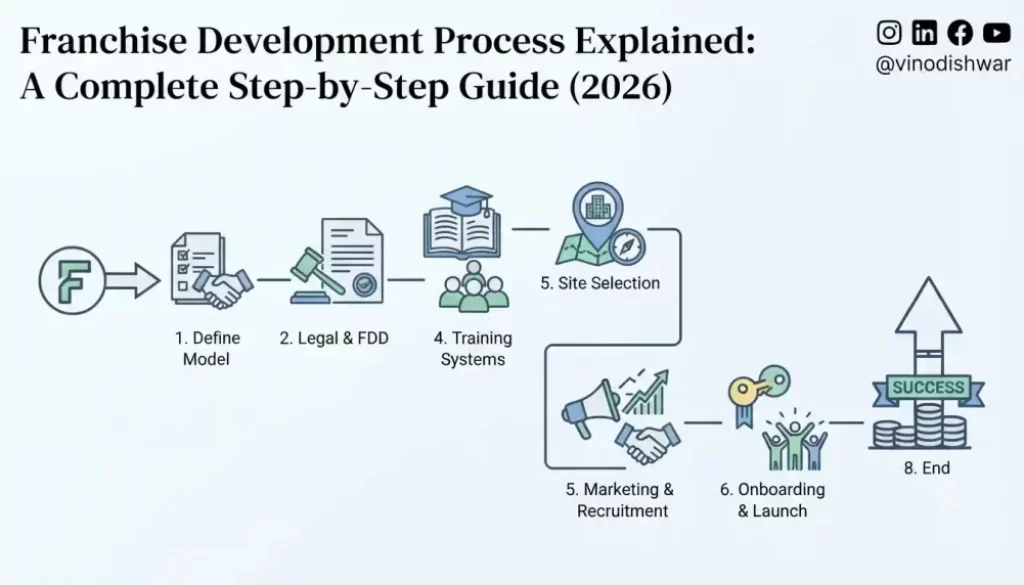
Franchise Development Process Explained: Step-by-Step
Step 1. Franchise Readiness Assessment
Every franchise journey begins with evaluating whether the business is ready for expansion.
A readiness assessment examines:
- Business profitability
- Market demand
- Operational stability
- Brand recognition
- Scalability
- Founder dependency
- Documentation
- Financial viability
This assessment identifies strengths, weaknesses, and areas that require improvement before franchising. Begin with a professional Franchise Readiness Assessment to evaluate your business before franchising.
https://franchisealpha.com/franchise-readiness-assessment/
Start by understanding What is Franchise Consulting?https://vinodishwar.com/what-is-franchise-consulting/
Step 2. Business Model Evaluation
Not every successful business is suitable for franchising.
This stage evaluates:
- Replicability
- Profit margins
- Unit economics
- Operational complexity
- Investment requirements
- Market scalability
The objective is to confirm that the business can be successfully duplicated across different locations.
Step 3. Business Process Mapping
Every operational activity should be documented.
This includes:
- Sales processes
- Customer service
- Inventory
- Marketing
- Recruitment
- Finance
- Quality control
Process mapping creates the foundation for Standard Operating Procedures.
Step 4. SOP Development
Standard Operating Procedures (SOPs) explain exactly how every important task should be performed.
SOPs cover:
- Opening procedures
- Closing procedures
- Customer interactions
- Inventory management
- Cash handling
- Staff responsibilities
- Hygiene standards
- Quality assurance
Well-written SOPs reduce operational variation. Learn more about the complete Franchise Consulting Process:
https://vinodishwar.com/franchise-consulting-process/
Step 5. Franchise Operations Manual
The Operations Manual combines all SOPs, policies, workflows, and operational standards into one comprehensive guide.
It becomes the primary reference document for franchisees and managers.
Step 6. Franchise Business Model Design
At this stage, businesses define:
- Franchise format
- Territory structure
- Investment model
- Revenue model
- Royalty structure
- Marketing contribution
- Support systems
A well-designed business model creates a win-win relationship for franchisors and franchisees.
Step 7. Legal Documentation
Legal documentation protects both parties.
Essential franchise documents include:
- Franchise Agreement
- Disclosure Documents
- Intellectual Property Protection
- Trademark Registration
- Confidentiality Agreements
- Operations Policies
Professional legal drafting reduces future disputes.
Step 8. Financial Planning
Financial planning includes:
- Initial investment
- Working capital
- Franchise fee
- Royalty model
- Marketing fund
- Revenue projections
- Profitability analysis
Clear financial planning improves franchisee confidence.
Step 9. Training Program Development
Successful franchises invest heavily in training.
Training programs should include:
- Franchise owner training
- Store manager training
- Employee induction
- Product knowledge
- Customer service
- Technology systems
- Operational compliance
Structured learning improves consistency.
Step 10. Franchise Marketing System
Develop a franchise marketing strategy that includes:
- Franchise website
- Franchise brochures
- Investor presentations
- Lead generation
- Digital marketing
- Franchise exhibitions
- Social media
Marketing attracts qualified franchise prospects.
Step 11. Franchise Sales Process
A structured recruitment process helps identify the right franchise partners.
Typical stages include:
- Lead qualification
- Discovery calls
- Business presentations
- Financial evaluation
- Territory discussions
- Due diligence
- Agreement signing
Selecting the right franchisee is more important than selling quickly.
Step 12. Franchise Launch
The launch process includes:
- Location setup
- Staff recruitment
- Training completion
- Technology installation
- Marketing launch
- Opening support
A successful launch establishes operational confidence.
Step 13. Ongoing Franchise Support
Successful franchisors provide continuous support through:
- Operational audits
- Business reviews
- Marketing assistance
- Training updates
- Technology support
- Performance coaching
Support strengthens long-term franchise relationships.
Step 14. Performance Monitoring
Track franchise performance using KPIs such as:
- Sales
- Profitability
- Customer satisfaction
- Compliance scores
- Operational audits
- Employee retention
Performance measurement drives continuous improvement.
Step 15. Continuous Franchise Development
Franchise systems should evolve continuously through:
- SOP updates
- Technology improvements
- Market research
- Product innovation
- Franchisee feedback
- Operational reviews
Continuous improvement keeps the franchise competitive.
Common Franchise Development Mistakes
Many businesses rush into franchising without proper preparation.
Common mistakes include:
- No SOPs
- Weak documentation
- Founder dependency
- Poor franchisee selection
- Inadequate training
- Weak support systems
- Poor financial planning
- Limited operational audits
Avoiding these mistakes significantly improves franchise success.
How Franchise Consultants Help
Professional franchise consultants provide end-to-end guidance throughout the franchise development journey.
Services typically include:
- Franchise readiness assessment
- Business model design
- SOP development
- Operations manual creation
- Legal coordination
- Franchise documentation
- Marketing strategy
- Franchise sales process
- Training systems
- Ongoing advisory support
Expert guidance reduces risk and accelerates expansion. Learn more about Franchise Consulting Services offered by Franchise Alpha: https://franchisealpha.com/franchise-consulting/
You may also like Top Benefits of Franchise Consulting: https://vinodishwar.com/top-benefits-of-franchise-consulting/
The SOLEMN® Framework
At Franchise Alpha, franchise development follows the proprietary SOLEMN® Framework.
Strategy
Evaluate business readiness and define franchise growth objectives.
Operations
Develop SOPs, Operations Manuals, business systems, and quality standards.
Legal
Prepare franchise agreements, intellectual property protection, and compliance documentation.
Entrust
Develop training systems, franchise onboarding, leadership development, and support programs.
Marketing
Create franchise marketing strategies, lead generation systems, and brand positioning.
Nitty-Gritty
Continuously improve franchise performance through audits, analytics, and operational reviews.
This structured methodology helps businesses build sustainable franchise systems that support long-term growth.
Frequently Asked Questions
What is franchise development?
Franchise development is the structured process of transforming a business into a franchise system through operational documentation, legal preparation, training, and business model design.
How long does the franchise development process take?
The timeline varies depending on the business, but most professionally managed franchise development projects take between three and six months.
What documents are required for franchise development?
Key documents include SOPs, Franchise Operations Manual, Franchise Agreement, training manuals, brand guidelines, financial models, and operational policies.
Why should businesses hire a franchise development consultant?
A consultant helps build scalable systems, reduce risks, prepare documentation, structure the business model, and guide the entire franchise development process professionally.
Conclusion
Franchise development is far more than expanding into new locations—it is the process of transforming a successful business into a scalable, repeatable, and profitable franchise system. Franchise Development Process Explained shows that successful franchising is far more than opening new locations—it is about creating a scalable, repeatable, and profitable business system.
By following a structured development process, businesses create stronger operational foundations, improve franchisee success, protect their brand, and position themselves for sustainable long-term growth.
The most successful franchise brands are built on preparation, documentation, training, and continuous improvement—not on rapid expansion alone.
A well-executed franchise development strategy creates opportunities that benefit both the franchisor and every future franchise partner. Explore more franchise growth resources at:
Call to Action
Ready to Franchise Your Business?
Book a Franchise Development Assessment with Vinod Ishwar and discover how to build a scalable franchise system through professional SOP development, operations manuals, legal documentation, business systems, franchise marketing, and end-to-end franchise consulting.
Receive a customized roadmap for transforming your business into a successful franchise brand.