Franchise Consulting Process Explained Step-by-Step: The Complete Guide for Indian Businesses (2026)
Introduction
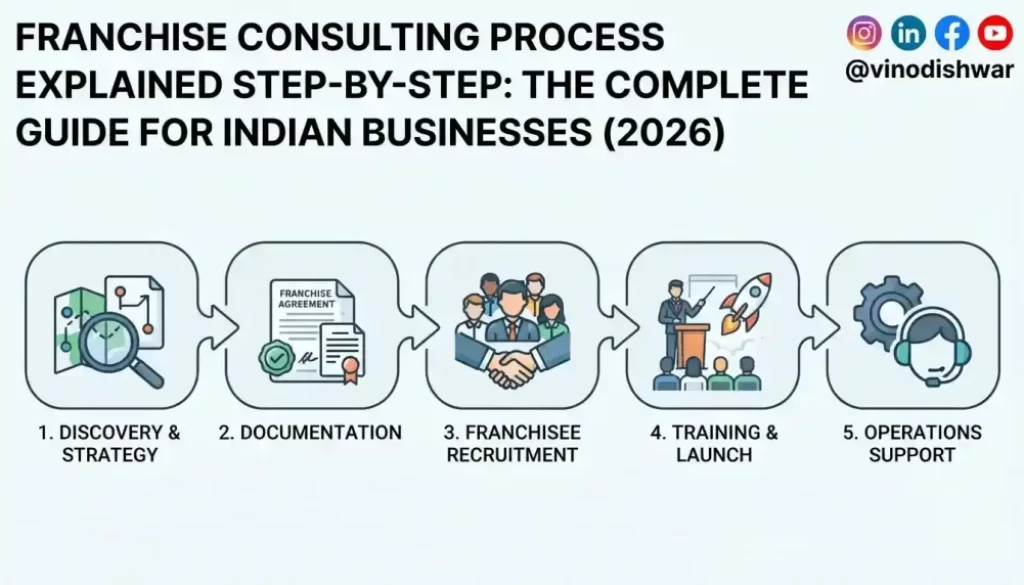
The Franchise Consulting Process is the foundation of building a successful and scalable franchise business. Franchising is widely regarded as one of the fastest and most effective ways to expand a successful business. By leveraging the investment, commitment, and entrepreneurial drive of franchise partners, businesses can grow into regional, national, or even international brands without bearing the full cost of opening company-owned outlets.
Franchising is widely regarded as one of the fastest and most effective ways to expand a successful business. By leveraging the investment, commitment, and entrepreneurial drive of franchise partners, businesses can grow into regional, national, or even international brands without bearing the full cost of opening company-owned outlets.
However, successful franchising does not happen by chance.
Behind every successful franchise network lies a carefully planned consulting process that transforms a single business into a scalable, repeatable, and profitable franchise system.
Many entrepreneurs assume franchise consulting simply involves preparing a franchise agreement. In reality, it is a comprehensive process that includes strategic planning, operational standardization, financial modeling, legal documentation, marketing, franchise sales, and ongoing support.
This guide explains the complete Franchise Consulting Process, step by step, helping you understand what happens at each stage and why professional guidance significantly improves your chances of long-term success.
What is the Franchise Consulting Process?
The franchise consulting process is a structured methodology used to evaluate, design, develop, and launch a franchise system.
Rather than simply selling franchise opportunities, the objective is to create a business model that can be replicated consistently across multiple locations while maintaining profitability, operational excellence, and brand consistency.
The process generally includes:
- Business Evaluation
- Franchise Readiness Assessment
- Expansion Strategy
- Financial Planning
- Documentation
- Legal Framework
- Franchise Marketing
- Franchise Sales
- Franchisee Training
- Launch Support
- Ongoing Growth
Each stage builds upon the previous one, ensuring that expansion is based on systems rather than assumptions. Learn more about our Franchise Consulting Services and discover how we help businesses develop scalable franchise systems.
Step 1 – Business Evaluation
Every successful franchise journey begins with understanding the current business.
A franchise consultant conducts a comprehensive assessment to determine whether the business is suitable for franchising.
Key evaluation areas include:
- Revenue and profitability
- Business model
- Operational maturity
- Customer demand
- Brand positioning
- Competitive advantage
- Scalability
- Leadership structure
This assessment identifies strengths, risks, and opportunities before any expansion begins.
Step 2 – Franchise Readiness Assessment
Not every successful business is automatically ready to become a franchise.
The readiness assessment evaluates whether the business can be replicated successfully by independent entrepreneurs.
Typical assessment criteria include:
- Proven profitability
- Standardized operations
- Repeatable customer experience
- Reliable supply chain
- Technology systems
- Staff training
- Brand reputation
- Documentation availability
If gaps are identified, they are addressed before moving to the next phase. Take our Franchise Readiness Assessment to evaluate whether your business is ready for successful franchise expansion.
Step 3 – Designing the Franchise Strategy
Once the business is deemed ready, a customized franchise strategy is developed.
This strategy answers critical questions such as:
- Which franchise model is appropriate?
- What investment should franchisees make?
- What franchise fee should be charged?
- What royalty structure should be adopted?
- What territories should be allocated?
- What support will franchisees receive?
- What is the long-term expansion roadmap?
A well-defined strategy creates a strong foundation for sustainable growth.
Step 4 – Financial Planning & Franchise Economics
A franchise system must be financially viable for both the franchisor and the franchisee.
This stage focuses on developing realistic financial projections, including:
- Initial investment requirements
- Franchise fee
- Royalty model
- Working capital estimates
- Operating costs
- Revenue projections
- Break-even analysis
- Return on investment (ROI)
Clear financial planning builds confidence among potential franchise investors.
Step 5 – Documentation & SOP Development
Documentation is one of the most critical aspects of franchise consulting.
A successful franchise system relies on comprehensive manuals and standardized processes that ensure every outlet operates consistently.
Key documents typically include:
- Franchise Operations Manual
- Standard Operating Procedures (SOPs)
- Training Manual
- Brand Guidelines
- Marketing Manual
- HR Policies
- Inventory Procedures
- Quality Assurance Standards
- Store Launch Checklist
These documents enable franchisees to replicate the business accurately.
Step 6 – Legal Documentation
Legal protection is essential when expanding through franchising.
A franchise consultant works alongside legal professionals to develop documentation such as:
- Franchise Agreement
- Confidentiality Agreement
- Intellectual Property Protection
- Territory Policy
- Trademark Usage Guidelines
- Compliance Documentation
Proper legal frameworks protect both the franchisor and franchisees while reducing the risk of future disputes.
Step 7 – Franchise Marketing Strategy
Building a franchise system is only the beginning. The next challenge is attracting the right franchise partners.
A franchise marketing strategy typically includes:
- Franchise website optimization
- Search Engine Optimization (SEO)
- Google Ads
- Social media campaigns
- Franchise portals
- Email marketing
- Investor webinars
- Franchise brochures
- Business presentations
The objective is to generate qualified franchise enquiries rather than simply increasing enquiry volume.
Step 8 – Franchise Lead Qualification
Not every investor is the right fit for your brand.
A structured qualification process helps evaluate potential franchisees based on:
- Financial capability
- Business experience
- Market knowledge
- Leadership skills
- Commitment level
- Alignment with brand values
Selecting the right franchise partners is often more important than selling the highest number of franchises.
Step 9 – Franchise Sales Process
After qualification, consultants guide businesses through a professional franchise sales process.
This generally includes:
- Initial consultation
- Business presentation
- Discovery meeting
- Financial discussions
- Due diligence
- Site evaluation
- Agreement execution
A structured sales process improves transparency and builds stronger franchise relationships.
Step 10 – Franchisee Training
Training equips franchisees with the knowledge and skills needed to operate the business successfully.
Training typically covers:
- Business operations
- Product knowledge
- Customer service
- Technology systems
- Marketing execution
- Financial reporting
- Compliance
- Quality standards
Comprehensive training promotes operational consistency across the franchise network.
Step 11 – Store Launch & Onboarding
Opening the first franchise outlet is a significant milestone.
Consultants assist with:
- Site setup
- Store design
- Equipment installation
- Inventory planning
- Staff recruitment
- Marketing launch
- Opening-day support
A smooth launch sets the stage for long-term success.
Step 12 – Ongoing Franchise Support
Franchise consulting does not end after the first outlet opens.
Long-term support typically includes:
- Operational audits
- Performance monitoring
- Marketing assistance
- Refresher training
- Business reviews
- Expansion planning
- Continuous improvement initiatives
Ongoing support strengthens franchise relationships and improves network performance.
Common Mistakes During the Franchise Consulting Process
Businesses often encounter challenges because they:
- Skip the readiness assessment.
- Expand before documenting systems.
- Set unrealistic franchise fees.
- Recruit unsuitable franchisees.
- Ignore operational training.
- Underestimate legal requirements.
- Focus on selling franchises rather than supporting them.
Avoiding these mistakes significantly improves the likelihood of sustainable franchise success.
The SOLEMN® Framework
At Franchise Alpha, the franchise consulting process follows the proprietary SOLEMN® Framework, ensuring a systematic and results-driven approach to expansion.
The framework focuses on:
Strategy
Designing a scalable franchise roadmap.
Operations
Developing SOPs, manuals, and standardized systems.
Legal
Supporting franchise documentation and compliance.
Entrust
Recruiting, onboarding, and supporting franchise partners.
Marketing
Generating qualified franchise leads and strengthening brand visibility.
Nitty-Gritty
Monitoring performance, implementation, and continuous improvement.
This structured framework helps businesses expand confidently while protecting brand consistency. To explore more franchise development strategies, business expansion insights, and consulting solutions, visit Franchise Alpha.
Who Should Follow the Franchise Consulting Process?
The process is suitable for businesses across a wide range of industries, including:
- Restaurants
- Cafés
- Cloud Kitchens
- Retail Stores
- Fashion Brands
- Salons
- Healthcare Clinics
- Educational Institutions
- Fitness Centers
- Automotive Services
- Home Services
- Professional Service Businesses
If your business has a proven, repeatable, and profitable model, franchise consulting can help prepare it for structured expansion.
Frequently Asked Questions
How long does the franchise consulting process take?
Most franchise consulting projects take between 6 and 12 weeks, depending on the complexity of the business, documentation requirements, and operational readiness.
Is franchise consulting necessary before franchising?
While not legally mandatory, professional franchise consulting significantly improves the chances of building a sustainable, scalable, and profitable franchise system.
What documents are created during franchise consulting?
Typical deliverables include operations manuals, SOPs, training manuals, brand guidelines, franchise agreements, financial models, and franchise marketing materials.
Can a small business follow the franchise consulting process?
Yes. Many successful franchise brands began as small businesses with one or two outlets before implementing structured franchise systems.
Conclusion
The franchise consulting process is much more than preparing agreements or recruiting investors. It is a comprehensive framework that transforms a successful business into a scalable franchise organization.
By following a structured process—from business evaluation and franchise readiness to documentation, marketing, franchisee training, and ongoing support—businesses can reduce expansion risks while creating a strong foundation for sustainable growth. For additional franchise development resources and expert business expansion guidance, explore Franchise Alpha.
Whether you operate a restaurant, retail store, education institute, healthcare business, or service brand, investing in professional franchise consulting can help you expand with greater confidence, consistency, and long-term success.
Call to Action
Ready to Build a Successful Franchise System?
Book a Franchise Readiness Assessment with Vinod Ishwar and discover how a structured franchise consulting process can help transform your business into a scalable franchise brand.
Receive expert guidance on strategy, documentation, operations, legal frameworks, franchise marketing, and expansion planning.