How to Validate Your Startup Idea Before Spending a Single Rupee
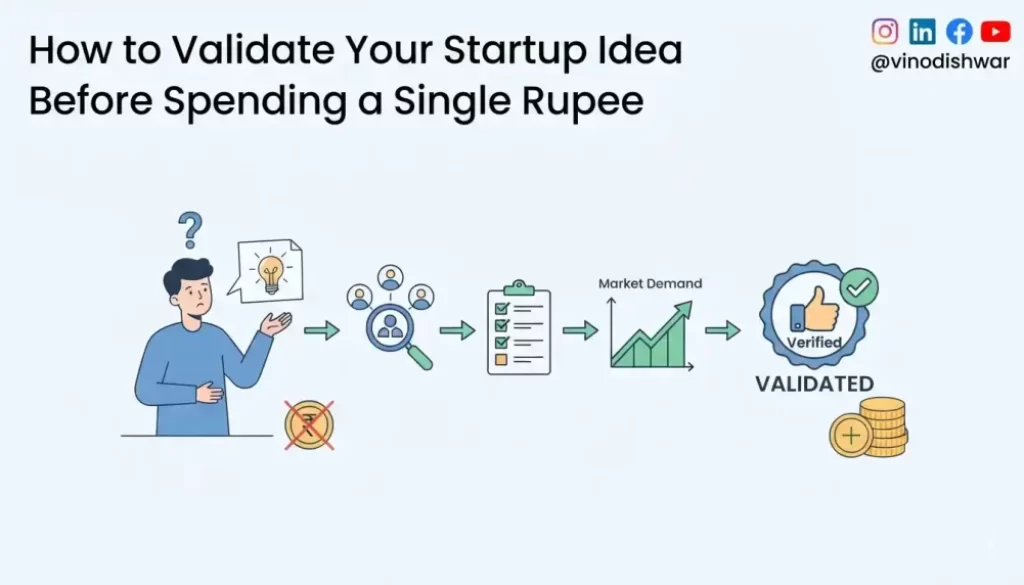
Learning how to validate a startup idea is one of the most important steps before investing time or money into a new business. Many founders assume their idea will succeed, but true validation comes from real customer feedback, market demand, and measurable actions—not assumptions. A structured validation process helps reduce risk and build a stronger foundation for long-term startup success. A successful validation process is also the foundation for achieving product-market fit.
Every founder believes their idea is good — that’s usually why they’re pursuing it. But belief isn’t validation, and the startup graveyard is full of well-built products that solved problems nobody was actually willing to pay to fix. Idea validation is the process of testing your assumptions against real market behavior, before you invest significant time, money, and emotional capital into building something the market may not want.
Why Founders Skip the Validate Startup Idea Process
Validation is often uncomfortable. It requires exposing your idea to potential rejection, criticism, and indifference, before you’ve had the chance to fall in love with a finished product. Many founders unconsciously avoid it, preferring the more exciting work of building — even though building without validation dramatically increases the risk of wasted effort. Proper validation also helps founders avoid common startup mistakes that delay growth.
How to Validate a Startup Idea Successfully
1. Talk to Potential Customers — Before You Pitch, Listen
The single most valuable validation activity is having structured conversations with 15–20 people who represent your target customer, focused on understanding their current problem and behavior, not pitching your solution. Ask about how they currently solve the problem, what frustrates them about existing options, and what they’ve actually paid for in the past — past behavior is a far stronger signal than hypothetical interest.
2. Create a Landing Page and Measure Real Interest
Build a simple landing page describing your proposed solution, with a clear call-to-action — sign up for early access, join a waitlist, or pre-order. Driving even modest traffic to this page and measuring genuine conversion tells you far more than survey responses, because it requires actual commitment, not just opinion.
3. Run a Smoke Test With a Minimal Offer
Before building the full product, test whether people will actually pay — even a small deposit or pre-order — for the promised solution. If people won’t commit even a small amount before the product exists, that’s an important signal worth taking seriously.
4. Study Existing Alternatives Closely
Customers are almost always solving their problem somehow already, even if imperfectly — through a competitor, a manual workaround, or simply tolerating the pain. Understanding these existing alternatives, and specifically why they fall short, sharpens your understanding of what a genuinely compelling solution needs to offer.
5. Build a Minimum Viable Product (MVP), Not a Full Product
Once initial signals are promising, build the smallest possible version of your solution that lets real customers use it and provide feedback — not the complete vision, but enough to test core assumptions in a real environment.
6. Look for Behavioral Evidence, Not Just Verbal Enthusiasm
People are often polite and encouraging in conversations, even when they have no genuine intention to buy. Prioritize signals that require real effort or commitment — sign-ups, pre-orders, referrals to others — over verbal enthusiasm alone.
Questions to Ask When You Validate a Startup Idea
- Is this a problem people actively want solved, or merely a mild inconvenience they’ve learned to live with?
- Are people currently spending money (or significant time and effort) addressing this problem?
- Is your target market large enough to build a sustainable business around?
- What would make someone switch from their current solution to yours?
- Can you reach this target customer through channels you can realistically afford?
Common Mistakes When You Validate a Startup Idea
- Only asking friends and family, who tend to be encouraging regardless of genuine interest.
- Asking hypothetical questions (“Would you use this?”) instead of observing actual behavior.
- Building a full product before testing core assumptions.
- Ignoring negative or lukewarm feedback because it doesn’t match the founder’s excitement.
- Confusing polite interest with genuine purchase intent.
A Realistic Perspective on Validation
Validation doesn’t guarantee startup success, and it isn’t a one-time checkpoint you complete before moving on permanently. Markets, customer needs, and competitive dynamics shift, and successful founders continue validating new features, pricing changes, and expansion ideas throughout the life of the business, not just at the very beginning.
Key Takeaways
- Idea validation tests real market demand before significant time and money are invested.
- Behavioral evidence — payments, sign-ups, referrals — is far more reliable than verbal enthusiasm.
- Studying existing alternatives sharpens understanding of what a compelling solution actually requires.
- MVPs should test core assumptions with real customers, not represent the complete product vision.
- Founders who consistently validate a startup idea throughout their business journey are more likely to build products that solve real customer problems and achieve sustainable growth.
Conclusion
Building a startup is hard enough when you’re solving a real, validated problem. Skipping validation and hoping the market agrees with your assumptions after the fact is one of the most avoidable ways founders waste time, money, and momentum. Professional startup consulting services can help founders validate business ideas, reduce risk, and create structured growth strategies. A disciplined validation process gives your startup a genuinely stronger foundation to build on.
-Vinod Ishwar
Frequently Asked Questions (FAQs)
1. Why is it important to validate a startup idea before building a product?
Validating a startup idea helps founders confirm that there is real customer demand before investing significant time, money, and resources. It reduces the risk of building a product that people do not need or want.
2. How can I validate a startup idea without spending money?
You can validate a startup idea by talking to potential customers, conducting market research, creating a simple landing page, collecting sign-ups, running surveys, and testing demand through pre-orders or waitlists before building the actual product.
3. What is the best way to validate a startup idea?
The best way to validate a startup idea is by observing real customer behavior. Actions such as sign-ups, pre-orders, referrals, or willingness to pay provide stronger validation than opinions or hypothetical feedback.
4. How many customer interviews are needed to validate a startup idea?
While the number varies depending on the industry, many founders begin by interviewing 15 to 20 potential customers. These conversations help identify customer pain points, buying behavior, and market demand.
5. Should I build an MVP before validating my startup idea?
No. Startups should first validate the problem and customer demand. Once there are positive validation signals, building an MVP becomes the next step to test the solution with real users.
6. What are common mistakes when trying to validate a startup idea?
Common mistakes include asking only friends and family, relying on opinions instead of customer actions, ignoring negative feedback, building a complete product too early, and assuming interest automatically means customers will pay.