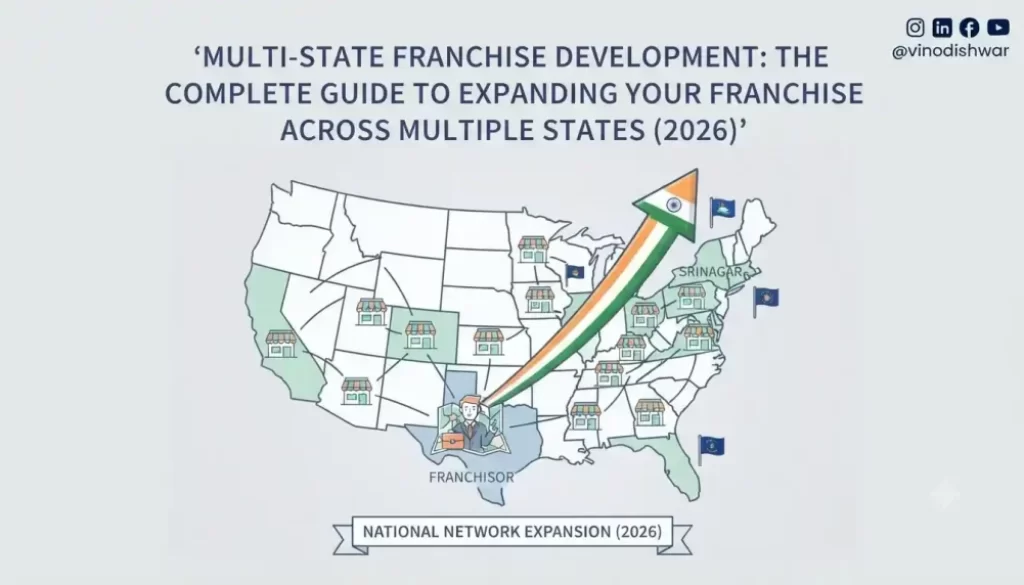
Multi-State Franchise Development: The Complete Guide to Expanding Your Franchise Across Multiple States (2026)
Expanding into multiple states is one of the biggest milestones in a franchise brand’s growth journey. While growing within a single city or region helps validate your business model, multi-state franchise development requires a much higher level of planning, operational maturity, leadership, compliance management, and strategic execution.
Each new state introduces unique market dynamics, customer preferences, labor availability, taxation, licensing requirements, real estate conditions, and competitive landscapes. Without a structured expansion framework, franchisors can face inconsistent customer experiences, operational inefficiencies, compliance risks, and slower franchise growth.
Successful multi-state franchise development combines standardized systems with localized execution. Businesses must establish scalable operations, recruit qualified franchise partners, build regional leadership, implement enterprise technology, and monitor performance across every territory.
Whether you’re franchising a restaurant, café, retail chain, salon, preschool, healthcare business, fitness brand, manufacturing company, or service organization, this guide explains how to successfully expand across multiple states while maintaining operational excellence and brand consistency.
Important: Franchise laws, taxation, licensing, labor regulations, advertising requirements, and industry-specific compliance obligations may vary by jurisdiction. Work with qualified legal, tax, accounting, and compliance professionals before expanding into new states.
What Is Multi-State Franchise Development?
Multi-state franchise development is the strategic process of expanding a franchise network into multiple states through structured territory planning, standardized operations, scalable support systems, and regional management.
Unlike expansion within one state, multi-state development requires additional focus on:
- Regional market analysis
- State-specific compliance
- Territory allocation
- Supply chain planning
- Leadership structure
- Technology integration
- Franchise recruitment
- Performance management
The objective is to create a sustainable national franchise network without compromising operational quality.
Why Multi-State Expansion Matters
A successful multi-state franchise network provides:
- Wider brand recognition
- Larger customer reach
- Diversified revenue streams
- Reduced dependence on one regional market
- Stronger purchasing power
- Greater franchise demand
- Increased business valuation
- Long-term scalability
Expansion across states also helps reduce geographic concentration risk.
Step-by-Step Multi-State Franchise Development Process
Step 1: Validate the Franchise Model
Before expanding into additional states, ensure your franchise system demonstrates:
- Consistent profitability
- Repeatable business processes
- Standardized Operations Manual
- Documented SOPs
- Strong franchisee satisfaction
- Reliable technology
- Proven recruitment systems
Expansion should be based on documented operational success.
Step 2: Research Target States
Evaluate each state using:
- Population growth
- Economic conditions
- Consumer demand
- Industry trends
- Competitive landscape
- Commercial real estate availability
- Workforce quality
- Infrastructure
Comprehensive market research supports informed expansion decisions.
Step 3: Build a State Expansion Roadmap
Develop a phased roadmap that prioritizes states based on:
- Market potential
- Operational readiness
- Logistics
- Brand awareness
- Investment requirements
- Long-term strategic goals
Avoid expanding into too many states simultaneously without adequate support capacity.
Step 4: Plan Franchise Territories
Create clearly defined territories within each state to:
- Prevent market overlap
- Protect franchisee investments
- Maximize customer coverage
- Support future regional expansion
recruit
Step 5: Strengthen Operations
Every franchise location should operate using identical core systems:
- Operations Manual
- SOP library
- Brand Guidelines
- Customer service standards
- Quality assurance processes
- Reporting procedures
Consistency strengthens customer trust across every state.
Step 6: Recruit High-Quality Franchisees
Implement a structured recruitment process including:
- Franchise marketing
- Lead qualification
- Discovery meetings
- Financial evaluation
- Due diligence
- Franchise agreement execution
- Onboarding
Recruitment quality has a direct impact on long-term network performance.
Step 7: Develop Regional Leadership
As your network grows, establish:
- Regional Directors
- Franchise Business Consultants
- Area Managers
- Training Specialists
- Marketing Coordinators
- Technical Support Teams
Regional leadership improves responsiveness and operational consistency.
Step 8: Build a Scalable Supply Chain
Expansion across states requires:
- Approved vendor programs
- Regional distribution partners
- Inventory management
- Procurement standards
- Logistics planning
- Vendor performance reviews
Supply chain reliability becomes increasingly important as the network grows.
Step 9: Invest in Enterprise Technology
Technology should unify operations across all states through:
- CRM
- ERP
- POS
- Franchise portals
- Learning Management Systems (LMS)
- Business Intelligence dashboards
- Inventory management platforms
- Digital document management
Enterprise technology enables centralized oversight with localized execution.
Step 10: Monitor and Improve Performance
Track network-wide KPIs including:
- Revenue per unit
- Same-store sales growth
- Franchisee profitability
- Customer satisfaction
- Compliance scores
- Marketing ROI
- Territory performance
- Franchisee retention
Use analytics to refine your expansion strategy continuously.
Multi-State Expansion Timeline
| Expansion Stage | Primary Focus |
|---|---|
| State 1 | Validate franchise model |
| States 2–3 | Standardize operations and recruitment |
| States 4–6 | Build regional leadership |
| States 7–10 | Strengthen governance and technology |
| Ongoing | Optimize performance and strategic expansion |
Growth should be paced according to operational readiness rather than aggressive unit targets.
Infrastructure Required for Multi-State Development
Operations
- Operations Manual
- SOP library
- Compliance audits
- Quality assurance program
Technology
- CRM
- ERP
- POS
- BI dashboards
- Franchise portal
- LMS
Marketing
- National branding
- State-specific campaigns
- Local SEO
- Google Business Profile optimization
- Public relations
- Reputation management
Finance
- Royalty management
- Financial reporting
- Budget forecasting
- Performance analytics
Leadership
- Regional Directors
- Franchise Consultants
- Marketing Managers
- Training Teams
- Technical Support
Multi-State Development Checklist
Before entering a new state, ensure you have:
Strategic Readiness
- State market research completed
- Expansion roadmap approved
- Territory strategy finalized
- Competitive analysis conducted
Operational Readiness
- Operations Manual updated
- SOPs standardized
- Vendor network established
- Support systems operational
Recruitment Readiness
- Franchise marketing strategy
- CRM workflows
- Qualification framework
- Discovery process
- Onboarding program
Technology Readiness
- CRM integrated
- POS configured
- ERP operational
- Reporting dashboards active
Marketing Readiness
- State launch campaign
- Local SEO strategy
- Google Business Profile setup
- Grand opening marketing plan
Practical Example
A home services franchise successfully expanded from one state into five neighboring states over four years.
The company implemented:
- State-by-state expansion planning
- Digital Operations Manual
- Enterprise CRM
- Regional support teams
- Standardized onboarding
- Territory management software
- Centralized KPI dashboards
- Quarterly operational audits
By following a structured development strategy, the franchise achieved consistent customer experiences and operational efficiency across multiple states.
Multi-State Franchise Development Framework
Validate Franchise Model
          │
          ▼
State Market Research
          │
          ▼
Expansion Roadmap
          │
          ▼
Territory Planning
          │
          ▼
Operations Standardization
          │
          ▼
Franchise Recruitment
          │
          ▼
Regional Leadership
          │
          ▼
Technology Integration
          │
          ▼
Performance Monitoring
          │
          ▼
National Franchise Growth
Common Multi-State Expansion Mistakes
Avoid these common pitfalls:
- Expanding before operations are standardized
- Ignoring state-specific regulatory requirements
- Weak territory planning
- Inconsistent franchise training
- Poor communication between regional teams
- Limited technology integration
- Weak supply chain management
- Inadequate franchise support
- Measuring growth only by unit count instead of overall performance
Best Practices
- Expand one state at a time whenever practical.
- Validate systems before entering new markets.
- Build regional leadership early.
- Standardize operations while allowing appropriate local adaptation.
- Invest in enterprise technology.
- Conduct regular operational audits.
- Monitor KPIs across all regions.
- Continuously improve systems based on franchisee feedback and performance data.
How Franchise Development Consultants Help
Professional franchise development consultants help businesses:
- Create multi-state expansion strategies
- Conduct market and territory analysis
- Design scalable franchise systems
- Build Operations Manuals and SOPs
- Implement CRM and enterprise technology
- Improve franchise recruitment
- Develop governance frameworks
- Coordinate documentation and compliance planning with qualified legal professionals
These capabilities enable sustainable expansion while protecting brand integrity.
Why Choose Franchise Alpha?
At Franchise Alpha, we help businesses build scalable multi-state franchise networks through our proprietary SOLEMN® Framework, integrating strategy, operations, governance, marketing, technology, and franchise support.
Strategy
Develop a customized multi-state expansion roadmap aligned with your long-term business objectives.
Operations
Standardize Operations Manuals, SOPs, quality assurance, onboarding, and franchise support systems across every state.
Legal
Coordinate with qualified legal professionals to support franchise agreements, intellectual property protection, territory planning, and regulatory compliance.
Entrust
Implement governance systems that improve accountability, operational consistency, and franchisee success across multiple regions.
Marketing
Generate qualified franchise leads through SEO, Google Ads, Meta Ads, content marketing, local SEO, and investor education while supporting state-specific marketing initiatives.
Nitty-Gritty
Deploy enterprise CRM platforms, ERP systems, BI dashboards, workflow automation, LMS platforms, and analytics to support scalable multi-state franchise development.
Frequently Asked Questions
What is multi-state franchise development?
Multi-state franchise development is the strategic expansion of a franchise business across multiple states using standardized systems, structured territory planning, regional leadership, and scalable support.
What should businesses consider before expanding into another state?
Businesses should validate their franchise model, conduct detailed market research, understand applicable legal and regulatory requirements, build operational infrastructure, and ensure they have adequate support systems before expansion.
Why is territory planning important in multi-state expansion?
Territory planning helps prevent internal competition, protects franchisee investments, improves market coverage, and creates a long-term roadmap for sustainable growth.
What technology supports multi-state franchise development?
Common solutions include CRM systems, ERP software, POS platforms, BI dashboards, Learning Management Systems, franchise portals, and inventory management tools that provide centralized oversight.
Conclusion
Multi-state franchise development is a major step toward becoming a nationally recognized franchise brand.
Businesses that combine strategic planning, standardized operations, enterprise technology, regional leadership, disciplined franchise recruitment, and continuous performance management create a strong foundation for long-term, sustainable expansion.
The most successful franchise systems do not simply grow into new states—they build scalable organizations capable of supporting franchisees consistently across every market.
Call to Action
Ready to Expand Your Franchise Across Multiple States?
Book a Franchise Readiness Assessment with Vinod Ishwar and discover how to build a structured multi-state franchise development strategy tailored to your growth goals.
Your assessment includes:
- Multi-State Expansion Audit
- Territory & Market Assessment
- Operations & Technology Review
- Recruitment & Support Evaluation
- Customized National Franchise Growth Roadmap
Build a scalable multi-state franchise network with confidence and operational excellence.