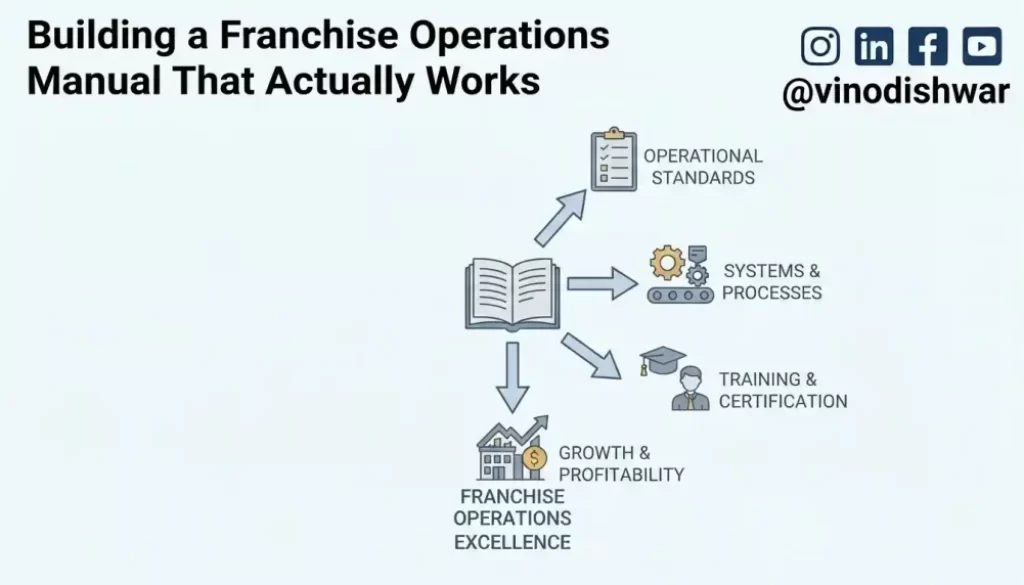
Building a Franchise Operations Manual That Actually Works
Franchise investment is one of the biggest financial decisions an entrepreneur can make. For most first-time franchisees, the franchise fee is often the first number they notice. However, the franchise fee represents only one part of the overall investment required to successfully establish and operate a franchise business.
And yet, most operations manuals fail at their core job. They get written once, printed or PDF’d, handed to the franchisee during training week, and never opened again.
Before making any franchise investment, it’s equally important to understand what makes a brand franchise-ready, as strong franchise systems provide better long-term growth opportunities for investors.
What an Operations Manual Actually Needs to Do
An effective operations manual isn’t a policy document — it’s a working tool that a franchisee’s staff can reference daily to make correct decisions without needing to call head office every time something unusual happens. Before making a franchise investment, evaluate all costs. If your manual doesn’t reduce the number of “what do I do in this situation” calls you receive, it isn’t doing its job.
Entrepreneurs should also explore government-backed initiatives like Startup India, which provides resources, guidance, and support for new business owners.
Core Components of a Strong Franchise Operations Manual
1. Brand Standards and Customer Experience Guidelines
This section defines exactly what the brand promises customers — service tone, presentation standards, response times, and the non-negotiables that must never vary across outlets, regardless of location or franchisee.
2. Standard Operating Procedures (SOPs) for Every Core Process
From opening and closing routines to inventory management, quality checks, and customer complaint handling — every recurring process should be documented step-by-step, in plain language, with visuals wherever possible. Text-only manuals are far less effective than manuals combining written steps with photos, diagrams, or short video references.
3. Staff Training and Onboarding Protocols
New staff hired by franchisees need a structured onboarding path, not ad-hoc training from whoever happens to be free that day. This section should outline role-specific training checklists and timelines.
4. Quality Control and Compliance Checklists
Daily, weekly, and monthly checklists that franchisees or their managers can use to self-audit against brand standards — covering hygiene, product quality, equipment maintenance, and presentation.
5. Financial and Reporting Procedures
Clear guidelines on royalty calculation, reporting formats, payment timelines, and any required financial documentation franchisees must submit to the franchisor.
6. Marketing and Local Promotion Guidelines
Rules around local marketing activities, brand asset usage, social media guidelines, and how franchisees can request or access centrally created marketing materials.
7. Crisis and Exception Handling
Guidance for scenarios outside routine operations — equipment failure, staff shortages, customer escalations, negative reviews, or local emergencies — so franchisees aren’t left improvising during high-pressure moments.
Why Most Manuals Fail — And How to Fix It
Problem: Manuals are too long and text-heavy. Franchisees and their staff won’t read a 200-page document during a busy shift. Fix: Structure content in short, scannable sections with visual aids, and consider splitting the manual into a “daily reference” version and a “complete reference” version.
Problem: Manuals are static. Businesses evolve, but manuals often don’t get updated for years. Fix: Build the manual as a living digital document, with version control, and establish a regular review cycle — ideally quarterly.
Problem: Manuals are written by people who’ve never run the outlet. This leads to theoretical processes that don’t match real-world constraints. Fix: Involve top-performing franchisees or outlet managers directly in drafting and refining SOPs.
Problem: No accountability for usage. Franchisees receive the manual but no one checks whether it’s actually being followed. Fix: Incorporate manual compliance into regular franchise audits and mystery shopper programs.
Digital vs Physical Manuals
Increasingly, franchisors are moving toward digital, searchable operations manuals hosted on internal platforms or apps — allowing real-time updates, easy searchability, and tracking of which sections franchisees have actually accessed. This is particularly valuable for larger networks where printed manual updates become logistically difficult to distribute consistently.
Key Takeaways
- An operations manual should function as a daily working tool, not a filed-away policy document.
- Visual, scannable formatting dramatically increases actual usage.
- A successful franchise investment requires careful planning.
- Manuals must be updated regularly to remain relevant and useful.
- Involving experienced franchisees in drafting SOPs improves real-world accuracy.
- Digital manuals offer better version control and usage tracking than printed versions.
- If you’re considering a franchise investment and need expert guidance, explore our Franchise Consulting services to make informed business decisions and choose the right franchise opportunity.
Conclusion
Brand consistency across a franchise network isn’t maintained through inspection alone — it’s built into the daily habits of every outlet through a manual that people actually use. Investing in a genuinely functional operations manual pays dividends in customer experience, franchisee confidence, and brand reputation for years to come.