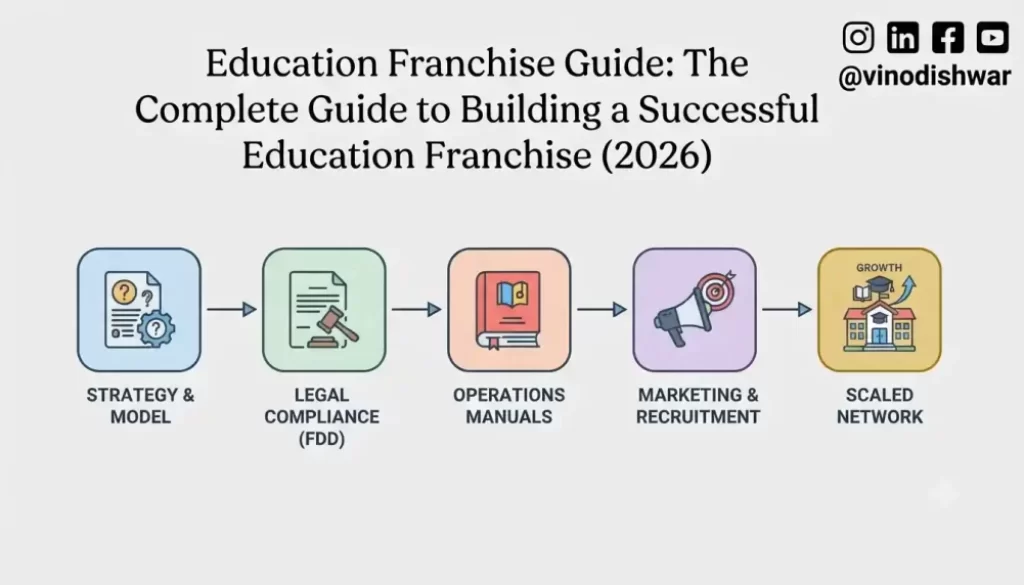
Education Franchise Guide: The Complete Guide to Building a Successful Education Franchise (2026)
Introduction
Education Franchise Guide is essential for schools, coaching institutes, preschools, edtech companies, and training centers that want to expand through franchising. India’s education sector offers enormous growth opportunities, but successful expansion requires standardized academic systems, faculty training, SOPs, quality assurance, and strong franchise support.
India’s education sector is one of the fastest-growing industries, creating significant opportunities for schools, preschools, coaching institutes, skill development centers, edtech companies, language academies, music schools, and vocational training providers.
However, opening more education centers alone does not create a successful franchise network.
The real challenge is delivering the same learning outcomes, teaching quality, operational excellence, and brand experience across every location.
Many education businesses fail during expansion because they rely heavily on founders, experienced teachers, or informal operating methods.
Successful education franchises are built on standardized academic systems, documented processes, structured training, quality assurance, and continuous franchise support.
This comprehensive Education Franchise Guide explains how to build an education business that can successfully expand across cities, states, and even internationally.
Education Franchise Guide: What Is an Education Franchise?
An Education Franchise is a business model where an education brand licenses its curriculum, systems, operations, brand identity, and support framework to independent franchise partners who operate educational centers under the same brand.
Examples include:
- Preschool Franchises
- K–12 School Networks
- Coaching Institutes
- Tuition Centers
- Skill Development Academies
- Language Institutes
- Music & Dance Academies
- Computer Training Centers
- STEM Education Centers
- EdTech Learning Centers
The objective is consistent educational quality while expanding geographically.
Why Every Education Franchise Guide Emphasizes Standardization
Franchising enables education brands to:
- Expand faster
- Reduce capital investment
- Build regional presence
- Increase brand recognition
- Generate recurring royalty income
- Reach underserved markets
- Standardize education delivery
- Improve business valuation
- Create long-term sustainability
- Develop national education networks
A structured franchise model accelerates growth while maintaining quality.
The 15-Step Education Franchise Framework
Step 1. Validate Your Education Model
Before franchising, ensure:
- Strong student outcomes
- High enrollment rates
- Positive parent feedback
- Sustainable profitability
- Proven academic methodology
A successful flagship center should become the model for expansion.
Step 2. Standardize Academic Delivery
Document:
- Teaching methodology
- Lesson planning
- Curriculum delivery
- Student assessments
- Classroom management
- Academic reporting
Consistency creates trust.
Step 3. Develop Standard Operating Procedures (SOPs)
Create SOPs for:
- Admissions
- Parent counseling
- Student onboarding
- Daily operations
- Faculty management
- Attendance
- Assessments
- Complaint handling
SOPs ensure operational consistency. /standard-operating-procedures-sops/
Step 4. Build an Education Operations Manual
Include:
- Academic policies
- Administrative procedures
- HR guidelines
- Marketing standards
- Brand guidelines
- Financial reporting
- Student management
Documentation enables scalable education businesses.
Step 5. Protect Intellectual Property
Secure:
- Trademarks
- Curriculum copyrights
- Brand assets
- Teaching materials
- Digital learning content
Protecting IP strengthens franchise value.
Step 6. Create the Franchise Business Model
Define:
- Franchise fees
- Royalty structure
- Territory rights
- Investment requirements
- Revenue model
- Franchise obligations
A transparent model builds confidence.
Step 7. Build Faculty Training Systems
Develop structured training for:
- Teachers
- Academic coordinators
- Center managers
- Counselors
- Franchise owners
Training ensures consistent learning experiences.
Step 8. Implement Technology
Adopt:
- Student Management System (SMS)
- Learning Management System (LMS)
- CRM
- ERP
- Online Assessment Platform
- Parent Communication App
Technology improves operational efficiency.
Step 9. Standardize Student Experience
Maintain consistency in:
- Admissions
- Classroom environment
- Teaching quality
- Assessments
- Parent communication
- Student support
Every center should deliver the same educational experience.
Step 10. Recruit the Right Franchise Partners
Evaluate partners based on:
- Passion for education
- Financial capability
- Local market knowledge
- Leadership
- Commitment to quality
Selecting the right franchisee is critical.
Step 11. Build Franchise Support Systems
Provide:
- Academic guidance
- Marketing support
- Operational assistance
- Technology support
- Business coaching
Continuous support improves franchise success.
Step 12. Monitor Performance
Track KPIs such as:
- Student enrollment
- Retention rates
- Parent satisfaction
- Academic outcomes
- Revenue growth
- Franchise profitability
Performance monitoring drives improvement.
Step 13. Conduct Academic Audits
Review:
- Teaching quality
- Curriculum implementation
- Student outcomes
- Faculty performance
- Brand compliance
Quality assurance protects reputation.
Step 14. Expand Region by Region
Grow through:
- Multi-city expansion
- State-wise development
- Master Franchise
- Area Development
- International education partnerships
Disciplined expansion minimizes risk.
Step 15. Continuously Innovate
Improve:
- Curriculum
- Teaching methods
- Digital learning
- Student engagement
- Faculty development
- Educational technology
Innovation keeps education brands relevant.
Essential Systems Every Education Franchise Needs
Every scalable education franchise should develop:
- Academic Operations Manual
- SOP Library
- Curriculum Documentation
- LMS Platform
- Student Management System
- CRM
- ERP
- Faculty Training Academy
- Franchise Support Portal
- Academic Audit Framework
These systems ensure quality across every center.
Common Education Franchise Mistakes
Avoid these mistakes:
- Expanding without proven curriculum
- Founder dependency
- Weak teacher training
- Poor franchisee selection
- Lack of documentation
- Inconsistent teaching standards
- Weak technology
- Limited franchise support
Preparation ensures sustainable growth.
How Education Franchise Consultants Help
Professional consultants assist by:
- Evaluating franchise readiness
- Developing franchise models
- Creating SOPs
- Preparing Operations Manuals
- Designing franchise documentation
- Building training systems
- Improving scalability
- Supporting national expansion
Expert guidance accelerates franchise success.
The SOLEMN® Framework
At Franchise Alpha, education franchises are developed using the proprietary SOLEMN® Framework.
Strategy
Develop long-term education expansion strategies, market positioning, franchise models, and growth roadmaps.
Operations
Standardize curriculum, SOPs, Operations Manuals, academic systems, administrative workflows, and quality management.
Legal
Protect trademarks, curriculum IP, develop Franchise Agreements, and ensure regulatory compliance.
Entrust
Build academic leadership, reduce founder dependency, strengthen organizational capability, and develop education managers.
Marketing
Accelerate growth through digital marketing, admissions campaigns, branding, franchise lead generation, and community engagement.
Nitty-Gritty
Measure KPIs, optimize enrollment, improve academic outcomes, strengthen franchise performance, and continuously enhance educational quality.
The SOLEMN® Framework helps education businesses become scalable and nationally recognized franchise brands.
Frequently Asked Questions
What is an Education Franchise?
An Education Franchise allows entrepreneurs to operate an educational institution using an established brand’s curriculum, systems, operations, and support framework.
Which education businesses can be franchised?
Preschools, schools, coaching institutes, tuition centers, language academies, music schools, skill development centers, and vocational institutes can all adopt the franchise model.
Why are SOPs important in education franchising?
SOPs ensure every education center follows identical operational and academic processes, delivering consistent learning experiences.
Why hire an Education Franchise Consultant?
A consultant helps standardize academic systems, develop franchise documentation, create scalable operations, improve profitability, and support long-term expansion.
Conclusion
This Education Franchise Guide demonstrates that sustainable expansion depends on standardized systems, strong leadership, documented processes, and continuous franchise support.
Education franchising is about much more than opening additional centers.
It is about replicating educational excellence through standardized systems, documented processes, trained faculty, strong leadership, and continuous innovation.
The most successful education brands build institutions that deliver the same quality of education regardless of location.
Great education changes lives.
Great systems allow that impact to scale.
Call to Action
Build a Successful Education Franchise
Book an Education Franchise Strategy Session with Vinod Ishwar to assess your business readiness, standardize academic operations, develop franchise documentation, strengthen systems, and create a customized roadmap for national education franchise expansion.
Receive a complete education franchise blueprint designed for sustainable growth and long-term success.