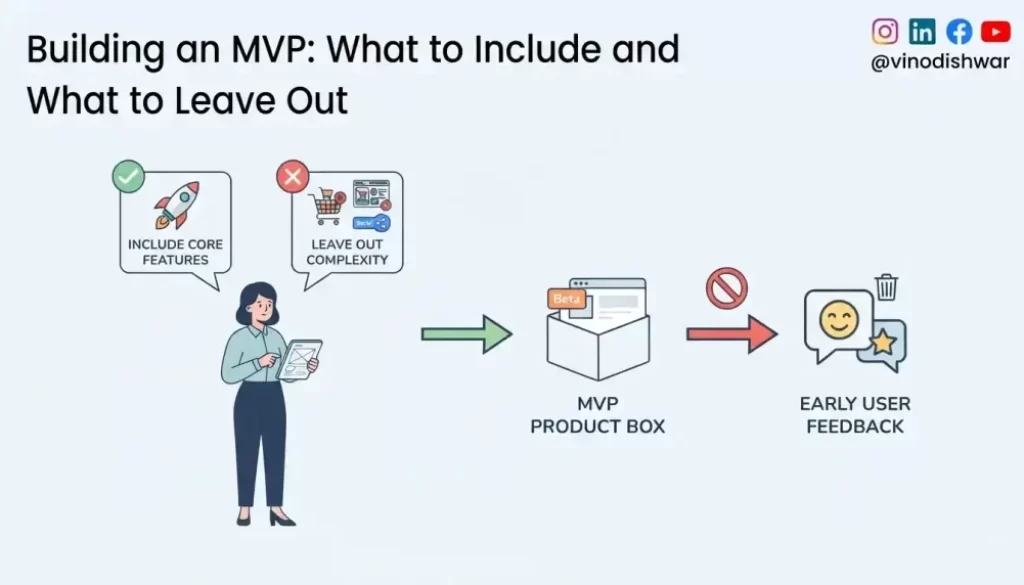
Building an MVP: What to Include and What to Leave Out
Building an MVP is one of the most important steps for startups looking to validate ideas before investing significant time and resources. A successful MVP helps founders test core assumptions, understand customer needs, and collect real feedback while avoiding unnecessary development costs. Before building an MVP, founders should validate whether they have achieved strong product-market fit.
The term “MVP” — minimum viable product — gets used often in startup circles, but genuinely understood less often than its popularity suggests. Many founders build something that’s neither minimal nor genuinely viable: either an over-engineered product with far more features than necessary to test core assumptions, or an underdeveloped one that fails to actually demonstrate the value proposition to real users. Getting the balance right is one of the highest-leverage decisions in a startup’s early life. Founders can learn more about startup experimentation principles through resources from Y Combinator.
What Building an MVP Really Means
Minimum means including only what’s necessary to test your riskiest assumptions — not every feature on your eventual product roadmap. Viable means the product must genuinely work well enough for real users to experience the core value proposition, not a broken or confusing prototype that fails to demonstrate what you’re actually testing.
How Startups Should Approach Building an MVP
1. Identify Your Riskiest Assumption First
Before deciding on features, identify the single assumption that, if wrong, would invalidate your entire business — often related to whether customers genuinely want and will pay for your core value proposition. Your MVP should be designed specifically to test this assumption as directly and cheaply as possible. Understanding customer needs early also helps founders avoid common startup mistakes that waste time and resources.
2. Focus on the Core User Journey, Not Every Use Case
Map the single most important path a user takes to experience your product’s core value, and build only what’s needed to support that specific journey well — resisting the temptation to build for every edge case or secondary use scenario upfront.
3. Choose Manual Processes Over Automation Where Possible
In early stages, it’s often faster and cheaper to manually handle processes behind the scenes — customer service, matching, fulfillment — rather than building full automation before you know the product-market fit is genuinely there. This is often called a “concierge MVP” approach. Many early-stage startups use lean approaches while testing ideas before creating larger operational systems.
4. Resist Feature Requests That Don’t Test Core Assumptions
Early users and advisors will suggest numerous additional features. Evaluate each suggestion against whether it helps test your core hypothesis, or whether it’s simply adding polish and complexity to a product whose fundamental viability isn’t yet proven.
5. Prioritize Speed to Learning Over Perfection
The goal of an MVP isn’t to impress users with polish — it’s to generate genuine learning as quickly and cheaply as possible. A rougher product that reaches real users sooner often generates more valuable learning than a polished one that takes months longer to launch.
What to Deliberately Leave Out of an MVP
- Advanced personalization or customization features
- Full-scale automation of processes that can initially be handled manually
- Secondary use cases or edge scenarios beyond the core user journey
- Extensive design polish beyond what’s needed for genuine usability
- Scalability infrastructure designed for a user base far larger than your current stage requires
Measuring Success After Building an MVP
Define clear, specific metrics before launching your MVP — user activation rates, retention after first use, willingness to pay, referral behavior — rather than relying on subjective impressions or anecdotal feedback alone. These metrics should directly relate to the core assumption you’re testing.
Common Building an MVP Mistakes Startups Make
- Building too many features, delaying launch and diluting the ability to isolate what’s actually working.
- Building too little, failing to genuinely demonstrate the core value proposition to real users.
- Skipping the “viable” requirement, launching something so rough that it fails to generate meaningful feedback.
- Ignoring quantitative metrics, relying only on qualitative impressions of user reaction.
- Treating the MVP as the final product, rather than one iteration in an ongoing learning process.
Key Takeaways
- An effective MVP tests your riskiest core assumption with minimal built features.
- “Viable” requires genuine usability, not just minimalism for its own sake.
- Manual, unscaled processes are often the right choice for testing early-stage assumptions.
- Speed to learning matters more than product polish at the MVP stage.
- Clear, predefined success metrics prevent subjective or biased interpretation of MVP results.
- The process of building an MVP helps founders make data-driven decisions before committing to large-scale product development.
Conclusion
An MVP is a learning tool, not a diminished version of your eventual product. Approached with discipline — focused tightly on testing your riskiest assumption — it becomes one of the most valuable, capital-efficient tools available to an early-stage startup.
-Vinod Ishwar
Frequently Asked Questions (FAQs)
1. What does building an MVP mean?
Building an MVP (Minimum Viable Product) means creating the simplest version of a product that delivers its core value while allowing startups to test their business idea with real users before investing in full-scale development.
2. Why is building an MVP important for startups?
Building an MVP helps startups validate assumptions, collect customer feedback, reduce development costs, and identify whether there is genuine market demand before investing significant time and resources.
3. What features should be included when building an MVP?
When building an MVP, startups should include only the essential features required to solve the primary customer problem and demonstrate the product’s core value. Additional features can be added after validating customer demand.
4. What should startups avoid when building an MVP?
Startups should avoid adding unnecessary features, over-engineering the product, excessive design polish, and building complex automation before validating their core business assumptions.
5. How long does it take to build an MVP?
The timeline for building an MVP depends on the complexity of the product, but many startups aim to launch within a few weeks or months so they can begin collecting customer feedback as early as possible.
6. How can founders measure the success of an MVP?
Founders can measure MVP success by tracking user activation, customer retention, feedback, willingness to pay, referral rates, and other metrics that show whether the product delivers value to its target audience.
7. What is the difference between an MVP and a final product?
An MVP is designed to test assumptions and gather feedback using only essential features, while a final product includes additional functionality, scalability, and refinements developed after validating market demand.