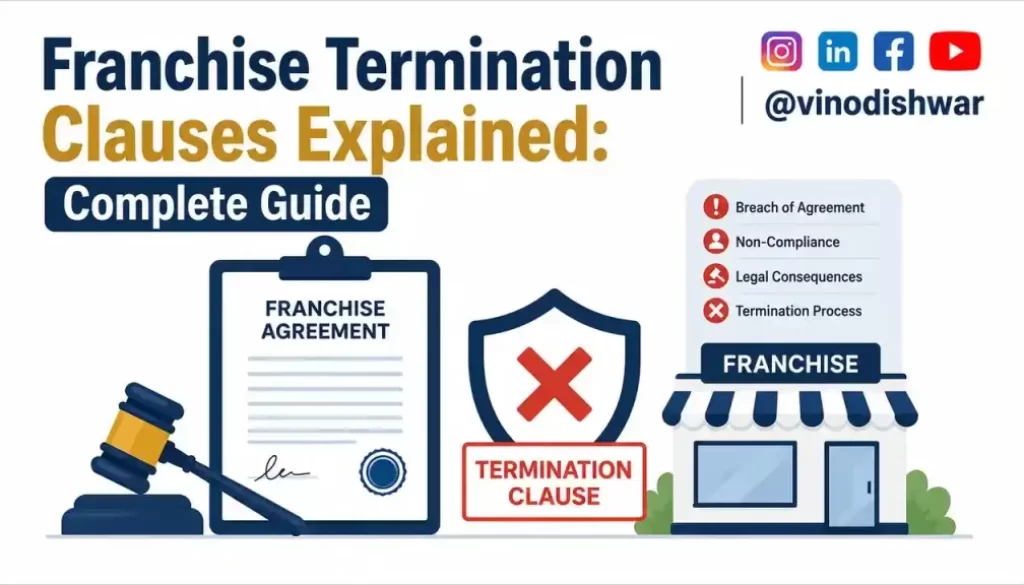
Franchise Termination Clauses Explained: Complete Guide
Franchise Termination Clauses are critical provisions in a franchise agreement because they define when and how a franchisor or franchisee can end the contractual relationship. They establish the circumstances that may trigger termination, the notice requirements, available cure periods, and the obligations that continue after the franchise relationship ends.
A franchise relationship may need to end before the scheduled expiry date because of serious contractual breaches, non-payment, repeated operational failures, brand misuse, fraud or misconduct, regulatory violations, insolvency, unauthorized transfer, persistent non-compliance, or mutual business decisions.
A franchise agreement establishes a long-term business relationship between a franchisor and franchisee. But not every franchise relationship continues until the scheduled expiry date.
A franchise relationship may need to end because of:
- Serious contractual breaches
- Non-payment
- Repeated operational failures
- Brand misuse
- Fraud or misconduct
- Regulatory violations
- Insolvency
- Unauthorized transfer
- Persistent non-compliance
- Mutual business decisions
This is where franchise termination clauses become critical.
A well-drafted termination clause explains when a franchise agreement can be terminated, who can terminate it, what notice is required, whether the breach can be cured, and what happens after termination.
For franchisors, termination provisions protect the brand and franchise system.
For franchisees, they provide clarity about contractual rights, obligations, defaults, and exit procedures.
In India, franchise termination provisions should be considered within the broader contractual framework, including the Indian Contract Act, 1872, along with other laws applicable to the specific business and circumstances.
What Is a Franchise Termination Clause?
A franchise termination clause is a contractual provision that establishes the circumstances and process through which a franchise agreement can come to an end before or at the end of the agreed contractual relationship.
A termination provision may address:
- Events of default
- Notice requirements
- Cure periods
- Immediate termination
- Termination without cause, where contractually permitted
- Mutual termination
- Insolvency
- Post-termination obligations
- De-branding
- Intellectual-property rights
- Outstanding payments
- Confidentiality
- Digital assets
- Customer information
- Dispute resolution
The exact structure depends on the franchise model and agreement.
Termination vs Expiry: What Is the Difference?
These concepts should not be confused.
Expiry
The franchise agreement reaches the end of its agreed term.
Example:
Agreement Term: 1 January 2026 – 31 December 2030
The agreement expires on 31 December 2030 unless renewed or otherwise extended.
Termination
The agreement ends because a contractual termination mechanism has been triggered.
Why Franchise Termination Clauses Matter
A franchise system involves multiple interconnected relationships.
The franchisor may have:
- Brand reputation to protect
- Customers to protect
- Other franchisees to protect
- IP to protect
- Supplier relationships
- Operational standards
The franchisee may have:
- Significant capital invested
- Employees
- Inventory
- Equipment
- Lease commitments
- Customer relationships
A poorly drafted termination clause can therefore create uncertainty at precisely the moment when clarity matters most.
15 Key Elements of Franchise Termination Clauses
1. Events of Default
The agreement should clearly identify what constitutes a material breach or default.
Possible examples include:
- Non-payment
- Unauthorized use of intellectual property
- Serious SOP violations
- Fraud
- Misrepresentation
- Regulatory violations
- Unauthorized transfer
- Failure to maintain required insurance
- Repeated quality failures
- Insolvency-related events
The exact events should be tailored to the franchise model.
2. Notice of Breach
Many agreements provide a formal notice process.
For example:
Breach Occurs ↓Written Notice ↓Description of Breach ↓Opportunity to Cure ↓Cured? ↙ ↘ Yes No ↓ ↓Continue Termination / Other Remedy
The agreement should specify how notices must be delivered.
3. Cure Period
A cure period gives the defaulting party an opportunity to correct a breach before termination becomes effective.
For example:
The franchisee receives 30 days to remedy a specified breach.
The actual period depends on the contract and type of breach.
Not every breach is necessarily suitable for the same cure period.
4. Immediate Termination
Certain serious events may justify a contractual mechanism for termination without a conventional cure period, depending on the agreement and applicable law.
Potential examples may include:
- Serious fraud
- Deliberate brand misuse
- Unauthorized assignment
- Certain criminal or regulatory events
- Serious health and safety violations
- Intentional disclosure of confidential information
The exact drafting matters.
A franchisor should not assume that simply labeling an event “immediate termination” automatically resolves questions of enforceability.
5. Non-Payment
Financial default is one of the most important termination considerations.
The agreement may address:
- Unpaid royalties
- Marketing contributions
- Technology fees
- Supplier payments
- Other contractual charges
A good provision should clarify:
- When payment becomes overdue
- Whether notice is required
- Whether a cure period applies
- What happens after repeated non-payment
6. Repeated Operational Non-Compliance
A franchisee may technically correct individual breaches but repeatedly fail to meet the brand’s operating requirements.
For example:
Month 1: Quality violation
Month 3: SOP violation
Month 5: Customer-service failure
Month 7: Audit failure
A franchise agreement may need to distinguish between an isolated issue and a repeated pattern of non-compliance.
This is one reason measurable performance standards are valuable.
7. Intellectual-Property Misuse
The franchise brand may be one of the franchisor’s most valuable assets.
Unauthorized use could include:
- Trademark misuse
- Unauthorized logos
- Unapproved advertising
- Copying proprietary material
- Unauthorized use after termination
- Misrepresentation of franchise status
Trademark rights in India are governed principally by the Trade Marks Act, 1999, subject to the specific circumstances and applicable provisions.
8. Insolvency and Financial Distress
Franchise agreements often contain provisions addressing insolvency-related events.
These may require careful drafting because insolvency law can affect contractual rights and remedies.
The agreement should be reviewed alongside applicable insolvency law rather than relying solely on a generic contractual clause.
9. Unauthorized Transfer
Franchise businesses are often granted based on the franchisor’s assessment of a particular franchisee.
Therefore, the agreement may restrict:
- Sale
- Assignment
- Change of control
- Transfer
- Sub-franchising
A franchisee should understand whether ownership changes require franchisor approval.
10. Regulatory or Licence Failure
Certain franchises cannot legally operate without specific licences or approvals.
Examples can include:
- Food businesses
- Healthcare
- Education
- Financial services
- Childcare
- Manufacturing
- Other regulated sectors
The agreement may establish consequences where required licences are lost or materially compromised.
11. Termination Without Cause
Some franchise agreements may provide a contractual right for one party to terminate without alleging a specific breach, subject to the wording and applicable law.
This is commercially different from termination for cause.
Termination for Cause
A defined event or breach triggers termination.
Termination Without Cause
The agreement permits termination based on a contractual right without establishing a specific default.
Whether such a provision is appropriate or enforceable depends on the agreement and applicable law.
12. Mutual Termination
Not every franchise exit needs to become a dispute.
The franchisor and franchisee can potentially agree to terminate the relationship mutually.
A mutual termination agreement can establish:
- Effective date
- Outstanding payments
- Asset treatment
- IP obligations
- Employee matters
- Inventory
- Digital accounts
- Confidentiality
- Release provisions
- Post-termination obligations
The exact terms should be documented properly.
13. Post-Termination Obligations
Termination is not the end of every contractual obligation.
A franchisee may need to:
- Stop using the brand
- Remove signage
- Return manuals
- Return confidential information
- Stop using proprietary systems
- Remove branded materials
- Deactivate certain digital accounts
- Stop representing itself as a franchisee
- Pay outstanding amounts
These obligations should be clearly addressed.
14. De-Branding Requirements
De-branding is especially important for physical franchises.
The agreement may need to address:
- Exterior signage
- Interior branding
- Packaging
- Uniforms
- Marketing material
- Website
- Social media
- Digital advertisements
- Printed materials
The objective is to prevent customers from believing that the former franchise location continues to operate under the brand.
15. Digital Asset Termination
Modern franchise agreements should address digital assets.
Questions include:
Website
Who controls the domain?
Social Media
Who owns the location’s social accounts?
Google Business Profile
What happens to the business listing?
CRM
Who controls customer and lead records?
Advertising
Who controls active campaigns?
Software
When does access end?
These issues should not be left entirely to informal arrangements.
Termination for Cause vs Termination Without Cause
| Feature | For Cause | Without Cause |
|---|---|---|
| Trigger | Defined breach/event | Contractual right |
| Breach required | Usually | Not necessarily |
| Notice | Depends on agreement | Depends on agreement |
| Cure period | Often applicable | May not apply |
| Dispute risk | Can be significant | Can also be significant |
| Documentation | Important | Very important |
| Legal review | Recommended | Recommended |
The actual rights depend on the contract and applicable law.
Common Franchise Termination Triggers
A franchise agreement may contain termination provisions relating to:
Financial
- Non-payment
- Repeated late payments
- Financial reporting failures
Operational
- Serious SOP violations
- Quality failures
- Repeated audit failures
Brand
- Trademark misuse
- Unauthorized advertising
- Brand reputation damage
Legal
- Regulatory violations
- Loss of required licences
- Material legal breaches
Ownership
- Unauthorized transfer
- Change of control
- Unauthorized sub-franchising
Conduct
- Fraud
- Misrepresentation
- Serious misconduct
What Happens After Franchise Termination?
Post-termination management can be just as important as the termination itself.
Step 1: Establish the Effective Date
Determine exactly when the franchise relationship ends.
Step 2: Stop Brand Use
The former franchisee should follow the contractual requirements relating to trademarks and branding.
Step 3: Remove Physical Branding
Signs, packaging and other branded materials may need to be removed.
Step 4: Disable Relevant Systems
Access to franchise systems may need to be suspended.
Step 5: Address Digital Assets
Review websites, social media, listings, advertising and other digital properties.
Step 6: Settle Financial Obligations
Calculate outstanding:
- Royalties
- Fees
- Supplier amounts
- Other contractual obligations
Step 7: Handle Confidential Information
Return or appropriately dispose of protected information as required.
Step 8: Manage Customers
Customer communications should be handled carefully to avoid confusion.
What Happens to Equipment?
Equipment can be complicated if the franchisee has invested substantial capital.
The agreement should clarify, where appropriate:
- Ownership
- Removal rights
- Transfer
- Buyback
- Disposal
- Lease arrangements
This is especially important for restaurants, gyms, clinics, manufacturing units and other asset-intensive franchises.
What Happens to the Franchise Location?
Termination does not automatically resolve the premises relationship.
The franchisee may have:
- A separate lease
- A landlord agreement
- A property loan
- A long-term rental commitment
The franchise agreement and premises arrangement should therefore be considered together.
Franchise Termination and Employees
Employees generally have their own employment relationships and legal obligations.
Termination of the franchise agreement does not automatically resolve:
- Salaries
- Notice periods
- Statutory obligations
- Employee contracts
- Benefits
- Final settlements
Employment-related matters should be handled according to applicable law and professional advice.
Franchise Termination and Customer Data
A terminated franchise may still possess customer information.
The parties should understand:
- Who controls the data
- What processing is permitted
- What happens to databases
- What information must be returned
- What must be retained
- What access must be disabled
Data-protection obligations should be assessed based on the actual data processing activities and applicable law, including the Digital Personal Data Protection Act, 2023, where applicable.
Franchise Termination Clauses: Franchisor Checklist
Before initiating termination, a franchisor should review:
Contract
- Is there a termination right?
- What event triggers it?
- Is notice required?
- Is a cure period required?
- Is the breach properly documented?
Evidence
- Payment records
- Audit reports
- Notices
- Communications
- Compliance records
- Relevant photographs or documentation
Operations
- Outstanding support obligations
- Inventory
- Equipment
- Premises
- Employees
IP
- Trademark use
- Signage
- Digital assets
- Marketing material
Exit
- De-branding
- System access
- Confidential information
- Outstanding payments
Franchise Termination Checklist for Franchisees
Before accepting or responding to termination, review:
Agreement
- Termination clause
- Default provisions
- Cure period
- Notice requirements
- Dispute process
Financial
- Outstanding royalties
- Supplier payments
- Deposits
- Inventory
- Equipment
Business
- Lease
- Employees
- Customers
- Vendors
Brand
- Signage
- Website
- Social media
- Marketing materials
- Software
Legal
- Grounds for termination
- Contractual remedies
- Dispute-resolution mechanism
- Post-termination restrictions
Common Franchise Termination Mistakes
1. Using Vague Termination Language
A clause such as:
“The franchisor may terminate if performance is unsatisfactory.”
creates uncertainty.
What qualifies as “unsatisfactory”?
2. Ignoring Cure Rights
A party may attempt immediate termination when the contract requires a cure opportunity.
Always follow the contractual procedure.
3. Poor Documentation
A termination decision should be supported by appropriate contractual records and notices.
4. Ignoring Notice Requirements
Even when a breach exists, the required notice procedure may still matter.
5. Forgetting Digital Assets
Terminating the physical franchise while leaving digital profiles active can create serious brand confusion.
6. Not Addressing Inventory
Unsold branded inventory can become a major problem after termination.
7. Ignoring the Lease
The franchise agreement may end while the property lease continues.
8. Continuing Brand Use After Termination
Former franchisees must understand the contractual and legal consequences of continued unauthorized brand use.
9. Making Public Statements Too Quickly
Public accusations can create additional legal and reputational risks.
Communications surrounding a termination should be handled carefully.
10. Treating Every Breach the Same
A minor reporting delay and serious fraud should not necessarily be treated identically.
The agreement should distinguish materiality and consequences appropriately.
Franchise Agreement Termination: A Practical Example
Imagine a franchisee repeatedly violates quality standards.
First Incident
Audit identifies a problem.
Action: Written notice and corrective action.
Second Incident
Problem repeats.
Action: Formal default notice, if appropriate.
Third Incident
Franchisee fails to correct the issue.
Action: Contractual termination mechanism may be considered.
Exit
The franchisee must comply with applicable:
- De-branding requirements
- IP obligations
- Financial settlement
- Confidentiality obligations
- System access requirements
This illustrates why a structured agreement and documentation process matter.
How Franchise Alpha Can Help
Franchise termination should be considered during franchise system design, not only when a dispute occurs.
At Franchise Alpha, businesses can build structured franchise systems covering:
Franchise Strategy
- Franchise model
- Commercial structure
- Territory strategy
- Unit economics
Operations
- SOPs
- Franchise manuals
- Training
- Compliance
- Performance monitoring
Franchise Marketing
- Brand positioning
- Franchise recruitment
- Lead generation
- Marketing systems
Technology
- Franchise CRM
- Reporting
- Automation
- Digital systems
Franchise Documentation
- Agreement requirements
- Default and termination frameworks
- Renewal structures
- Exit planning
- Coordination with qualified legal professionals
The objective is to make the franchise system clear before problems occur, rather than trying to define responsibilities after a dispute begins.
Frequently Asked Questions
What is a franchise termination clause?
A franchise termination clause establishes the circumstances and process under which a franchise agreement can be ended before or during the contractual relationship.
What are common reasons for franchise termination?
Common contractual triggers can include non-payment, serious operational violations, IP misuse, fraud, regulatory problems, unauthorized transfer, insolvency-related events, and repeated material breaches.
Can a franchise agreement be terminated immediately?
Some agreements provide mechanisms for immediate termination for specified serious events. Whether immediate termination is available depends on the contract and applicable law.
What is a cure period in a franchise agreement?
A cure period gives a party an opportunity to correct a specified contractual breach before termination becomes effective, where the agreement provides such a mechanism.
Can a franchisor terminate a franchise without cause?
Some agreements may provide contractual rights to terminate without cause, subject to their wording and applicable law. The specific agreement should be reviewed by qualified counsel.
Can a franchisee challenge termination?
Potentially, depending on the facts, agreement, applicable law, and dispute-resolution provisions. A franchisee should obtain appropriate legal advice before responding to a disputed termination.
What happens to digital assets after franchise termination?
The agreement should address websites, social media accounts, Google Business Profiles, CRM systems, advertising accounts, customer data, and other digital assets.
Should franchise termination clauses be reviewed by a lawyer?
Yes. Termination provisions can have significant financial, operational, IP, and legal consequences. Professional legal review is recommended.
Conclusion
Franchise termination clauses are among the most important provisions in a franchise agreement because they determine what happens when the relationship breaks down or needs to end.
Termination should never be treated as an afterthought.
For franchisors, a clear termination framework helps protect the brand, franchise network, customers, IP, and operating standards. Visit Franchise Alpha and Webs Alpha
For franchisees, understanding termination provisions helps protect their investment, contractual rights, business assets, and exit strategy.
The best time to clarify termination rights is before signing the franchise agreement—not after a dispute begins.
Call to Action
Building or Reviewing a Franchise Agreement?
Make sure your termination framework covers defaults, notice, cure periods, IP protection, de-branding, digital assets, inventory, equipment, financial settlement, dispute resolution, and post-termination obligations.
Franchise Alpha helps businesses develop structured franchise systems across strategy, operations, marketing, technology, and franchise development, with legal matters coordinated with qualified professionals.
Book a Franchise Strategy & Agreement Readiness Session
Get clarity on:
- Franchise Agreement Structure
- Termination Conditions
- Default & Cure Framework
- Franchisee Performance
- Brand & IP Protection
- Franchise Exit Planning
- Renewal Strategy
- SOP Compliance
- Franchise Operations
Build the framework before the conflict.