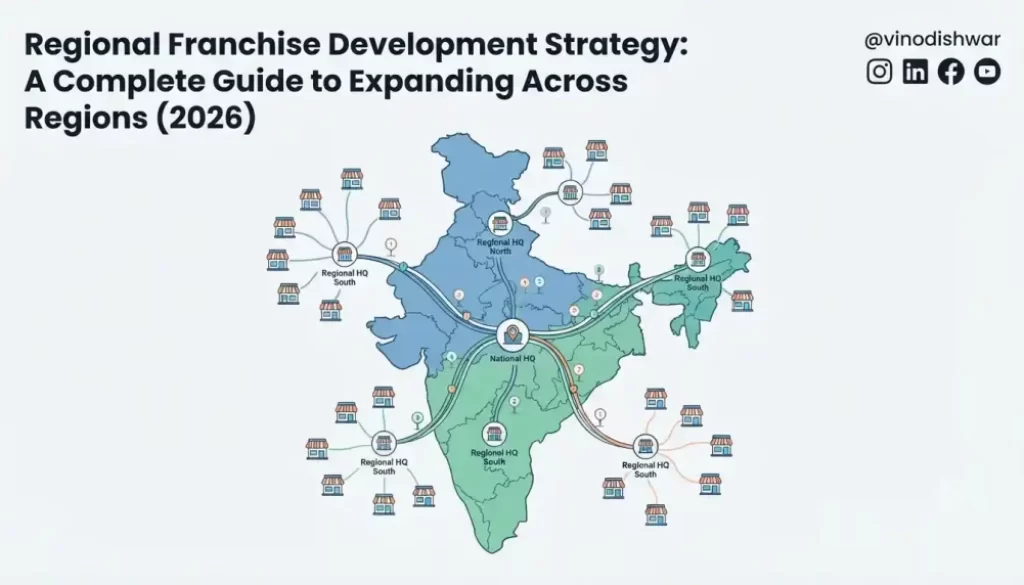
Regional Franchise Development Strategy: A Complete Guide to Expanding Across Regions (2026)
Expanding a franchise business successfully requires more than opening outlets in different cities. Sustainable growth depends on a well-planned Regional Franchise Development Strategy that aligns market demand, operational capabilities, territory management, and franchisee support.
Many franchise brands fail because they expand randomly—opening locations wherever opportunities arise rather than following a structured regional growth plan. This often results in operational inefficiencies, inconsistent customer experiences, increased support costs, and underperforming franchisees.
A regional franchise development strategy helps businesses grow systematically by focusing on specific geographic regions, optimizing resources, and building strong local market presence before expanding further.
Whether you’re franchising a restaurant, café, retail store, salon, fitness center, healthcare clinic, education institute, or service business, a regional approach provides the foundation for scalable and profitable expansion.
This guide explains how regional franchise development works, its benefits, planning process, territory strategies, and best practices for building a successful regional franchise network.
What is a Regional Franchise Development Strategy?
A Regional Franchise Development Strategy is a structured expansion plan that focuses on developing a franchise network within a defined geographic region before moving into additional markets.
Instead of expanding nationwide immediately, businesses prioritize:
- Regional market selection
- Territory planning
- Franchise recruitment
- Local marketing
- Operational support
- Supply chain optimization
- Performance monitoring
The objective is to establish market leadership within one region before replicating the model elsewhere.
Why Regional Expansion Matters
Regional expansion offers several advantages over scattered national growth.
Benefits include:
- Stronger brand recognition
- Lower operational costs
- Faster franchise support
- Efficient logistics
- Better marketing ROI
- Improved customer experience
- Stronger franchisee collaboration
- Higher territory profitability
Building regional dominance creates a stable platform for future national and international expansion.
Key Elements of a Regional Franchise Development Strategy
1. Market Research
Before selecting a region, analyze:
- Population demographics
- Consumer demand
- Income levels
- Competition
- Commercial real estate
- Economic growth
- Industry trends
Choosing the right market significantly improves franchise success.
2. Territory Planning
Effective territory planning prevents internal competition while maximizing market coverage.
Consider:
- Population density
- Travel distance
- Catchment areas
- Purchasing behavior
- Urban vs rural markets
- Expansion potential
Well-defined territories improve franchisee profitability.
3. Regional Expansion Goals
Establish measurable objectives, such as:
- Number of outlets
- Target cities
- Revenue milestones
- Market share
- Franchise recruitment targets
- Customer acquisition goals
Clear goals guide decision-making and resource allocation.
4. Franchise Recruitment
Recruit franchise partners who:
- Understand the regional market
- Have financial capability
- Share the brand vision
- Possess operational expertise
- Commit to long-term growth
Quality franchisees contribute more to sustainable expansion than rapid recruitment.
5. Operational Infrastructure
Before expanding, ensure your business has:
- Standard Operating Procedures (SOPs)
- Operations Manual
- Training systems
- CRM platform
- Reporting dashboards
- Quality assurance processes
Strong systems maintain consistency across every regional outlet.
6. Regional Marketing Strategy
Localized marketing should include:
- Digital advertising
- Social media campaigns
- Community engagement
- Regional influencers
- Public relations
- Local events
- Search engine optimization
Regional marketing increases brand awareness while supporting franchisee success.
7. Supply Chain & Logistics
A regional strategy should optimize:
- Vendor relationships
- Inventory management
- Warehousing
- Distribution
- Delivery schedules
- Procurement
Efficient logistics reduce costs and improve operational reliability.
Regional Development Models
Businesses may choose different expansion approaches.
Single-Unit Growth
Individual franchisees operate one outlet within the region.
Best for:
- Boutique businesses
- Salons
- Cafés
- Education centers
Multi-Unit Development
Experienced operators manage multiple outlets across a region.
Best for:
- Restaurants
- Retail chains
- Fitness brands
- Healthcare clinics
Area Development
One developer commits to opening multiple locations according to a development schedule.
Best for:
- Fast regional expansion
- Metropolitan markets
- High-demand territories
Master Franchise
A master franchisee develops and manages an entire state or country.
Best for:
- National expansion
- International markets
Regional Expansion Roadmap
| Stage | Objective |
|---|---|
| Market Research | Identify high-potential regions |
| Territory Planning | Define protected territories |
| Franchise Recruitment | Select qualified partners |
| Operations Setup | Standardize systems |
| Marketing Launch | Build regional awareness |
| Outlet Development | Open initial locations |
| Performance Monitoring | Optimize operations |
| Regional Leadership | Expand market share |
Practical Example
A premium salon brand operates 15 successful locations in Bengaluru and plans expansion across Karnataka.
Instead of entering multiple states immediately, the company adopts a regional strategy.
The plan includes:
- 8 salons in Mysuru
- 6 salons in Hubballi
- 5 salons in Mangaluru
- 4 salons in Belagavi
The company develops:
- Regional training center
- Local warehouse
- Dedicated support team
- Regional marketing campaigns
- Territory-specific recruitment strategy
After achieving strong regional market share, the brand expands into neighboring states using the same proven model.
Regional Franchise Development Framework
Successful Business
        │
        ▼
Franchise Readiness Assessment
        │
        ▼
Regional Market Research
        │
        ▼
Territory Planning
        │
        ▼
Franchise Recruitment
        │
        ▼
Operations & Training Systems
        │
        ▼
Regional Marketing
        │
        ▼
Supply Chain Development
        │
        ▼
Outlet Launch
        │
        ▼
Performance Monitoring
        │
        ▼
Regional Market Leadership
        │
        ▼
National Expansion
Common Mistakes to Avoid
Avoid these common regional expansion mistakes:
- Expanding into too many regions simultaneously
- Ignoring market research
- Poor territory planning
- Weak operational documentation
- Recruiting unsuitable franchisees
- Inconsistent marketing
- Insufficient support teams
- Lack of performance measurement
Regional success depends on disciplined execution rather than rapid expansion.
How Franchise Development Consultants Help
Professional franchise consultants help businesses by:
- Assessing franchise readiness
- Conducting regional market analysis
- Designing territory strategies
- Developing franchise business models
- Preparing legal documentation
- Creating SOPs and Operations Manuals
- Recruiting franchise partners
- Supporting long-term regional growth
Expert guidance minimizes risk while accelerating expansion.
Why Choose Franchise Alpha?
At Franchise Alpha, we help businesses build scalable regional franchise networks using our proprietary SOLEMN® Framework.
Strategy
Develop customized regional expansion strategies aligned with business objectives.
Operations
Create SOPs, Operations Manuals, and scalable operational systems.
Legal
Prepare Franchise Agreements, territory structures, and regional development documentation.
Entrust
Reduce founder dependency through standardized business systems.
Marketing
Generate qualified franchise leads through targeted regional marketing campaigns.
Nitty-Gritty
Monitor KPIs, optimize franchise performance, and support sustainable regional expansion.
Frequently Asked Questions
What is a Regional Franchise Development Strategy?
A Regional Franchise Development Strategy is a structured plan for expanding a franchise network within a defined geographic region before entering additional markets.
Why is regional expansion better than random expansion?
Regional expansion improves operational efficiency, strengthens brand recognition, reduces support costs, optimizes logistics, and creates stronger market presence.
Which businesses benefit from regional franchise development?
Restaurants, retail brands, salons, healthcare providers, fitness centers, education institutes, and service businesses all benefit from structured regional growth strategies.
Can regional expansion support national growth?
Yes. Many successful franchise brands first establish regional market leadership before expanding nationally and internationally.
Conclusion
A Regional Franchise Development Strategy provides the structure needed to expand efficiently while maintaining operational consistency and franchisee success.
By focusing on one region at a time, businesses can optimize resources, strengthen brand recognition, improve customer experience, and create repeatable systems for future expansion.
Regional growth is not simply about opening more outlets—it is about building a sustainable franchise ecosystem that can be replicated across new markets with confidence.
Call to Action
Ready to Build Your Regional Franchise Expansion Strategy?
Book a Franchise Readiness Assessment with Vinod Ishwar and discover how to develop a customized regional franchise growth plan for your business.
Your assessment includes:
- Franchise Readiness Evaluation
- Regional Market Analysis
- Territory Planning
- SOP & Operations Review
- Customized Regional Expansion Roadmap
Build a scalable regional franchise network designed for long-term growth and profitability.