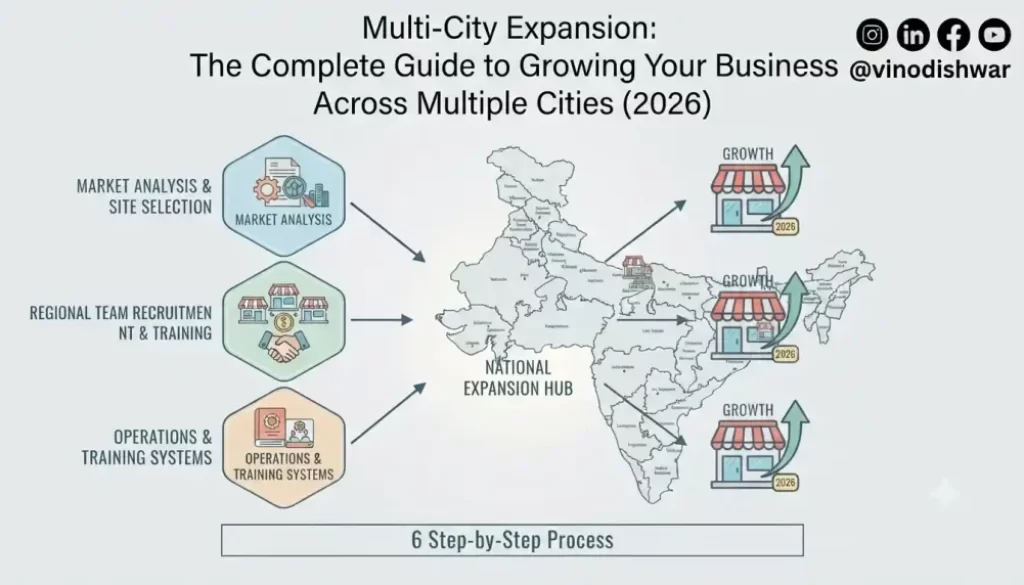
Multi-City Expansion: The Complete Guide to Growing Your Business Across Multiple Cities (2026)
Introduction
Multi-City Expansion is one of the biggest milestones in any business journey. Expanding beyond your home city allows businesses to reach new markets, increase revenue, and build a stronger brand presence. However, successful multi-city expansion requires careful planning, standardized systems, and strong operational leadership.
Expanding beyond your home city is one of the biggest milestones in any business journey.
A successful multi-city business enjoys greater brand visibility, diversified revenue streams, stronger market presence, and increased business valuation. However, expanding into multiple cities also introduces new challenges, including operational complexity, regional customer preferences, logistics, recruitment, quality control, and leadership management.
Many businesses fail during expansion because they assume success in one city automatically guarantees success in another.
The reality is that Multi-City Expansion requires careful planning, standardized systems, market intelligence, and strong operational leadership.
Whether you’re planning to open company-owned branches, expand through franchising, or adopt a hybrid model, a structured expansion strategy significantly improves your chances of long-term success.
This guide explains how to successfully scale your business across multiple cities while maintaining operational consistency and sustainable growth.
Why Multi-City Expansion Matters
Multi-City Expansion is the strategic process of growing a business by establishing operations in multiple cities while maintaining consistent quality, customer experience, and profitability.
Expansion can take several forms:
- Company-owned outlets
- Franchise locations
- Master franchise networks
- Regional partnerships
- Distribution networks
- Hybrid expansion models
The objective is to build a scalable business capable of serving customers across different geographic markets.
Why Expand into Multiple Cities?
A successful multi-city strategy helps businesses:
- Increase revenue
- Reach new customer segments
- Strengthen brand awareness
- Reduce dependence on a single market
- Improve business valuation
- Attract investors
- Build competitive advantages
- Create economies of scale
- Enhance supplier relationships
- Support long-term business growth
Expansion creates resilience and long-term value.
The 15-Step Multi-City Expansion Framework
Step 1. Perfect Your Existing Operations
Before entering a new city, ensure your current business demonstrates:
- Consistent profitability
- Strong customer satisfaction
- Efficient operations
- Documented business systems
- Stable leadership
Expansion begins with operational excellence.
Step 2. Conduct Market Research
Evaluate:
- Population demographics
- Customer demand
- Purchasing behavior
- Local competition
- Economic conditions
- Growth potential
Every city presents unique opportunities and challenges.
Step 3. Define Your Expansion Model
Choose between:
- Company-owned outlets
- Franchising
- Area development
- Master franchising
- Joint ventures
The right model depends on your capital, operational capability, and long-term goals. Learn how expert franchise consultants help businesses expand through proven franchise models. Franchise Development Services
Step 4. Standardize Business Systems
Develop:
- SOPs
- Operations Manual
- Training programs
- HR policies
- Financial controls
- Customer service standards
Standardization enables consistent execution across cities.
Step 5. Build a Regional Leadership Structure
Appoint regional managers responsible for:
- Operations
- Sales
- Staff development
- Performance monitoring
- Compliance
Regional leadership accelerates decision-making.
Step 6. Implement Technology
Adopt scalable systems such as:
- ERP
- CRM
- POS software
- Inventory management
- Business Intelligence dashboards
- HRMS
Technology improves visibility across multiple locations.
Step 7. Strengthen Supply Chain Operations
Develop:
- Regional warehouses
- Vendor partnerships
- Logistics planning
- Inventory forecasting
- Procurement systems
Efficient supply chains support consistent operations.
Step 8. Recruit Local Talent
Hire individuals who understand:
- Local culture
- Customer expectations
- Regional business practices
Local expertise enhances customer engagement.
Step 9. Customize Marketing
While maintaining brand consistency, adapt marketing to reflect:
- Local festivals
- Consumer behavior
- Regional languages
- Cultural preferences
Localized marketing improves customer connections.
Step 10. Ensure Brand Consistency
Maintain uniform standards for:
- Store design
- Customer experience
- Product quality
- Employee appearance
- Brand messaging
Customers should recognize the same brand in every city.
Step 11. Monitor Performance
Track KPIs including:
- Revenue per location
- Customer satisfaction
- Profit margins
- Inventory turnover
- Marketing ROI
- Employee productivity
Data-driven decisions improve expansion outcomes.
Step 12. Maintain Quality Control
Conduct regular:
- Operational audits
- Mystery shopping
- Compliance reviews
- Customer feedback analysis
Quality should never decline with expansion.
Step 13. Optimize Financial Management
Monitor:
- Expansion budgets
- Cash flow
- ROI
- Regional profitability
- Operational costs
Financial discipline supports sustainable growth.
Step 14. Scale Gradually
Expand city by city instead of opening too many locations simultaneously.
Controlled expansion reduces operational risk.
Step 15. Continuously Improve
Review:
- Business systems
- Customer insights
- Technology
- Leadership performance
- Expansion strategy
Continuous improvement keeps the business competitive. Businesses should regularly review their Business Growth Strategy to stay competitive as they enter new markets.
Essential Systems for Multi-City Expansion
Before entering additional cities, establish:
- Operations Manual
- SOP Library
- ERP Platform
- CRM System
- HR Management System
- Learning Management System
- Marketing Toolkit
- Financial Dashboard
- Quality Audit Framework
- Performance Reporting System
Scalable systems enable scalable businesses.
Common Multi-City Expansion Mistakes
Avoid these common pitfalls:
- Expanding too quickly
- Ignoring local market differences
- Weak operational systems
- Poor leadership development
- Lack of standardized training
- Inconsistent customer experience
- Insufficient technology
- Weak financial planning
Preparation is the key to successful expansion.
How Business Expansion Consultants Help
Experienced consultants help businesses by:
- Evaluating expansion readiness
- Conducting market research
- Designing expansion strategies
- Developing franchise models
- Creating SOPs
- Standardizing operations
- Building leadership systems
- Supporting multi-city growth
Professional expertise reduces risk and improves scalability. Businesses looking for structured expansion can explore Franchise Alpha’s consulting approach and nationwide business growth solutions. Franchise Alpha Consulting
The SOLEMN® Framework
At Franchise Alpha, Multi-City Expansion strategies are developed using the proprietary SOLEMN® Framework.
Strategy
Identify target cities, market opportunities, expansion priorities, and long-term growth objectives.
Operations
Standardize business systems, technology, training, SOPs, and operational processes across every location.
Legal
Develop expansion agreements, intellectual property protection, compliance systems, and governance structures.
Entrust
Build regional leadership teams, strengthen organizational culture, and empower local management.
Marketing
Execute national branding with localized campaigns, digital marketing, lead generation, and customer acquisition strategies.
Nitty-Gritty
Measure KPIs, optimize operational efficiency, strengthen profitability, and continuously refine expansion performance.
This framework enables businesses to grow across multiple cities while maintaining operational consistency and customer satisfaction.
Frequently Asked Questions
What is Multi-City Expansion?
Multi-City Expansion is the process of growing a business by establishing operations in multiple cities while maintaining consistent quality, systems, and profitability.
When should a business expand into another city?
Expansion should occur only after achieving consistent profitability, standardized operations, documented systems, and strong leadership in the existing market.
What is the best expansion model for multiple cities?
The ideal model depends on business goals, available capital, operational readiness, and industry. Options include company-owned outlets, franchising, and hybrid models.
Why hire a Business Expansion Consultant?
A consultant helps businesses create scalable expansion strategies, reduce operational risks, standardize systems, and accelerate sustainable multi-city growth.
Conclusion
Expanding into multiple cities is a major step toward building a nationally recognized business.
Success depends on more than opening new locations—it requires standardized systems, strong leadership, localized market understanding, financial discipline, and continuous operational improvement.
Businesses that plan carefully and scale strategically create stronger brands, happier customers, and sustainable long-term growth. Working with experienced Franchise Consulting professionals helps businesses expand into new cities while maintaining operational consistency.
The goal is not simply to be present in more cities—it is to deliver the same exceptional experience in every city.
Call to Action
Plan Your Multi-City Expansion Strategy
Book a Business Expansion Strategy Session with Vinod Ishwar to assess your expansion readiness, identify high-potential markets, standardize business systems, and create a customized roadmap for successful multi-city growth.
Receive a strategic expansion blueprint designed for sustainable, scalable business success.