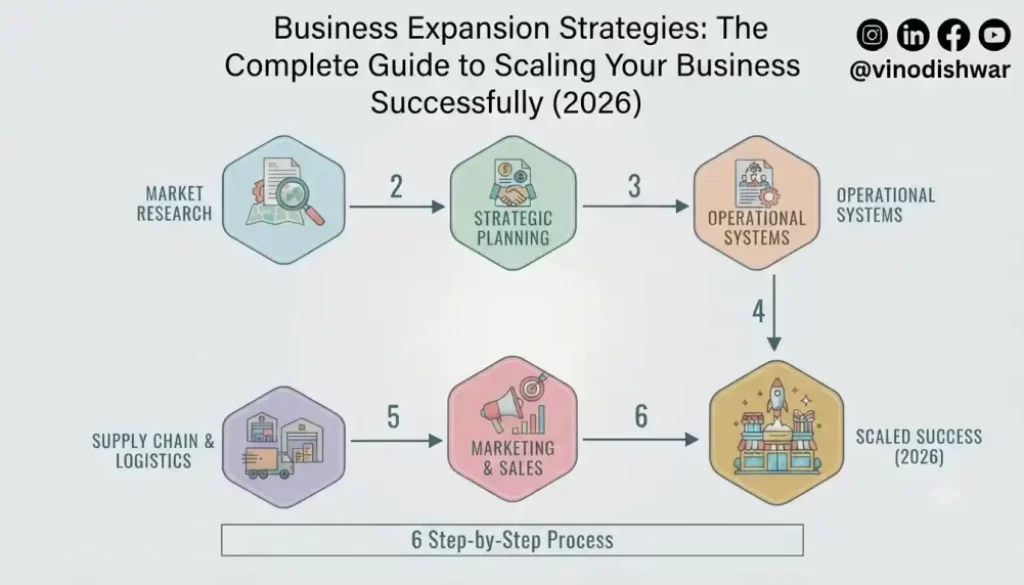
Business Expansion Strategies: The Complete Guide to Scaling Your Business Successfully (2026)
Introduction
Business Expansion Strategies are essential for companies that want to grow sustainably without losing operational control. Every successful business eventually reaches a critical question: How do we grow without losing control?
Every successful business eventually reaches a critical question:
How do we grow without losing control?
While many businesses focus on increasing sales, sustainable growth requires a structured expansion strategy. Expanding too quickly without systems can strain operations, reduce customer satisfaction, and increase financial risk. Expanding too slowly can allow competitors to capture market share. Franchise Alpha
A well-planned Business Expansion Strategy helps entrepreneurs grow revenue, enter new markets, diversify income streams, strengthen brand presence, and build long-term business value.
Whether you are a startup, SME, retail brand, restaurant, education company, healthcare provider, or manufacturing business, choosing the right expansion model can determine your future success.
This guide explores the most effective business expansion strategies and explains how to scale your business with confidence.
What Are Business Expansion Strategies?
A Business Expansion Strategy is a structured plan that helps a company grow its operations, revenue, customer base, and market presence while maintaining operational efficiency and profitability.
Expansion can involve:
- Opening new locations
- Franchising
- Licensing
- Entering new cities or countries
- Launching new products
- Building strategic partnerships
- Expanding digitally
- Acquiring businesses
- Increasing production capacity
The objective is sustainable, scalable, and profitable growth.
Why Business Expansion Matters
A structured expansion strategy helps businesses:
- Increase revenue
- Enter new markets
- Build brand recognition
- Diversify income streams
- Improve business valuation
- Reduce market dependency
- Create competitive advantages
- Attract investors
- Improve operational efficiency
- Build long-term sustainability
Growth should be intentional—not accidental.
The 15 Best Business Expansion Strategies
Strategy 1. Franchise Expansion
Transform a successful business into a franchise through Franchise Development by allowing entrepreneurs to operate under your brand while following standardized systems.
Ideal for:
- Restaurants
- Cafés
- Retail
- Education
- Healthcare
- Fitness
- Professional services
Franchising enables rapid expansion with shared investment.
Strategy 2. Open Company-Owned Branches
Expand through locations fully owned and managed by your company.
Benefits include:
- Greater operational control
- Consistent customer experience
- Higher profit retention
This model requires higher capital investment.
Strategy 3. Expand into New Markets
Identify underserved regions and launch operations in:
- New cities
- New states
- International markets
- Emerging business districts
Market research should guide every expansion decision.
Strategy 4. Launch New Products or Services
Increase revenue by introducing complementary offerings that meet existing customer needs.
Product diversification reduces dependency on a single revenue stream.
Strategy 5. Digital Business Expansion
Grow through:
- E-commerce
- Online consultations
- Digital products
- Subscription services
- Mobile applications
Digital channels provide scalable growth opportunities.
Strategy 6. Licensing
License your intellectual property, products, or business systems to other operators while maintaining ownership of the brand.
Licensing offers lower operational involvement than franchising.
Strategy 7. Strategic Partnerships
Collaborate with complementary businesses to:
- Share customers
- Expand distribution
- Increase brand visibility
- Reduce marketing costs
Partnerships accelerate growth through collaboration.
Strategy 8. Business Acquisition
Acquire an existing company to:
- Enter new markets
- Gain customers
- Acquire talent
- Increase market share
Due diligence is essential before acquisitions.
Strategy 9. Joint Ventures
Partner with another organization to pursue specific growth opportunities while sharing resources and risks.
Joint ventures are particularly effective in new or international markets.
Strategy 10. Channel Expansion
Increase sales through:
- Dealers
- Distributors
- Resellers
- Online marketplaces
- Corporate partnerships
Expanding sales channels broadens market reach.
Strategy 11. Strengthen Business Systems
Before expanding, standardize:
- SOPs
- Operations Manuals
- Training
- CRM
- Financial reporting
- Technology
Strong systems support scalable growth.
Strategy 12. Invest in Marketing
Expand customer acquisition through:
- SEO
- Google Ads
- Social Media
- Email Marketing
- PR
- Content Marketing
Consistent marketing fuels business expansion.
Strategy 13. Build Leadership Teams
Expansion requires leaders who can manage:
- Operations
- Sales
- Marketing
- Finance
- Human Resources
Growth depends on people as much as processes.
Strategy 14. Secure Growth Capital
Expansion may require:
- Internal funding
- Bank finance
- Venture capital
- Angel investment
- Strategic investors
Financial planning reduces expansion risk.
Strategy 15. Measure and Optimize
Track KPIs including:
- Revenue growth
- Customer acquisition
- Profitability
- Market penetration
- Operational efficiency
- Customer satisfaction
Continuous improvement supports sustainable expansion.
Choosing the Right Business Expansion Strategies
Consider factors such as:
- Business maturity
- Capital availability
- Industry
- Market demand
- Operational readiness
- Leadership capability
- Technology infrastructure
- Growth objectives
The best expansion model depends on your unique business goals and your overall Business Growth Strategy.
Common Business Expansion Strategies Mistakes to Avoid
Avoid these common pitfalls:
- Expanding too quickly
- Weak business systems
- No SOP documentation
- Poor financial planning
- Inadequate leadership
- Ignoring market research
- Weak customer support
- Lack of performance measurement
Growth without systems often leads to operational challenges.
How Consultants Improve Business Expansion Strategies
Experienced Franchise Consulting experts and business expansion consultants help organizations by:
- Assessing business readiness
- Developing expansion strategies
- Creating franchise models
- Designing operational systems
- Standardizing SOPs
- Conducting market research
- Improving financial planning
- Supporting national and international growth
Professional guidance reduces risk and accelerates sustainable expansion.
The SOLEMN® Framework
At Franchise Alpha, Business Expansion Strategies are developed using the proprietary SOLEMN® Framework.
Strategy
Define business vision, expansion objectives, target markets, and growth roadmap.
Operations
Standardize SOPs, Operations Manuals, technology systems, CRM, and performance management.
Legal
Develop expansion agreements, intellectual property protection, compliance processes, and governance structures.
Entrust
Strengthen leadership, franchisee relationships, management capability, and organizational culture.
Marketing
Drive expansion through branding, digital marketing, lead generation, investor outreach, and customer acquisition.
Nitty-Gritty
Measure KPIs, optimize operational performance, improve scalability, and continuously refine expansion strategies.
This structured framework enables businesses to expand efficiently while maintaining quality, consistency, and profitability.
Frequently Asked Questions
What is a Business Expansion Strategy?
A Business Expansion Strategy is a structured plan that helps businesses increase revenue, enter new markets, expand operations, and achieve sustainable long-term growth.
What is the best business expansion model?
The ideal model depends on the business. Common strategies include franchising, licensing, company-owned expansion, strategic partnerships, acquisitions, and digital growth.
When should a business expand?
A business should expand after achieving operational stability, consistent profitability, documented systems, and sufficient management capacity.
Why hire a Business Expansion Consultant?
A consultant helps develop scalable strategies, reduce expansion risks, standardize operations, improve systems, and accelerate sustainable growth.
Conclusion
Business expansion is more than opening new locations—it is about building a scalable organization capable of delivering consistent value across multiple markets.
Whether you choose franchising, licensing, acquisitions, partnerships, or digital growth, success depends on planning, systems, leadership, and disciplined execution.
Businesses that invest in structured expansion strategies create stronger brands, increase profitability, attract investors, and build long-term competitive advantages.
The most successful companies don’t simply grow—they scale strategically.
Call to Action
Build a Scalable Business Expansion Strategy
Book a Business Expansion Strategy Session with Vinod Ishwar to assess your business readiness, develop a customized expansion roadmap, design scalable business systems, evaluate franchise opportunities, and create a long-term growth strategy.
Receive a personalized expansion plan aligned with your business goals and market opportunities.